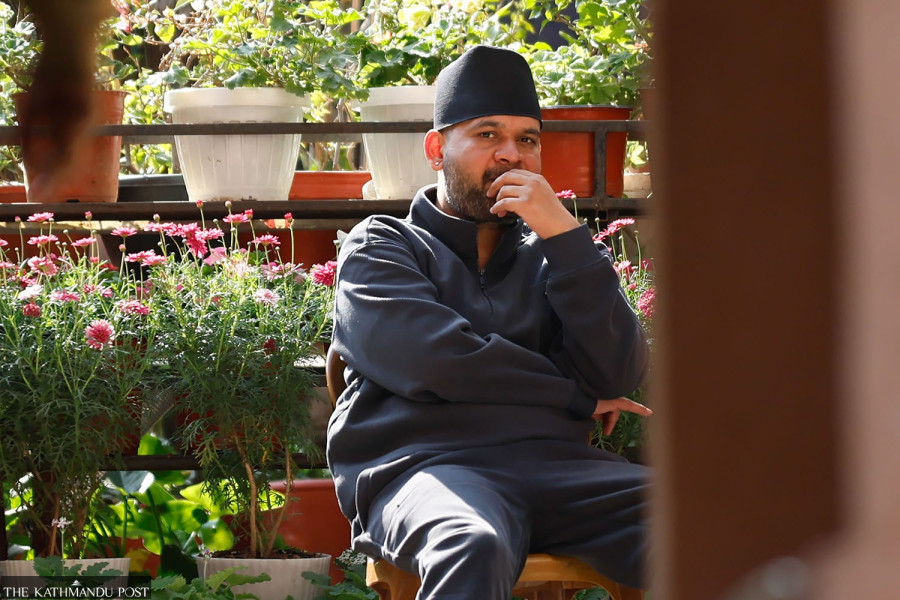
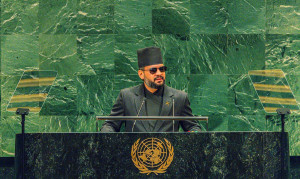
Elected as an independent in the 2022 local elections, Kathmandu Metropolitan City Mayor Balendra Shah stunned the political establishment by defeating, with a huge margin, candidates from traditionally strong parties such as the Nepali Congress and the CPN-UML.
After the victory, however, Shah largely withdrew from public and political engagement. He was often criticised for not meeting even his well wishers, let alone voters. He also kept his distance from wider political circles.
That approach appears to have shifted Wednesday, when Shah began a series of meetings. With the March elections drawing closer, he has broken his long silence.
The Sushila Karki-led interim government formed on the back of the September Gen Z movement has announced the elections for the House of Representatives on March 5.
Shah’s close aide claimed that he has decided to enter the electoral fray.
Mayor Shah is a key stakeholder of the Gen Z revolt that swept the KP Sharma Oli-led coalition government on September 9 with a youth wave against corruption and misgovernance. During the height of the protests, Shah used social media to suggest the dissolution of Parliament and formation of a citizens’ government, a call subsequently backed by Gen Z protesters.
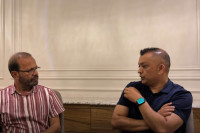
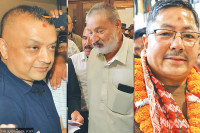
On Wednesday, Mayor Shah met Dr Bhagawan Koirala, Nepal’s only dollar billionaire Binod Chaudhary, and Nepali Congress leader Chandra Bhandari, among others. The meetings continued on Thursday, as he interacted with Congress leader Sunil Sharma; Energy, Water Resources and Irrigation Minister Kulman Ghising; Rastriya Swatantra Party (RSP) chair Rabi Lamichhane; former independent lawmaker of the dissolved House of Representatives Amaresh Kumar Singh; and former prime minister Baburam Bhattarai.
All meetings on Wednesday and Thursday took place at the Lalitpur residence of Mayor Shah’s chief adviser, Kumar Ben. The fact that a former prime minister, a former deputy prime minister and home minister, as well as a sitting minister, have all met with Mayor Shah at a place of his choosing underscores the significant influence and standing he now commands in Nepali politics.
Former prime minister Baburam Bhattarai, who met Mayor Shah on Thursday, advised him to work to unite new and alternative political forces.
“I have consistently argued that all new and alternative forces should move forward together, and that is precisely what I am working towards,” Bhattarai told journalists after the meeting. “When Balen suggested we meet to discuss this, I agreed. My message is simple: all those who see themselves as new and alternative should unite, and they will have my goodwill.”
These meetings are aimed at institutionalising the changes brought about by the Gen Z movement in September and gauging opinion across different sectors, with Shah also signalling his intent to enter national politics, a person close to the mayor claimed.
Similarly, on Thursday, Mayor Shah met with several Gen Z representatives, including Raksha Bam. Ashutosh Jha, a representative of Gen Z Digital Dastak who also took part in one meeting with the mayor, said that Gen Z representatives had urged Shah to take an active role in politics—as a guardian figure for the Gen Z movement. In response, Shah encouraged Gen Z representatives to move forward in a spirit of unity.
During the meetings, Shah indicated that he plans to enter politics and used the opportunity to gauge what kind of support those he met could offer. At the same time, he made efforts to reassure them of his commitment to the current constitution. Following her meeting, Gen Z representative Bam clarified that Shah had assured them of his commitment to the existing federal democratic system and the constitution, and that they were ready to collaborate with him based on that assurance.
Many doubt Shah’s commitment to the three-tier federal system particularly after he chose to vote only for federal seats while skipping the voting for provincial seats during the 2022 federal and provincial elections.
Before Mayor Shah started his marathon discussions with the people from different sectors, Shah also held extensive talks with RSP chair Lamichhane on Monday night. Their meeting stretched to more than six hours, spanning both group settings and in one-on-one conversations.
Following the meeting, people close to Shah claimed that Lamichhane had proposed putting Shah forward as a prime ministerial candidate in the upcoming elections, in the event of Shah contesting under the RSP banner.
However, Lamichhane, speaking to the media in Chitwan on Tuesday, denied making any such proposal.
Just two days after his meeting with the RSP chair Lamichhane, Shah stepped up his political engagements.
“After the RSP appeared reluctant to fully open the door of cooperation, mayor Shah began a series of meetings on his own,” a member of Mayor Shah’s secretariat told the Post.
Since being elected mayor of Kathmandu, Shah has rarely made his personal engagements public through the media. That is why his meetings with various figures on Wednesday stood out as a clear departure from his earlier, rather aloof working style.
Many believe that the negotiation with the RSP chair may not have progressed as expected, and suspect the series of meetings that followed were aimed at putting pressure on the RSP chief.
A person close to Shah, who is also a central committee member of the RSP, does not entirely dismiss that possibility. If the cooperation between the RSP and Shah cannot materialise, the RSP will face a setback, the person claimed.
According to him, once Shah formally announces his party affiliation and his decision to contest the upcoming elections, a large number of RSP central committee members as well as leaders who previously left the party, are likely to join Shah.
Shah is expected to contest the elections under Desh Bikash Party, which is registered with the Election Commission, according to Surendra Bajgain, a member of Mayor Shah’s secretariat who also looks after media affairs.
Bajgain also said that he submitted a list of potential proportional representation (PR) candidates to the mayor on Wednesday. As per the schedule of the Election Commission, political parties have to submit their closed lists of PR candidates on December 28 and 29.
Mayor Shah had initially hoped to bring both the RSP and Kulman Ghising together, and had even made an effort to that end through his aides. Shah had conveyed a message to RSP chair Lamichhane—while Lamichhane was still in Nakkhu Prison in connection with the cooperative fraud case—that if the RSP and Ghising could unite, he would support the party while continuing to serve as mayor.
However, with the two sides failing to come together, Ujyalo Nepal Party (UNP) has since been formed with Ghising as its patron. Even after the establishment of the UNP, there was no breakthrough in achieving cooperation between the RSP and the new party. As a result, people close to Shah now claim that the mayor himself is preparing to enter the political arena.
According to close associates of both Mayor Shah and Kulman Ghising, Thursday’s meeting between the two involved discussions about potential collaboration and they are inching close to an agreement. By contrast, the meeting with Lamichhane was inconclusive. While emerging from the meeting with Shah, Lamichhane told mediapersons that one could gauge how the discussion went simply by looking at his face.
When asked, “Are you going to raise the stick [the election symbol Shah had used during mayoral election] or ring the bell [the RSP’s election symbol]?” Lamichhane offered a rather strange reply: “Don’t you see it in my face? Isn’t it shining?”




 15.26°C Kathmandu