In ‘Pariwartan’, action swings between entertaining and absurd
Although the film impresses with striking visuals, its overly verbose dialogues and exaggerated violence prevent it from realising its potential. Screengrab Via YouTube
How often do we see a woman lead an action film in Nepali cinema? More specifically, how often do we see her holding a gun, chasing criminals, shouting orders, and taking up space in a genre long dominated by men?
Rarely.
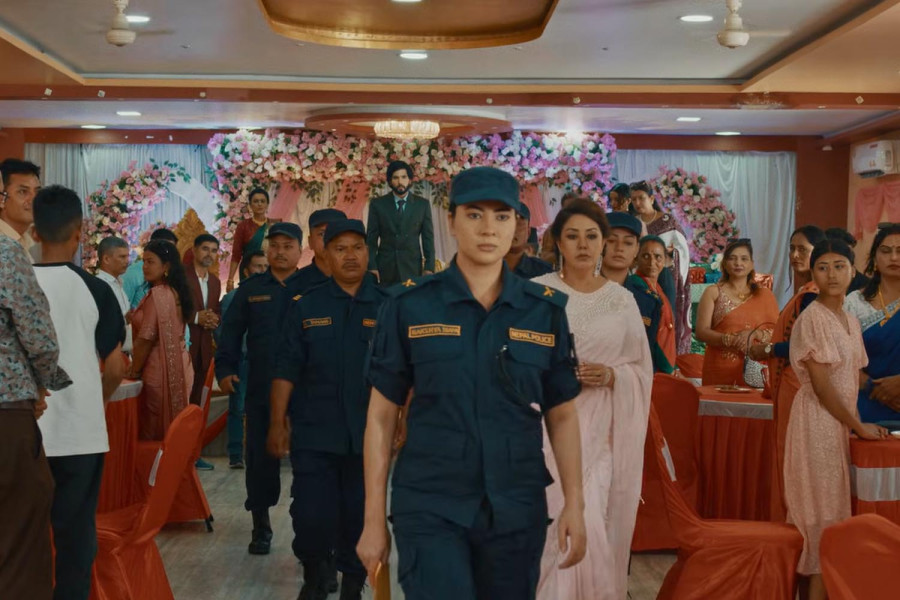
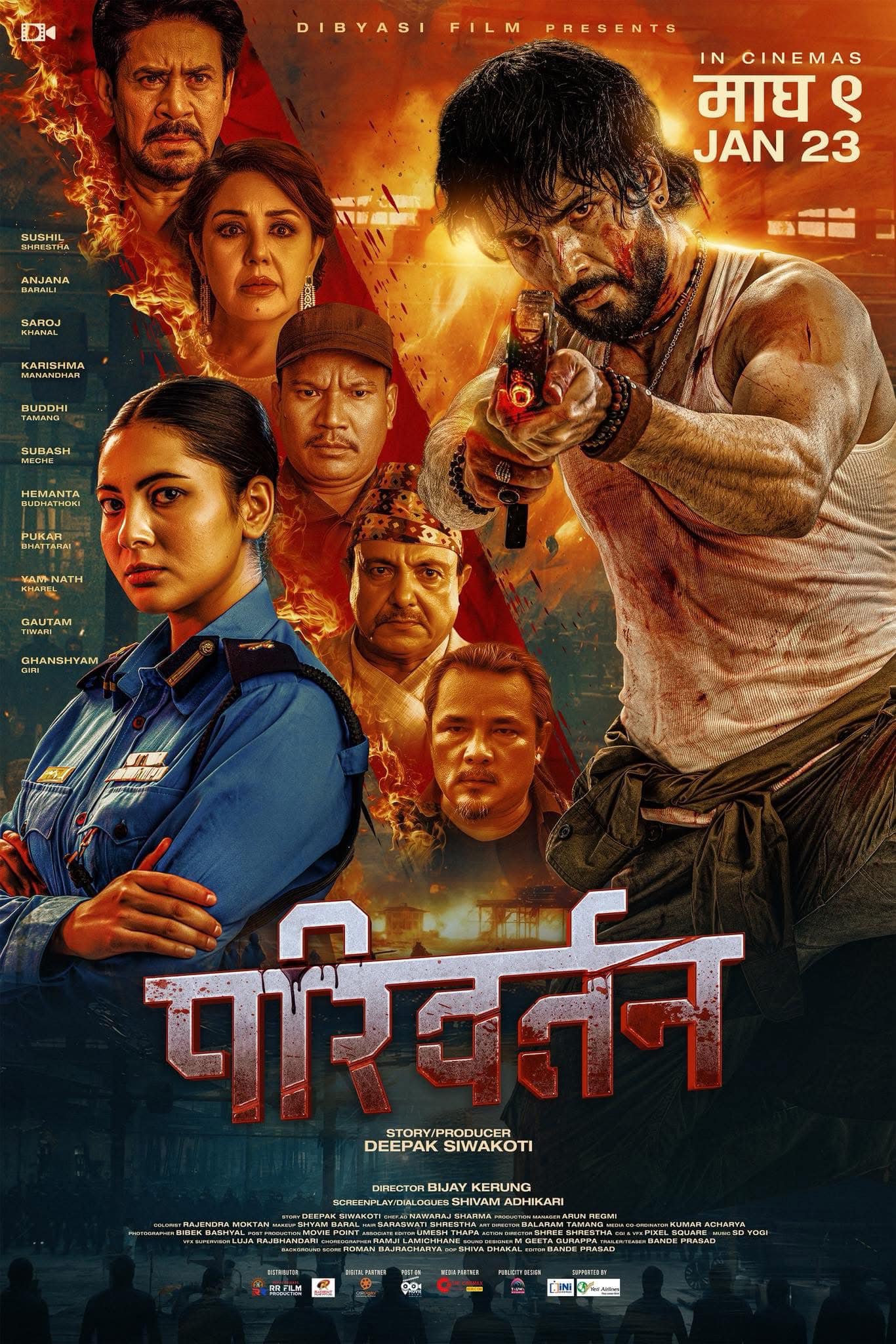
In ‘Pariwartan’, a recently released action drama, that rarity becomes the film’s most refreshing element. Anjana Baraili plays a police inspector, a role that demands authority, aggression, and physical courage. In an industry where female characters are still frequently reduced to romantic side notes orbiting male heroes, her presence feels like a shift.
Rakshya (Anjana Baraili) fights, commands, and drives the narrative forward. Watching her in action sequences is exciting, not because the choreography is revolutionary, but because the image itself feels new in the Nepali cinematic landscape.
The film builds her backstory around a relationship shaped by class prejudice. As a young woman from a socially privileged background, she falls in love with Safal (Sushil Shrestha, who plays a dual role), a man from a squatter’s settlement. Their relationship challenges social hierarchies, and the punishment is brutal. A tragedy follows, but the film treats this trauma more as a plot device than an emotional foundation.
Years later, she meets Paras (Sushil Shrestha), the male lead, who looks exactly like Safal. This resemblance becomes the basis of their connection. Here, the story enters psychologically complex territory but handles it too simply.
Rakshya’s attachment feels less like new love and more like an attempt to replace unresolved loss. Instead of examining grief, memory, and longing with depth, the film uses physical resemblance as a romantic shortcut. The result is a heroine who is powerful in uniform but emotionally stuck in the past. The contrast could have made her deeply human, but the writing frames it more as melodrama than inner conflict.
Romantically, the film also falls back on familiar tropes. Paras and his mother, played by Karishma Manandhar, are shown doing charity and donation work, and this kindness becomes another key reason she softens towards him. Despite the sentiment being warm, the device feels overused in South Asian cinema.
Just when the relationship begins to feel predictable, the film delivers one of its strongest moments. On the day of Rakshya’s engagement to Paras, she arrives not dressed as a bride but in her police uniform. What follows is a dramatic, surprising, and effective scene. It restores her agency and reinforces her commitment to duty over personal ties.
The film also attempts to function as a mirror to contemporary Nepali society. Corrupt politicians, criminal networks, and weak governance shape the larger narrative. A disgraced minister casually flees across the Nepal-India border with no visible security checks, a detail that feels unintentionally comic.
Nepali cinema has recently leaned heavily into stories about corruption and systemic failure. Although this reflects reality, the repetition is beginning to feel predictable. For viewers seeking escapism, ‘Pariwartan’ may feel heavy and overly familiar. For those who value cinema as social commentary, it offers recognisable, if not particularly fresh, observations.
The action, meanwhile, swings between entertaining and absurd.
In one fight scene, Paras battles a group of goons when heavy rain suddenly pours down without any buildup. No thunder, no darkening skies, just instant cinematic rainfall. I know things are not supposed to feel realistic in cinema, but instead of heightening drama, it draws unintentional laughter. The film repeatedly confuses exaggeration with intensity.
The violence is especially extreme. Heads are chopped off. Arms are severed. Blood sprays across the frame. The camera does not cut away. These scenes may appeal to viewers who enjoy graphic action, but for many, they are likely to feel excessive and disturbing.
Violence in cinema is not new, but here it often lacks emotional grounding. When brutality becomes spectacle, it risks turning serious stakes into visual shock value. In several moments, the exaggeration is so pronounced that it becomes unintentionally funny, undercutting the tension the film is trying to build.
Moreover, the film feels overly verbal. Rather than allowing visuals, silence, or metaphor to carry meaning, it spells out its every theme through dialogue. This creates the impression that the filmmakers do not fully trust the audience to read between the lines.
One area where the film feels more grounded is in its portrayal of how women in uniform are treated. The female inspector, Rakshya, faces sexualised comments and disrespect from men who cannot see beyond her appearance. These moments are uncomfortable but important. It reflects a reality many professional women encounter. They underline the film’s attempt to show that no matter how high a woman rises, society often continues to objectify her.
Technically, the film has its strengths. The cinematography captures the landscapes of eastern Nepal beautifully, especially the plains of the Tarai. Small visual details, like cigarette smoke curling in the air, are framed with care. The song ‘Pakeko Chuiri’ is polished, with pleasing costumes, makeup, choreography and scenic backdrops of hills and mountains.
By the end, however, the film returns to heavy violence, sending audiences out of the theatre with disturbing images still fresh in their minds. It is telling that screenings have reportedly been sparsely attended.
‘Pariwartan’ is ambitious in its attempt to combine female empowerment, social commentary, romance, and high-octane action. But its uneven writing and exaggerated execution prevent it from fully delivering on its promise.
Sanskriti Pokharel, a former reporter and sub-editor at the Post, is a final-year student of Journalism, Mass Communication, and English Literature at St. Xavier's College, with experience in media, research, and communication.




 21.42°C Kathmandu