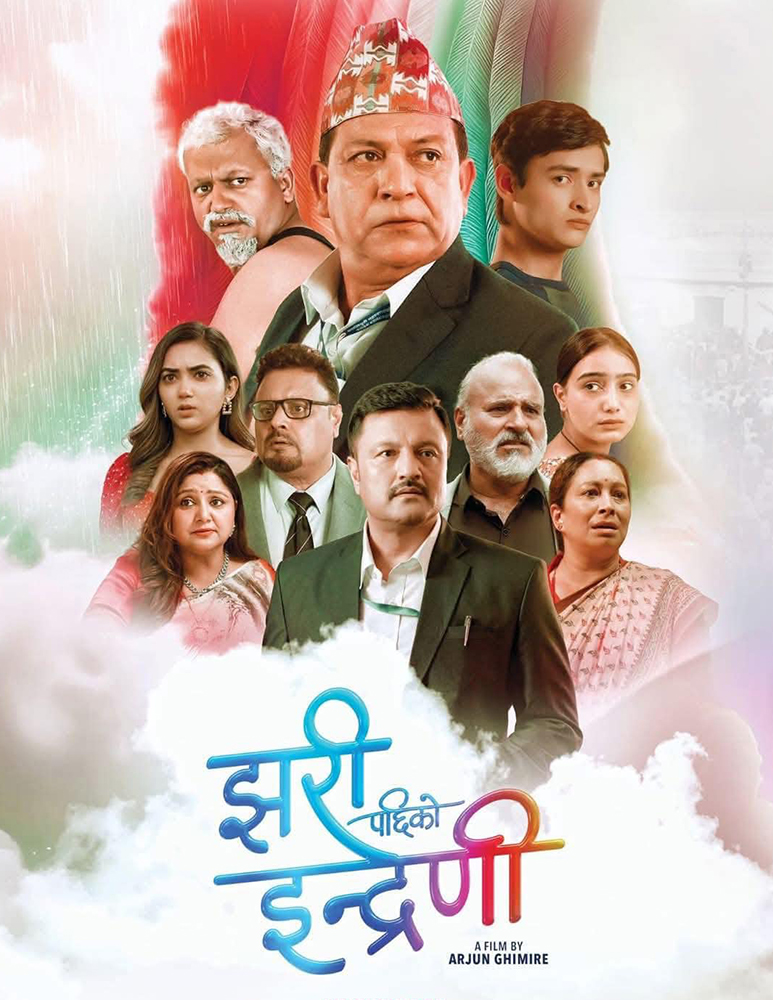
‘Jhari Pachi Ko Indreni’ tells the story of Ganesh Prasad Sharma, a ward secretary whose honesty in a corrupt system makes him a victim rather than a hero.Photo: Screengrab via YouTube
In a system built on corruption, being honest comes at a cost.
‘Jhari Pachi Ko Indreni’ explores this cost through the life of Ganesh Prasad Sharma (Ganesh Upreti), a ward secretary whose everyday choices challenge what society has come to accept as normal.
In our society, people working in government offices, whether in low or high positions, are often seen living in big houses and owning many properties. The reason is no secret. Corruption has become normalised. Against this reality, Ganesh’s small, congested, and unimpressive home stands out and raises questions. It feels unusual, even suspicious.
Gradually, the film makes it clear that this modest life is not accidental. Ganesh never takes bribes and lives only on his hard-earned salary. He is shown as “rahar le garib,” (poor by choice), a description that reflects both his integrity and the irony of honesty in a corrupt system.
Moreover, the contrast is made obvious through his brother-in-law (Ramesh Upreti), an accountant who lives lavishly, employs servants, and enjoys all the comforts Ganesh denies himself. Corruption is visible through this contrast. Still, the performances ground these choices. Characters fit their roles convincingly, and the casting feels deliberate rather than decorative.
However, when the film turns to its institutional spaces, its blind spots become evident. Inside the ward office, women are nearly invisible in positions of authority. They appear mostly as receptionists or background staff, never as decision makers.
Deepa Shree Niraula’s character, the accountant’s wife, has no professional life outside the home. She enjoys the luxury made possible by corrupt money and frequently humiliates her own sister and the household servants. Yet, she is never given any real agency. She exists only as a symbol of greed and moral decay, not as a fully developed character.
Similarly, other women in the film are shown wanting to go to Australia, but always on a dependent visa. No woman holds a position of authority, and none are allowed independent ambitions. Women appear largely as decorative figures, present to support male narratives rather than shape the story themselves.
The portrayal of Ganesh’s wife (Sarita Giri) invites unintended humour. She is almost always dressed in a saree, even inside the home. Yes, the costume might be meant to signify simplicity or traditional values, but it feels outdated. In contemporary Kathmandu households, sarees are rarely worn as everyday wear by middle-aged women. A kurtha would have felt more natural and believable.
Humour, however, is not entirely accidental. One of the most amusing sequences involves a peon who openly scolds the ward chairman and accountant, particularly during their after-office drinking sessions. As they loudly discuss bribe money in a public restaurant with remarkable carelessness, the peon lectures them like a moral guardian. The reversal of power dynamics is unexpected and undeniably funny. The theatre bursts into laughter, not because the scene is realistic, but because it is so boldly absurd. A peon reprimanding his bosses feels more like wish fulfilment than observation, yet it works as satire.
Similarly, scenes in which the ward chairman, accountant, and peon make TikTok videos in the office are clearly designed for comic relief. They dance energetically and collapse breathless once the video ends. These moments are funny, yes, and also critique the system.
The film shifts focus when it introduces Ganesh’s son, Sohan, whose desire to go abroad mirrors the aspirations of countless Nepali youths. Australia is his dream, and like many parents, Ganesh resists it. Their conflict unfolds dramatically, with Sohan staging a protest inside the house, holding a placard and refusing to eat. Eventually, Ganesh agrees, but under strict conditions. Sohan must live on rent in Kathmandu, return his monthly allowance, avoid borrowing money, avoid Nepali SIM cards, and start sending money home once employed. These rules reflect Ganesh’s belief in self-reliance. Initially, Sohan misunderstands this resistance, seeing it as control rather than care.
Yet, the film’s realism falters when Sohan easily finds a room in Ason. Anyone familiar with Kathmandu’s rental market knows this is nearly impossible. Finding a room usually takes weeks, sometimes months. This convenience weakens the emotional weight of his struggle.
The most powerful sequence arrives just before the interval. As Balen Shah’s ‘Aam Nepali Buwaa’ plays, Ganesh becomes the victim of the very system he tried to resist. Despite his honesty, he is framed in a corruption scandal involving millions. His face floods television screens. People laugh at him, mock him, even spit on him. One moment stands out. Ganesh steps out into the rain, soaked, silent, walking without direction. In a striking time-lapse shot, the world rushes past him while he remains still, frozen in disbelief. The performance here is deeply affecting. Combined with the song, the scene delivers genuine goosebumps. You feel his helplessness.
This moment captures the film’s strongest argument. In a corrupt system, honesty does not merely fail to succeed, it becomes a liability.
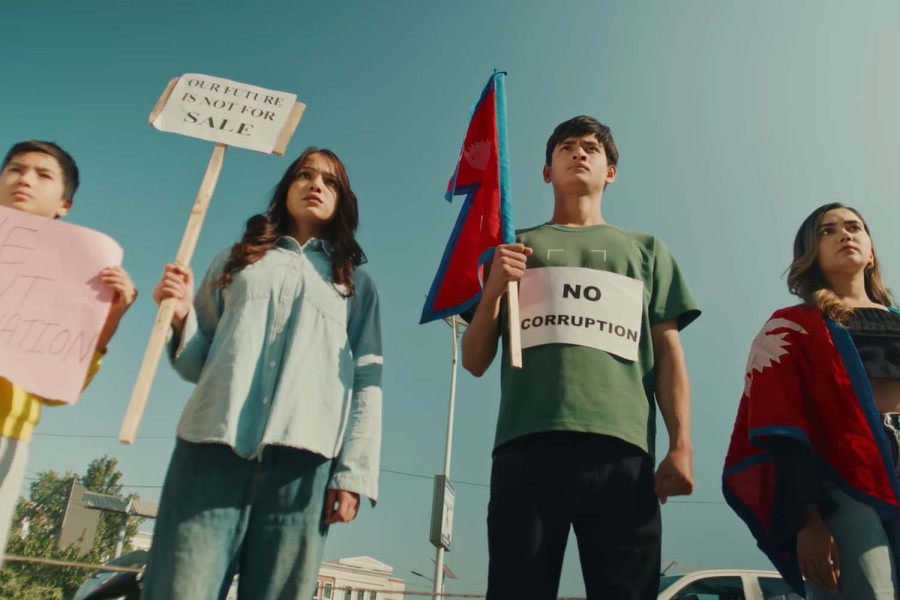
Towards the end, the film gestures toward collective resistance. Sohan announces a protest against corruption through social media, calling people to Maitighar. The posts trend, crowds gather, and a movement appears to form.
However, this sequence feels rushed and performative. It seems to imitate Gen Z-style protests without fully understanding their dynamics. The emotional buildup is thin, and the political awakening does not feel earned. More development could have strengthened this arc, although it might have complicated the film’s linear narrative.
Ultimately, ‘Jhari Pachi Ko Indreni’ is sincere in its intentions and occasionally powerful in its execution. It wants to believe in rainbows, but it is most convincing when it lingers in the rain.
Sanskriti Pokharel, a former reporter and sub-editor at the Post, is a final-year student of Journalism, Mass Communication, and English Literature at St. Xavier's College, with experience in media, research, and communication.




 17.57°C Kathmandu