Showcased at the Nepal Human Rights International Film Festival, ‘Shakti’ follows a single mother and her daughter as they navigate sexual violence, caste prejudice, and institutional indifference in Kathmandu. Photos: Courtesy of Crystal Mountain Films and Paribartan Productions
Throughout history, cinema has been used as a medium to spark conversation, ignite movements and inspire change. ‘Shakti’, directed by Nani Sahra Walker, belongs to this lineage of cinema.
It is a film that unfolds through silences, gestures, and everyday moments, asking difficult questions about caste, sexual violence, and justice without turning them into spectacle.
Set in Kathmandu, ‘Shakti’ follows Durga (Laxmi Bardewa), a single mother, and her young daughter, Lila (Polina Oli). The film opens not with conflict but with a memory. Durga and her “kuire” (foreigner) husband embrace each other by a river, hills resting quietly in the background.
The image is tender and calm. There is no dialogue, only closeness. Soon after, the calm dissolves. Their separation is communicated without explanation. This opening establishes the film’s language early on. Emotional shifts are shown rather than spoken. What is absent matters as much as what is present.
Walker’s camera frequently frames Kathmandu in ways that feel almost deceptive. In one shot, the valley is seen through branches and leaves. The composition looks peaceful, even protected. Yet the city within that frame is marked by social chaos, inequality, and exclusion. This contrast runs throughout the film. Beauty and violence coexist, often within the same image.
Durga’s world is introduced through her workplace. She cleans hospital floors, moving through narrow corridors washed in pale blue light. The space feels cold and impersonal. The repetition of her labour is emphasised, not dramatised. These scenes subtly underline how institutions depend on people like Durga while denying them dignity. She is seen constantly moving, yet socially immobile.
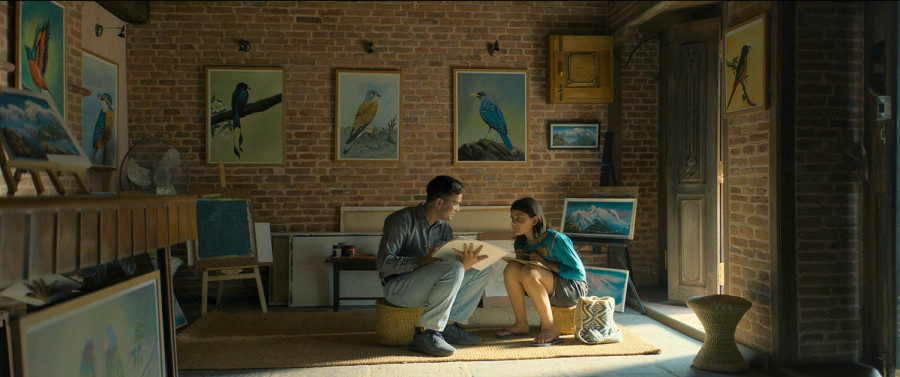
Lila, in contrast, is first shown as full of energy. She runs through alleys, plays with boys, steals fruit at school, and paints freely. The light around her is warmer. The colours are brighter. The film makes a clear visual distinction between mother and daughter. Durga carries exhaustion and restraint. Lila carries openness. At this point, she carries innocence, and the world has not yet taught her to be afraid.
Another striking aspect of the movie is the near absence of background music. Most scenes unfold without any score.
What ‘Shakti’ does well is linger on the ordinary before it breaks. We see the everyday lives of Durga, Lila, and Durga’s sister Maya (Menuka Pradhan) in mundane moments. They struggle financially, but the film does not reduce them to suffering alone. There is routine, affection, and shared space. This attention to normalcy makes the later rupture feel invasive.
Lila’s change is slow and unsettling. Gradually, she stops painting and playing. Her drawings turn into aggressive black lines. Her body withdraws. Walker never stages the abuse explicitly. Instead, she trusts the viewer to read trauma through her behaviour. This restraint is one of the film’s strongest choices. It refuses voyeurism. The focus remains on the impact, not the act.
When the abuse by Lila’s art teacher comes to light, the film shifts its attention toward systems of response. Durga goes to the police, carrying the weight of her daughter’s silence. The officer listens mechanically. His questions circle her full name, caste, and husband. Even in a moment of extreme vulnerability, Durga is required to locate herself within patriarchal and caste hierarchies. Her pain is acknowledged only through paperwork.
The film’s treatment of caste is understated but sharp. Before enrolling Lila in art classes, Durga asks what her husband does. Her answer, that she works in a hospital, carries little social value. Later, at the police station, her caste becomes a fixation. The message is clear: A woman’s credibility is measured through lineage and marital status, not through truth.
One of the most disturbing details the film highlights is the legal limitation that requires sexual abuse to be reported within thirty five days. The rule is presented plainly, almost casually. That is what makes it cruel. Trauma is not linear. Silence is often a survival response. By imposing time limits, the system protects itself rather than the survivors.
Healing in ‘Shakti’ does not come from institutions. It comes from women. Maya’s (Durga’s sister) role is central here. She stays present throughout the transitions. Her care is practical, patient, and steady. In a film filled with closed doors, Maya represents a form of listening that does not need proof.
The shaman sequence is visually striking and emotionally charged. Set in a dim room with red curtains, oil lamps, and Newari architectural elements, the scene feels suspended in time. It may divide viewers. Some may see it as a return to tradition. Others may question its implications. What the film suggests, however, is less about belief and more about desperation. When formal systems refuse to heal, people turn elsewhere.
Also, another striking aspect of ‘Shakti’ is the near absence of background music. Most scenes unfold without any score. Daily life is presented without sound, telling the viewer how to feel. This restraint works in the film’s favour. By refusing music in ordinary moments, Walker avoids manipulating emotion. Silence becomes a presence that carries the weight instead. And when the film does allow sound to surface, it feels earned rather than imposed. The lack of music makes the violence harder to escape and the quiet moments heavier.
Towards the end, Lila asks her aunt Durga to go to Swayambhu. Durga smiles. As Lila climbs the steps of Swayambhu with a faint smile, the film resists closure. There is no declaration of recovery. There is only movement. The moment feels tentative, fragile, and honest.
‘Shakti’ is not a comfortable film. Its pacing is slow, and its silences are heavy. At times, its symbolism may feel elusive. Yet these qualities reflect the reality it portrays. Trauma does not resolve neatly. Justice is often delayed or denied. Walker does not offer consolation. She offers attention.
Nepal Human Rights International Film Festival is happening at the Film Development Board, Chabahil and Nepal Tourism Board, Bhrikutimandap.
Sanskriti Pokharel, a former reporter and sub-editor at the Post, is a final-year student of Journalism, Mass Communication, and English Literature at St. Xavier's College, with experience in media, research, and communication.




 17.57°C Kathmandu

.jpg)
%20(1).jpg)