



 15.68°C Kathmandu

Fri, Oct 23, 2026
Money
Weak demand keeps Nepal’s stock market under pressure
NEPSE drops 0.95 percent as weekly turnover rises 15 percent, wiping Rs43 billion off investors’ market wealth, while analysts call for measures to restore confidence and boost demand.
bookmark![]()
![]()
Pritam Bhattarai
Published at : August 22, 2026
Updated at : August 22, 2026 14:32
Kathmandu
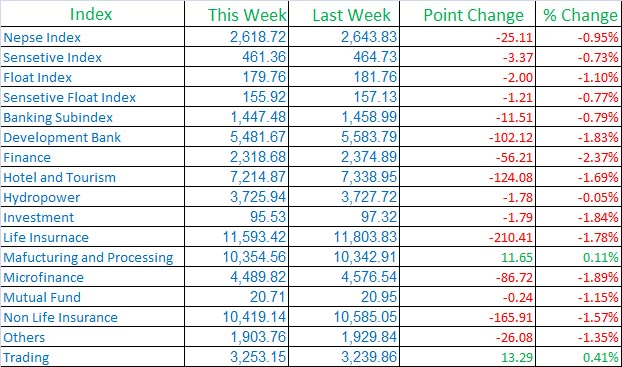
The Nepal Stock Exchange (NEPSE) index fell 25.11 points, or 0.95 percent, during the trading week from August 17 to 21, while trading activity increased sharply as investors rotated their holdings and booked profits.
The benchmark index closed at 2,618.72 points on Friday, down from 2,643.83 points a week earlier. Trading activity increased substantially, driven largely by heavy turnover in hydropower and manufacturing stocks.
The decline also reduced investors’ paper wealth. Total market capitalisation fell to Rs4.504 trillion at the end of the week from Rs4.547 trillion a week earlier, wiping out about Rs43 billion in market value.
The broader market also weakened. The Sensitive Index fell 3.37 points, or 0.73 percent, to 461.36 points, while the Float Index declined 2 points, or 1.10 percent, to 179.76 points.
Despite the decline in stock prices, liquidity remained strong. Weekly turnover rose 15.33 percent to Rs21.22 billion, up Rs2.82 billion from Rs18.40 billion the previous week. Average daily turnover increased to Rs4.24 billion from Rs3.68 billion.
Most sectoral indices ended lower. The Finance sector recorded the steepest decline, falling 2.37 percent, followed by Microfinance at 1.89 percent and Investment at 1.84 percent. The Banking index dropped 0.79 percent to 1,447.48 points.
Manufacturing and Processing was among the few sectors to gain, rising 0.11 percent, while the Trading index increased 0.41 percent.
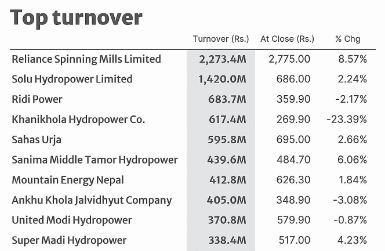
Sarvottam Paints was the week’s top gainer, rising 101.06 percent to Rs797.60. Mount Everest Power Development gained 69.66 percent to Rs774. Khanikhola Hydropower Company was the biggest loser, falling 23.39 percent to Rs269.90.
Reliance Spinning Mills recorded the highest turnover at Rs2.27 billion and closed at Rs2,775. Solu Hydropower was the most actively traded stock by volume, with more than 2.04 million shares changing hands. Its share price rose 2.24 percent to Rs686.
Investor and market analyst Tilak Koirala said oversupply and weak demand were among the main reasons the stock market has struggled to gain momentum.
“The biggest problem right now is oversupply and a lack of demand,” Koirala said.
He urged the government to take measures to increase demand in the capital market, including creating an institution that could pool funds from the Citizen Investment Trust, Employees Provident Fund and Social Security Fund and invest them in the stock market.
Koirala also said the government’s approach to the capital market was discouraging investors. Investigations into capital market activities have created uncertainty and weakened investor confidence, he said.
“Most small investors have already exited the market, while big investors are hesitant to increase their investments because of a lack of confidence,” he said. “The government needs to take steps to restore that confidence.”
Koirala also called for regulatory changes to allow institutional investors to participate more actively.
For a short-term boost to the stock market and the broader economy, he suggested reducing the mandatory holding period for bank and financial institutions from six months to 30 days before they can sell listed shares. He also proposed raising the investment limit for insurance companies from the current 10 percent for non-life insurers and 15 percent for life insurers to at least 30 percent of their investable funds.
He also called for removing the six-month holding requirement for mutual funds and qualified institutional investors, saying the rule can contribute to artificial price increases in newly listed companies.
Despite the current weakness, Koirala remains optimistic about the market’s longer-term prospects if the government takes steps to rebuild investor confidence.
He said the government should encourage financially strong companies to enter the market while discouraging weak companies from using initial public offerings primarily to raise funds for their own interests.
Chartered accountant and market analyst Manish Aryal said he did not expect the market to rise significantly in the short term.
The recent increase in trading volume in hydropower stocks has offered some hope and could trigger a swing in the market, he said. But the overall market remains in a consolidation phase, with insufficient turnover to sustain an upward move.
“At present, there isn’t enough volume to push the market higher,” Aryal said. Daily turnover would need to reach around Rs8 billion to Rs10 billion for the market to gain sustained momentum, he said.





Most Read from Money

Nepal travel agents threaten to stop selling Thailand trips over visa rules

Why does an hour long flight to Dhangadhi cost more than a flight to New Delhi?
Malaysia rejects Nepal’s demand to open recruitment to all manpower agencies

No school, but a graduation cap for women dairy farmers

Nepal arrests four medical service providers as Malaysia recruitment row deepens
Editor's Picks




E-PAPER | October 23, 2026

×