



 14.7°C Kathmandu

Fri, Oct 23, 2026
Money
Nepse struggles to gain momentum as investors lose Rs7 billion in wealth
The market shed 6.26 points to close at 2,643.83 as turnover fell 14.22 percent, with investors remaining cautious despite improved financial results from listed companies.
bookmark![]()
![]()
Pritam Bhattarai
Published at : August 15, 2026
Updated at : August 15, 2026 16:17
Kathmandu
The Nepal Stock Exchange (Nepse) index fell 6.26 points, or 0.24 percent, over the trading week from August 10 to 14, closing at 2,643.83 points as investors remained cautious amid weak market confidence.
Trading activity also weakened. Total turnover stood at Rs18.40 billion, down 14.22 percent from Rs21.45 billion in the previous week. Average daily turnover over the five trading sessions was Rs3.68 billion.
Total market capitalisation fell to Rs4.547 trillion from Rs4.554 trillion a week earlier, wiping out around Rs7 billion in market value.
Nine of the 13 sectoral indices ended the week lower, while four gained.
The Trading sub-index recorded the steepest decline, falling 4.37 percent, or 148.04 points, to 3,239.86 points. The Finance index dropped 0.96 percent to 2,374.89, while the Manufacturing and Processing index fell 0.49 percent to 10,342.91.
The Hotel and Tourism sub-index was the top performer, rising 0.68 percent, or 49.52 points, to 7,338.95. The Microfinance index gained 0.30 percent to 4,576.54, while the Investment and Others indices each rose 0.24 percent.
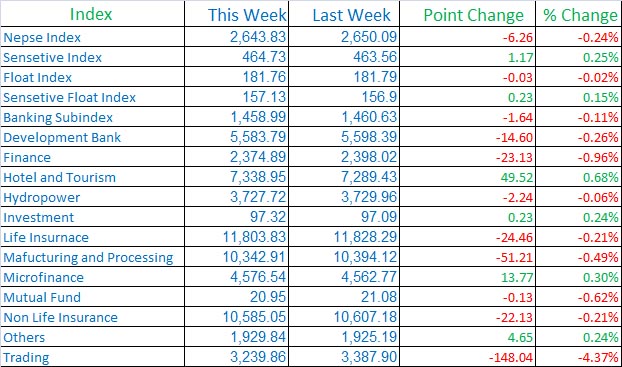
The Sensitive Index, which tracks Class A companies, gained 1.17 points, or 0.25 percent, to 464.73. The Float Index fell 0.02 percent to 181.76.
Among individual stocks, Mount Everest Power Development recorded the biggest gain, rising 52.07 percent to Rs456.20. Sarvottam Paints climbed 32.23 percent to Rs396.70, while Ghalemdi Hydro and Khanikhola Hydropower gained 9.21 percent and 9.07 percent, respectively.
Mahila Lagubitta was the biggest loser, falling 21.05 percent to Rs1,279. Aatmanirbhar Lagubitta dropped 11.32 percent to Rs5,320, while Upper Lohore Khola Hydropower declined 9.76 percent to Rs342.
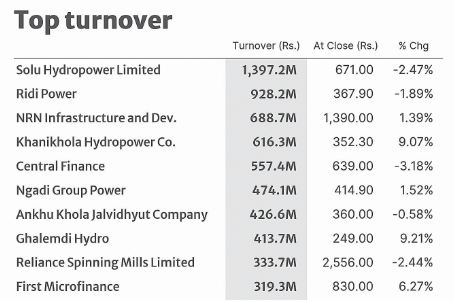
Energy companies dominated trading activity. Solu Hydropower recorded the highest turnover at Rs1.397 billion, although its share price fell 2.47 percent to Rs671. Ridi Power followed with Rs928.2 million, while NRN Infrastructure and Development recorded Rs688.7 million.
Ridi Power was also the most actively traded stock by volume, with 2.445 million shares changing hands. Its share price closed at Rs367.90.
Market analyst and former banker Jagannath Dhungel said he saw little indication of a sustained market recovery, with traders increasingly looking for opportunities to exit rather than hold shares for the long term.
“Investors are looking for a way out because confidence in the market has declined,” Dhungel said.
He attributed the weak sentiment to several factors, including the economic slowdown following the Covid-19 pandemic, uncertainty surrounding the new government, and ongoing investigations into market-related activities.
Growing supply without corresponding measures to increase demand is another concern, he said.
“Even though most companies have published comparatively improved financial statements, the market is slowing because traders are mostly looking for short-term gains,” Dhungel said.
He expects the market could see a short-term rise as mutual funds, which he said had sold shares towards the end of the previous fiscal year to maintain their financial reports, are likely to return to the market.
Investor and market analyst Subas Chandra Dhungana said the market has historically gained momentum in July and August, supported by the budget, monetary policy, and dividend season.
“This year, however, the market has not risen as expected because investors lack confidence,” he said.
Despite companies reporting better financial results at the end of the fiscal year, the market has struggled to gain momentum because Nepal’s stock market is largely driven by retail investors seeking short-term returns rather than dividends, Dhungana said.
The market also lacks enough institutional investors to absorb the growing supply of shares, he said.
For the market to regain short-term momentum, daily turnover would need to rise to around Rs8 billion to Rs9 billion, according to Dhungana. Current daily turnover is around Rs4 billion.
“Historically, the market tends to gain momentum around November,” he said.



Most Read from Money

Nepal travel agents threaten to stop selling Thailand trips over visa rules

Why does an hour long flight to Dhangadhi cost more than a flight to New Delhi?
Malaysia rejects Nepal’s demand to open recruitment to all manpower agencies

No school, but a graduation cap for women dairy farmers
Nepal arrests four medical service providers as Malaysia recruitment row deepens
Editor's Picks




E-PAPER | October 23, 2026

×