



 19.12°C Kathmandu

Mon, Sep 21, 2026
Money
Nepse falls 35 points, wiping Rs70 billion off market value
The benchmark index dropped 35.45 points or 1.32 percent, last week as selling pressure pulled down 11 of Nepse’s 13 sectoral indices.
bookmark![]()
![]()
Pritam Bhattarai
Published at : August 8, 2026
Updated at : August 8, 2026 12:04
Kathmandu
The Nepal Stock Exchange (Nepse) index corrected by 35.45 points, or 1.32 percent, last week as selling pressure across major sectors dragged down the market.
The benchmark index closed at 2,650.09 points on Friday, down from 2,685.54 points at the end of the previous week.
Market sentiment remained cautious throughout the five trading days. The Sensitive Index, which tracks Class A companies, fell 6.57 points, or 1.40 percent, to 463.56 points. The Float Index declined 2.80 points, or 1.52 percent, to 181.79 points, while the Sensitive Float Index dropped 2.58 points, or 1.62 percent, to 156.90 points.
Nepse’s total market capitalisation fell to Rs4.55 trillion from Rs4.62 trillion a week earlier, wiping Rs70 billion off investors’ holdings. The market capitalisation declined by 1.52 percent over the week.
Trading activity also weakened slightly. Total turnover fell by Rs220 million, or 1.02 percent, to Rs21.45 billion from Rs21.67 billion in the previous week. Average daily turnover stood at Rs4.29 billion, down from Rs4.334 billion.
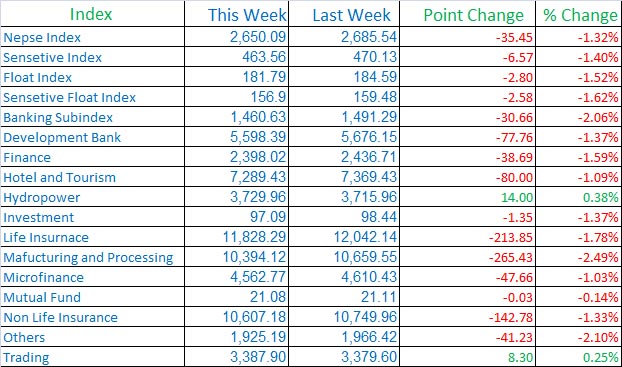
Eleven of Nepse’s 13 sub-indices ended the week lower, with Manufacturing and Processing, Others and Banking recording the biggest declines.
The Manufacturing and Processing index suffered the steepest fall, dropping 265.43 points, or 2.49 percent, to 10,394.12 points. The Others index fell 41.23 points, or 2.10 percent, to 1,925.19 points, while the Banking index declined 30.66 points, or 2.06 percent, to 1,460.63 points.
Hydropower and Trading were the only sectors to post gains. The Hydropower index rose 14 points, or 0.38 percent, to 3,729.96 points, while Trading advanced 8.30 points, or 0.25 percent, to 3,387.90 points.
Top gainers and losers
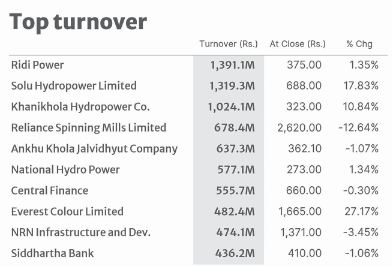
Everest Colour Limited was the week’s biggest gainer, rising 27.17 percent to Rs1,665 per share. Solu Hydropower Limited gained 17.83 percent to Rs688, while Khanikhola Hydropower Company rose 10.84 percent to Rs323.
Reliance Spinning Mills was the biggest loser, falling 12.64 percent to Rs2,620. Samudayik Laghubitta declined 9.48 percent to Rs982.10, while Bhagawati Hydropower fell 6.55 percent to Rs556.
Ridi Power leads turnover
Ridi Power was the most traded company by value, recording turnover of Rs1.391 billion. Its shares rose 1.35 percent to Rs375. It also topped the volume table, with 3.676 million shares changing hands.
Solu Hydropower recorded the second-highest turnover at Rs1.319 billion, with 2.024 million shares traded. Khanikhola Hydropower followed with a turnover of Rs1.024 billion from 3.254 million shares.
Analysts divided over market outlook
Chartered accountant and market analyst Manish Aryal sees some grounds for optimism despite the recent correction.
He said the market could receive support from improving financial statements of listed companies, particularly banks and financial institutions (BFIs) and hydropower companies, which account for a significant share of listed firms.
“Most companies in the BFIs have reported gradual improvement in their fourth-quarter results, while some others are expected to publish better results,” Aryal said. “Some hydropower companies have also reported improved results, and others are expected to do so.”
Lower interest rates could further support the earnings of hydropower companies and other borrowers, he said.
Aryal also pointed to Finance Minister Swarnim Wagle’s recent meeting with chief executive officers of commercial banks, during which the minister assured them that the government would facilitate the release of loans from banks’ excess liquidity.
“An increase in lending would have a positive impact on banks’ profitability, which could eventually increase the value of banking stocks,” he said.
Aryal also sees signs that institutional investors are accumulating fundamentally strong stocks. He said banking stocks have remained relatively resilient despite weak market sentiment in recent weeks, which could indicate that the market is building momentum.
Investors are also awaiting implementation of Nepal Rastra Bank’s decision to raise the margin lending limit on fundamentally sound stocks from 70 percent to 80 percent, he said.
“BFIs are now waiting for clarity on the provision. At present, they are providing margin loans of up to 70 percent,” Aryal said.
Market analyst Ajay Singh Thapa, however, does not expect the market to regain strong momentum in the short term.
Investors remain reluctant to enter the market because listed companies have not delivered the returns they expected, he said. Many investors are instead looking for opportunities to exit.
“Over the past three or four years, investors have not received adequate returns on their investments. Many are instead looking for opportunities to exit the market. In such a situation, how can the market gain momentum?” Thapa said.
He is more optimistic about the longer-term outlook, however.
Once measures introduced by the government and financial regulators begin to take effect, the market could enter a sustained bull run over the next 18 months to two years, he said.





Most Read from Money

A flood of bad news leaves Nepal’s tourist hubs eerily quiet

How crypto found a ‘legal’ route into Nepal’s relief efforts
Nepalis cut back on food as ‘hyperinflation’ and shortages bite

LPG crisis deepens in Kathmandu, restaurants on the brink

Germany provides €8 million in assistance to Nepal after Bhotekoshi floods
Editor's Picks

What triggered the Rasuwa flood? Scientists piece together a complex chain of events

The floods keep coming. Nepal keeps starting over

In a settlement destroyed by the Bhotekoshi flood, a disabled couple offer strangers the little they have

Nepal working on detailed assessment as Bhotekoshi flood reconstruction could cost up to $5 billion

Rabindra Dhant gave Nepal a reason to smile. Now his camp wants real action behind the praise
E-PAPER | September 21, 2026

×