Tatopani reopening unlikely before festive season. Traders urge Beijing talks
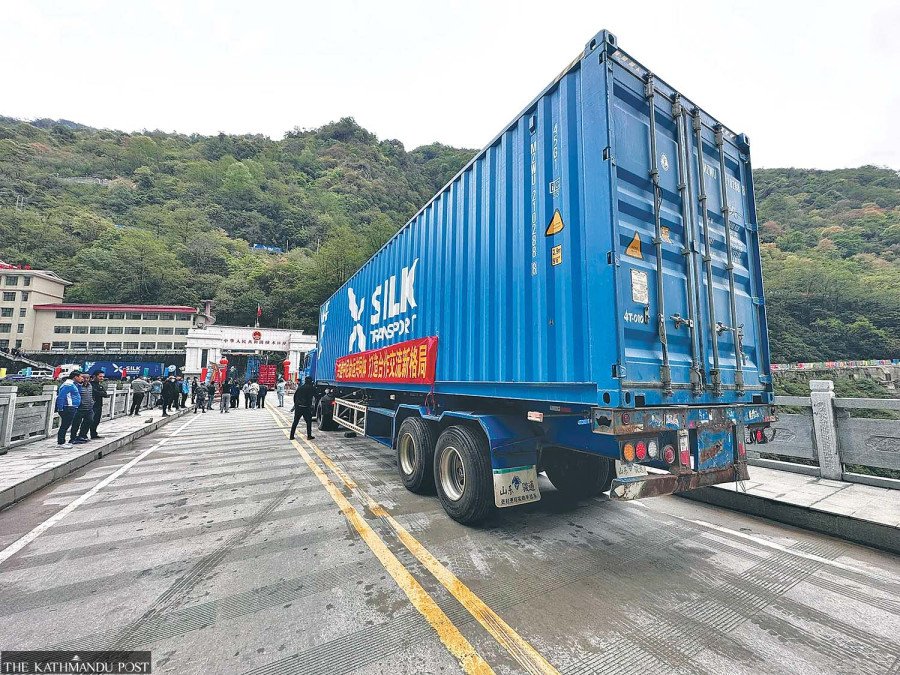
Disruptions at two northern crossings have pushed more cargo through Korala, where high transport costs and limited infrastructure are delaying shipments ahead of Dashain. A China-bound cargo truck at the Friendship Bridge at Nepal-China border in Tatopani, Sindhupalchok, in this undated photo. China closed the border for trade two weeks ago, following the Rasuwa floods. Post File Photo
The reopening of the Tatopani border point in the north appears highly unlikely before the festive season, as traders urge the government to negotiate with Beijing for its early reopening.
Traders say the closure has put pressure on the Korala border point in Mustang and driven up transport costs. September is the peak period for imports of festival-targeted goods, including electric vehicles, electronics, and apples from China.
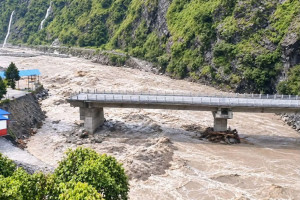
The devastation caused by the August 26 Bhotekoshi floods has stalled trade through the Rasuwagadhi border, after much of the infrastructure there was destroyed. With Tatopani already closed, pressure has shifted to Korala. Traders fear that delays in consignments could affect festive-season orders.
Days after the disaster, China closed the Tatopani border point in Sindhupalchok on August 29 for imports and exports until further notice, citing the risk of landslides.
Tatopani customs officials said Chinese authorities had not initially provided a reason for the closure. However, on August 31, the Tatopani Customs Office received an email from the Chinese side informing it that imports and exports through Tatopani, known as Zhangmu on the Chinese side, would remain suspended until further notice.
An official at the foreign ministry, requesting anonymity, told the Post that the ministry is taking diplomatic initiatives with Beijing to reopen Tatopani. But according to sources privy to the matter, reopening the border point before the Dashain festival, which begins in mid-October, remains uncertain.
The industry ministry and Customs Department are also unaware of any developments regarding the reopening.
On Tuesday, lawmakers demanded that the government initiate diplomatic negotiations to reopen Tatopani.
Lawmaker Yubaraj Dulal told Parliament that the prolonged closure of the Tatopani border point had severely affected festive imports.
He said the border closure had not only affected traders but also consumers.
“At a time when inflation is weighing on consumers, I demand that the government hold diplomatic negotiations to reopen the Tatopani border point quickly,” he said.
Dulal, who is also the chief whip of the Nepali Communist Party, said China had not been allowing drivers from outside Mustang to enter its territory and that a shortage of heavy-vehicle drivers had created difficulties for traders. He urged the government to negotiate with China to allow drivers to enter certain parts of the border areas.
Traders and customs officials said that if China allows trade through the Tatopani border point, road conditions would not pose a major problem despite some damage along the route.
Tatopani Customs Chief Dipendra Prakash Giri said Chinese customs officials had told their Nepali counterparts that they had not received any orders from higher authorities to reopen the border point.
“Despite a small landslide, the condition of the Araniko Highway is not bad for now and there will be no problem in trading through the highway,” he said.
The border point is open to people returning from the Kailash Manasarovar pilgrimage through Tatopani, said Giri.
Traders have repeatedly urged the government to restore regular operations at the border point.
In February 2021, Nepali traders accused China of imposing an ‘undeclared trade blockade’ after their merchandise-laden container trucks were not allowed to cross the border into Nepal for 16 months, with China taking strict precautionary measures during the pandemic.
“Resuming the Tatopani border point would come as a huge relief for us. It saves time and reduces trade costs, especially after we have already suffered huge human and financial losses due to the Bhotekoshi floods,” said Ram Hari Karki, president of the Nepal Trans-Himalayan Border Commerce Association.
Thirty to 40 goods-carrying vehicles are arriving at the Korala border point daily, with hundreds of electric vehicles also passing through the border point, he said. The transport fare from Korala to Kathmandu, which had reached nearly Rs450,000, has now fallen to around Rs350,000. It takes four to five days for goods to reach Kathmandu.
More than 200 vehicles are waiting for customs clearance at the Korala, said Karki. An empty container reaching Korala takes four to five days to load goods and complete customs clearance.
By contrast, transport from Tatopani to Kathmandu costs just Rs50,000, and goods can reach Kathmandu within four to five hours, he said.
Nepal imported goods worth Rs47.48 billion via the Tatopani border point in the last fiscal year ended in mid-July, out of total imports worth Rs425.24 billion from China.
Opened for trade last September, the Korala border point, which does not have essential customs infrastructure, is struggling to handle the additional traffic diverted from the two major crossings.
Trade expert Rabi Shankar Sainju said China was taking precautions at the Tatopani border point after what happened at Rasuwagadhi.
“Closure of the Tatopani border point has definitely impacted Nepal-China trade. But China is in a wait-and-watch situation after what happened recently, given the similar geographical conditions,” said Sainju, a former commerce joint secretary.
Nepal has sought Chinese assistance to rebuild the road linking Syaphrubesi with the Rasuwagadhi border crossing.
China has responded positively to Nepal’s proposal and indicated that it is willing to help, although no formal agreement has yet been signed, according to the Minister of Infrastructure Development in a recent interview with Kantipur.
Krishana Prasain is a business reporter for The Kathmandu Post covering markets. Before joining The Kathmandu Post in 2018, she spent 3 years in New Business Age magazine covering business.




 24.79°C Kathmandu