Trade shifts to under-resourced Korala point after Rasuwa and Tatopani closures
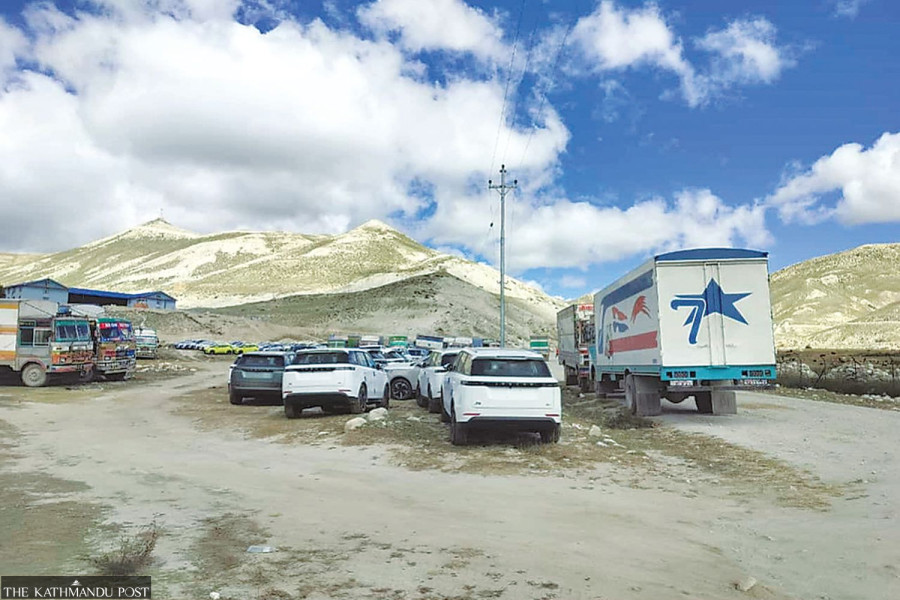
Customs officials seek additional manpower and equipment as traders divert stranded containers to the border point in upper Mustang. Cargo trucks and vehicles at the Korala customs point on the Nepal-China border in upper Mustang, in this undated photo. Post file photo
With the two major northern trade points—Rasuwagadhi and Tatopani—coming to a complete halt, the Korala border point, the only remaining northern trade route, is struggling to handle the pressure of two major crossings at once.
Mustang Customs Chief Bidur Chudal has arrived in Kathmandu to coordinate with the Department of Customs and the Ministry of Finance to seek additional manpower to handle the increased workload at Korala.
“Trade through the Korala is challenging,” he said. “We don’t have basic customs infrastructure or sufficient manpower. We won’t be able to handle the pressure of two trade points.”
Korala Customs also lacks essential equipment such as an X-ray machine and walkthrough scanners, forcing officials to conduct inspections manually.
“If we had an X-ray machine, it would make the customs process much quicker and easier,” said Chudal.
Currently, 12 customs officials are handling operations at the border point, but Chudal said at least 15 staff members are needed. There are not even staff quarters at the border point.
The pressure on Korala is also raising concerns about the condition of the road leading to the border. The area is geographically challenging, and the increased movement of cargo vehicles could damage the road, officials said.
Around 175 containers stranded at Kerung, which was hit by landslides last week, are expected to be diverted to Korala, according to Chudal. The containers could start arriving from Wednesday.
The regular flow of cargo through Korala has already slowed because the Thankot-Mugling section of the Prithvi Highway has been closed for nearly a week.
Currently, only eight to 10 cargo vehicles are passing through the Mustang border point each day, Chudal said. When the Korala border point came into operation for international trade last year, 30 to 40 cargo containers were entering Nepal daily ahead of the festive season.
Located at an altitude of around 4,650 metres in upper Mustang, the Korala customs point was opened for international trade in September last year, following the flash flood in the Lhende River in Rasuwa that swept away the Miteri Bridge at Kerung.
The border point was officially inaugurated in November 2023.
The Kaligandaki Corridor, which reaches the Korala border, is connected to the Siddhartha Highway in Syangja district and extends to the Sunauli border point in Rupandehi district.
The route from Sunauli on the Nepal-India border to Korala on the Nepal-China border, through the Siddhartha Highway and Kaligandaki corridor, has been viewed as a potential alternative trilateral trade route connecting Nepal, India and China.
However, Korala remains vulnerable to disruptions caused by snowfall. The border point was closed for more than a week in April because of heavy snowfall and was also closed in December last year.
The Mustang customs point has around 1,000 ropani (50.87 hectares) of land, allowing customs clearance to be carried out within the same area. However, it does not have a proper customs yard. Around 30 to 50 vehicles can be accommodated on the customs premises, said Chudal.
Nepal imported goods worth Rs14.4 billion through the Mustang customs point in the last fiscal year, while exports amounted to Rs205.57 million.
By comparison, imports through the Rasuwa customs point were worth Rs45.73 billion, while exports stood at Rs894.60 million during the same period. Imports through the Tatopani border point amounted to Rs47.48 billion.
Traders are increasingly worried about diverting cargo through Korala because of congestion and delays in customs clearance.
Tribhuvan Dhar Tuladhar, president of the Nepal-China Chamber of Commerce and Industry, said traders have already started diverting containers.
“About 200 containers stranded in Nyalam in China and originally headed for Tatopani are being diverted to Korala,” he said.
The cost of transporting goods from Korala to Kathmandu has also increased. The transportation fare has risen to around Rs300,000 per container from Rs250,000 before the flood, Tuladhar said.
Korala, however, is relatively safer from floods and landslides than the other northern trade routes, he said. But inadequate customs infrastructure and poor road conditions on the Nepal side make the route difficult for traders.
“Korala is safe in terms of floods and landslides, but inadequate customs infrastructure and poor road conditions on the Nepal side are challenging,” said Tuladhar. “Landslides along the highways have added to the problem.”
The closure of the Prithvi Highway since Sunday has created another problem for traders using Korala. Cargo vehicles heading to Kathmandu must now use other routes.
Three alternative routes—Kanti Highway, Daksinkali and Tribhuvan Highway—are being used to connect Kathmandu after the Prithvi Highway was blocked. Goods are currently being transported through the Tribhuvan Highway.
“Ambulances and vehicles carrying essential supplies such as petroleum products, medicines and other essential goods are being given priority, and we are facilitating the smooth flow of vehicles,” said Superintendent of Police Naresh Raj Subedi of the Kathmandu Valley Traffic Police.
Korala is one of the six customs points identified under the 2016 Nepal-China Transit Protocol, which gives Nepal access to Chinese land and sea ports and is intended to reduce the country’s dependence on India for third-country trade.
The broader agreement is aimed at transforming Nepal from a landlocked country into a “land-linked” one.
Despite its strategic importance, traders say Korala is not financially viable for regular commercial trade because of high transportation costs.
It takes two to three days for cargo vehicles to reach Kathmandu from Korala, compared with about a day from Tatopani.
Despite the long distance and frequent snowfall, Korala faces relatively lower risks from floods and landslides than Nepal’s other northern trade routes.
Krishana Prasain is a business reporter for The Kathmandu Post covering markets. Before joining The Kathmandu Post in 2018, she spent 3 years in New Business Age magazine covering business.




 22.21°C Kathmandu