



 14.81°C Kathmandu

Sat, Oct 24, 2026
Money
Beijing signals support for rebuilding flood-ravaged Rasuwagadhi route
Nepal has sought Chinese assistance to rebuild the 16-km Syaphrubesi-Rasuwagadhi road, while the government prepares a temporary track to restore access to the border crossing.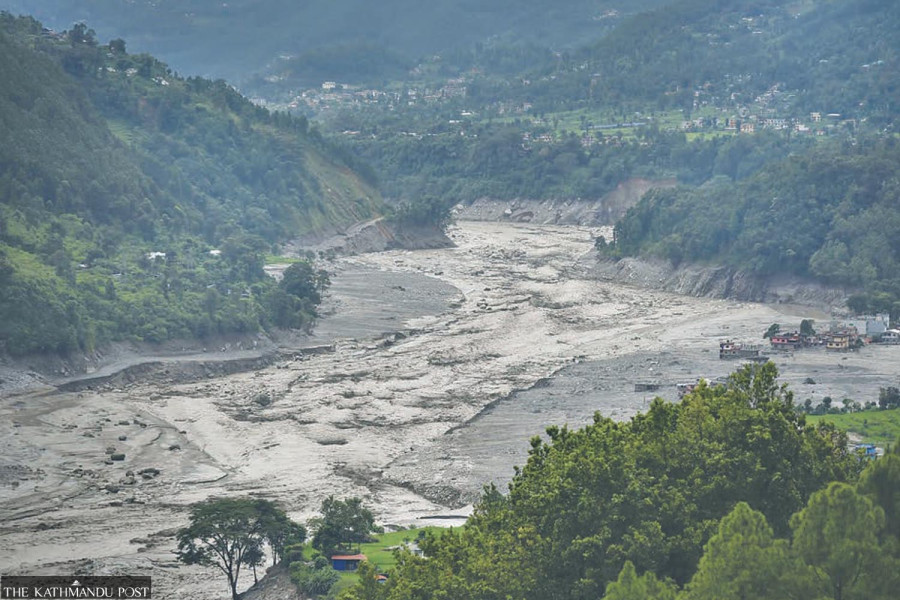
bookmark
Gaurav Pokharel & Bimal Khatiwada
Published at : September 14, 2026
Updated at : September 14, 2026 06:55
Kathmandu
Nepal has sought Chinese assistance to rebuild the road linking Syaphrubesi with the Rasuwagadhi border crossing, the key trade route in the north, which was severely damaged by the August 26 floods.
China has responded positively to Nepal’s proposal and indicated that it is willing to help, although no formal agreement has yet been signed, the Ministry of Infrastructure Development has said.
The roughly 16-km Syaphrubesi-Rasuwagadhi road was being upgraded under a Rs6.5 billion Chinese-funded project when the August 26 floods swept away large sections, severely damaging the border crossing and cutting a major trade link between Nepal and China.
The project completion period was 39 months.
The government is now looking at a temporary track to restore access to Rasuwagadhi while working on a longer-term plan to rebuild the road in a safer location. Discussions with China on the plan are continuing.
“China has given us a verbal commitment to provide assistance, although a written agreement has not yet been signed,” Infrastructure Development Minister Sunil Lamsal told Kantipur in an interview. “We understand that they are preparing for it, and regular discussions are also taking place.”
The government is meanwhile assessing temporary options to restore access to the border point.
“The route is not only a trade corridor between Nepal and China. There are many settlements along it as well,” Lamsal said. “For now, we are preparing to use a temporary track to keep the route to Rasuwagadhi open. In the long term, we need to build a safer road, but for the time being we will make do with a temporary track.”
He added, “For now, we are preparing to operate through a temporary track until Rasuwagadhi. In the long term, we need to build a safer road, but for the time being we will make do with a temporary track.”
He said the government was examining safer ground around the existing road alignment as it works to reopen the crossing.
“We are also discussing various alternatives,” Lamsal said. “We have sent a proposal to the Chinese government asking for support in restoring the border point, and we have held discussions with them.”
Rasuwagadhi emerged as Nepal’s main alternative trade route with China after the Araniko Highway and the Tatopani border area suffered repeated disruptions, particularly following the 2015 earthquake.
The crossing handles imports including electric vehicles, electrical goods, ready-made garments, footwear, agricultural products, telecommunications equipment, machinery used by hydropower projects, vehicles and industrial machinery. Nepal exports smaller quantities of handicrafts, woollen goods, medicinal herbs, noodles, copper utensils and agricultural products to China, according to the Rasuwa Customs Office.
Electric vehicles account for around 60 percent of total imports through the crossing, according to customs officials.
“Large numbers of electric vehicles used to come through Rasuwagadhi. But after the flood on July 8, 2025, many of them were sent directly to the Chobhar dry port customs office,” said Rajendra Dhungana, chief customs officer at Rasuwa. “So we did not have consolidated data on how many vehicles entered through Rasuwagadhi.”
Rasuwa Customs had set a revenue collection target of Rs25.5 billion for the current fiscal year.
In the first month of the fiscal year, it collected Rs1.86 billion against a target of Rs1.78 billion.
In the second month, from mid-August to mid-September, the target was set at Rs2.04 billion. So far, Rs900 million had been collected by August 25, a day before the floods struck the border area.
The disaster completely wiped out the border point and its surroundings.
It remains unclear when it can reopen. Customs officials say it is no longer possible to rebuild the customs office and other facilities at their former locations.
“Imports of garments and footwear had picked up from mid-August ahead of the upcoming festivals,” Dhungana said. “The border was operating well, and revenue collection was exceeding the target. The flood swept everything away within moments.”
Located about 152 km north of Kathmandu, Rasuwagadhi has become an important gateway for Nepal-China trade and a major source of customs revenue. It also plays a role in border management and economic activity in the northern region.
According to a historical document published by the Rasuwa Customs Office, the customs office was established at Rasuwagadhi in 1956 to facilitate trade between residents of Rasuwa and people in the Kerung area of Tibet.
Tatopani had traditionally served as the main land route for Nepal-China trade. But the 2015 earthquake caused extensive damage in Sindhupalchok and left the crossing shut for a prolonged period. Rasuwagadhi subsequently grew into Nepal’s principal northern trade route.
After the Rasuwagadhi crossing resumed operations, trade through the route expanded and commercial activity in the area increased. China formally recognised it as an international border crossing in 2017, further increasing its importance.
The crossing was hit by another major flood on July 8, 2025, when the Lhende river, near the Nepal-China border, swelled and swept away the Miteri bridge. The customs yard at Timure was also inundated, destroying vehicles and containers parked there. The crossing resumed operations about six months later, on January 1, 2026.
But just months after reopening, the border point was again devastated, this time by the August 26 Bhotekoshi flood.
The government is now preparing to restore the crossing once again after the Bhotekoshi disaster.
The disaster also raised questions about whether Nepal had received adequate warning from the Chinese side, as the floods originated upstream in Tibet.
Lamsal, however, said the disaster appeared to have caught China off guard as well.
“It seems the Bhotekoshi floods were also ‘unpredicted’ for the Chinese side,” he said. “There was some disturbance upstream, but nobody noticed it. China also suffered significant damage.”
Videos circulated on social media after the disaster suggested that people on the Chinese side had also received little warning, he said.
“Whoever saw the flood before it reached the Rasuwagadhi border point informed others. The first people to see it were the army personnel at the border,” Lamsal said. “Even then, they could not save people. The floods swept away the entire border point. There are major lessons to be learned from this.”
Nepal and China have since discussed establishing a live-tracking system to monitor activity in glacial lakes in the high Himalayas, Lamsal said.
“There is no difficulty in getting weather information,” he said. “But it is difficult to know when a landslide has occurred in the mountains or when a glacial lake has burst. We are now looking at how to address that gap.”
Nepal already has an agreement with India to exchange disaster early-warning information, and a similar process with China is now underway, he said.
“The Cabinet decided on the day of the disaster that the Foreign Ministry should begin the necessary preparations,” Lamsal said. “I understand that the ministry has already moved the process forward.”
The government is also considering relocating people living in areas exposed to glacial lake outburst floods and other hazards.
“We are also assessing settlements along other riverbanks across the country,” Lamsal said. “The government is preparing to identify areas that could be at risk if glacial lakes burst.”
He said work had already begun to identify vulnerable routes, markets and settlements that may need to be relocated. A separate task force has been formed to study the issue, with a detailed report expected within a month.
“We will then decide how to move the process forward,” he said.
The government has also formed separate task forces to work on roads and bridges, temporary shelters, holding centres and drinking-water supplies, among other needs.
For people displaced by the Bhotekoshi floods, the immediate plan is to provide temporary accommodation in safer locations nearby.
An estimated 8,692 households, or 39,114 people, were affected by the disaster, according to Lamsal. They were initially placed in 39 holding centres.
“But we never intended to keep them there for more than a week,” he said. “We also believe that keeping people in such conditions for a prolonged period is not appropriate psychologically.”
Connectivity problems have delayed the relocation process, he said. The government is considering providing financial assistance to people who can rent accommodation on their own, while also building temporary houses for those who need them.
Gaurav Pokharel
Pokharel is a journalist at Kantipur Media Group covering national security, defence, and good governance.


Most Read from Money

Why does an hour long flight to Dhangadhi cost more than a flight to New Delhi?
Nepal travel agents threaten to stop selling Thailand trips over visa rules
Malaysia rejects Nepal’s demand to open recruitment to all manpower agencies
No school, but a graduation cap for women dairy farmers
Nepal arrests four medical service providers as Malaysia recruitment row deepens
Editor's Picks




E-PAPER | October 24, 2026

×