Mud and steep cliffs hamper efforts to reopen flood-hit roads
Twenty-four days after the Bhotekoshi floods, Rasuwa and Nuwakot remain cut off from each other, while Dhading district headquarters also lacks a direct road link. Nepali Army personnel set up a truss bridge over the Trishuli river in Devighat, Nuwakot, earlier this month. Hemanta Shrestha/TKP
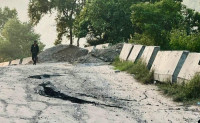
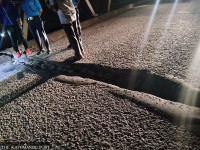
Mud, unstable ground and steep cliffs are hampering efforts to reopen the Dhunge-Betrawati road, a key route linking the flood-hit areas with the rest of the country.
The road section between Galchhi and Dhunge is largely operational. At Ratmate, a 200-metre section between Galchhi and Devighat, a new track has been opened after the Trishuli river washed away the road from below.
A bridge over the Kolpu Khola on the Galchhi-Bidur section has also been repaired and reopened, said Shubharaj Neupane, deputy director general and spokesperson for the Department of Roads. The Nepali Army has installed a temporary Acrow bridge at Devighat.
Workers have cleared mud, sand and debris from sections between Devighat and Trishuli’s Dhunge Bazaar. But clearing the road around Betrawati has proved difficult because machinery is sinking into the marshy ground, Neupane said.
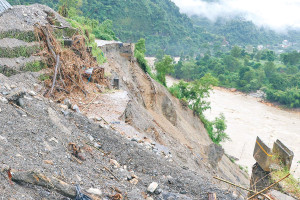
Beyond Dhunge Bazaar, floods washed away about 1.5 km of road at Gerkhutar. An alternative road has been repaired and opened to traffic. At Bhainse, where the original road was completely destroyed, a new 1.5-km track has been opened. Another 500-metre section between Bhainse and Betrawati was washed away, and the terrain there is too steep and rocky for conventional road-building equipment.
The government is preparing to install a Bailey bridge over the Falakhu khola at Betrawati, using a 70-metre bridge supplied by India. Once installed, it will restore a direct road connection between Rasuwa and Nuwakot.
“Machines are available, but there is nowhere to deploy them. In Betrawati, they sink into the marshy ground,” Neupane said. “We have to keep working while also pulling out machines that get stuck.”
Because of hard rock on the cliff section, authorities are considering blasting to open a track and are coordinating with the Nepali Army, he said.
The government aims to restore road access to the Rasuwagadhi border crossing with China before the Dashain festival, which begins in the second week of October. Two machines have already been sent towards Syabrubesi via Dhunche, while a technical team is assessing possible alternative routes.
The Infrastructure Development Ministry said it had asked China to open the road track from the Rasuwagadhi side towards Syabrubesi. China has responded positively to the request, according to ministry officials.
The August 26 floods destroyed much of the 16-km road between Syabrubesi and Rasuwagadhi, leaving debris where the road once stood. Bijaya Jaisi, director general of the Department of Roads, said opening a new track along the stretch remained difficult.
A Bailey bridge is also being prepared for Syabrubesi, after which officials will determine how to proceed towards the border, Jaisi said.
The floods washed away 41 motorable bridges between Rasuwa and Dhading, severing road links between Rasuwa and Nuwakot. A permanent bridge over the Trishuli river at Furke Khola, which provides direct access to Dhading district headquarters, was also destroyed.
Nepal has received two 100-metre Bailey bridges from China and three 70-metre bridges from India, said Sushil Babu Dhakal, joint secretary at the Infrastructure Development Ministry. The Nepali Army has three 70-metre Bailey bridges, while the Department of Roads has 11 bridges of up to 48 metres.
The immediate priority is to reopen the road from Galchhi through Dhunche and Syabrubesi to the Rasuwagadhi border and restore direct road access to Dhading district headquarters, Dhakal said.
A 100-metre bridge supplied by China may not be suitable for the Furke Khola crossing because it would require an intermediate support, which the site does not have. Two Chinese technicians have arrived to assess whether the bridge can be installed there.
The bridge is being brought into Nepal through the Korala border in Mustang and is currently being transported via Jomsom.
Officials say a single-span bridge of about 94 metres is likely to be needed at Furke Khola. Nepal has requested longer bridges from the United Arab Emirates, the United States and France.
“We have asked the relevant agencies to send longer bridges rather than smaller ones,” Dhakal said. “They have responded positively.”
Jaisi said the 100-metre bridges from China would be used elsewhere if they were found unsuitable for Furke Khola. The search for a suitable bridge is continuing, he said, adding that the government would begin construction of a permanent bridge if a suitable Bailey bridge could not be secured.
The Department of Roads estimates that the floods caused about Rs30 billion in damage to roads and bridges alone. Rebuilding them is expected to cost around Rs50 billion.




 14.3°C Kathmandu