



 12.97°C Kathmandu
Sun, Oct 11, 2026
Politics
Constitution Day puts Nepal’s constitutional future in focus
Leaders broadly defend the charter’s gains but differ over whether the priority should be implementation, review or amendment.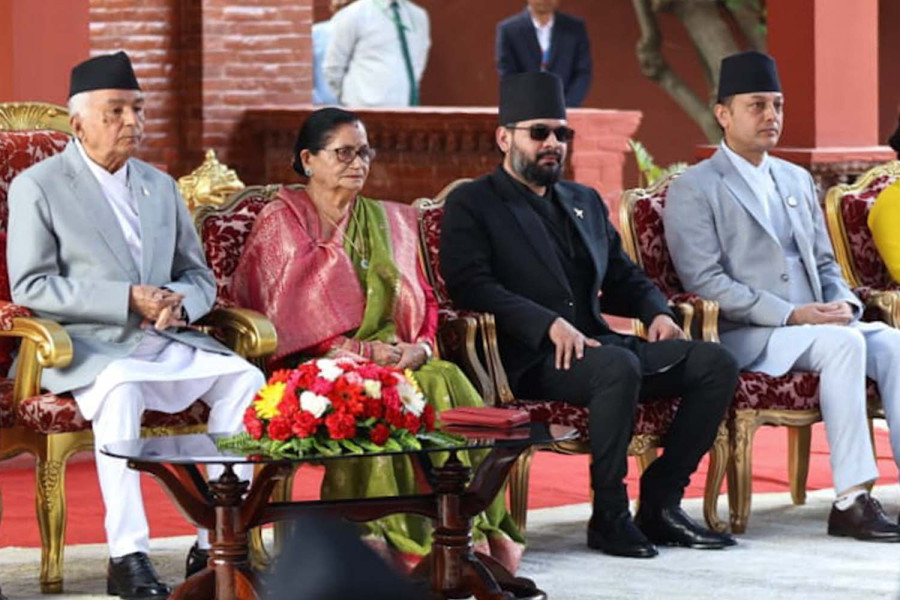
bookmark
Kul Chandra Neupane
Published at : September 20, 2026
Updated at : September 20, 2026 06:43
Kathmandu
Nepal marked the 11th anniversary of its constitution on Saturday with political leaders calling for its core achievements to be protected while differing over how the charter should evolve.
President Ramchandra Paudel called for full implementation of the constitution, while Prime Minister Balendra Shah said his government was committed to upholding it in both letter and spirit. Leaders of major political parties, however, placed varying emphasis on constitutional review, possible amendments and translating its guarantees into improvements in people’s daily lives.
The constitution, promulgated on September 20, 2015, established a federal democratic republic and enshrined fundamental rights, inclusive and proportional representation and a federal system of government.
Addressing a Constitution Day ceremony at the President’s office in Sheetal Niwas, Paudel said the constitution had laid the foundation for civil liberties, the rule of law, inclusive representation and social, cultural and economic transformation.
He called for full compliance with its provisions, greater accountability in public administration, more effective constitutional bodies and easier access to justice.
“Democracy will be strengthened only when we establish a culture of respecting disagreement, learning from criticism and making the state accountable to the people,” Paudel said.
The head of the state said the constitution should be viewed not simply as a written document but as a shared commitment to citizens’ aspirations, expectations and rights.
This year’s Constitution Day is marked as Nepal deals with the aftermath of the devastating Bhotekoshi flood of August 26. President Paudel called for a united effort to provide relief, rescue and rehabilitation to those affected, while stressing the need for transparent, accountable and results-oriented government.
At a separate ceremony at Tundikhel, Prime Minister Shah said the government was committed to implementing the constitution and its underlying principles.
“However good a constitution may be, it becomes a piece of paper if those entrusted with implementing it are not honest and continuously active,” Shah said. “This is the beginning, not the end.”
He said the government’s priorities included ending discrimination and inequality, promoting development and prosperity, and building a more equitable society based on social justice.
Shah also highlighted good governance, saying the government was working to reduce the size of the administrative machinery, maintain zero tolerance for corruption, ensure political neutrality in the bureaucracy and make appointments to public and state positions on the basis of merit.
The government, he said, was also committed to cooperation and coordination among the federal, provincial and local governments.
Shah linked constitutional implementation with economic and technological change, saying his government was working towards a knowledge-based economy centred on artificial intelligence, digital technology, cybersecurity, innovation and startups.
“Good governance is not a slogan,” Shah said. “It is work.”
While the President and prime minister focused largely on implementation and governance, party leaders used Constitution Day to outline different priorities for the next phase of the charter.
Ruling Rastriya Swatantra Party chair Rabi Lamichhane described the constitution as a “sacred contract” between the state and citizens.
He said its fundamental rights would have meaning only when they became part of the daily lives of marginalised citizens. Nepal still has work to do to build a stronger foundation for economic prosperity, social justice and good governance, he said.
Lamichhane also called for a review of the constitution centred on people at the margins of society.
“The constitution is a living document,” he said. “Its provisions can evolve and be amended based on experience gained through political practice.”
Nepali Congress president Gagan Kumar Thapa said constitutional amendments should be discussed with “courage and clarity” while protecting the charter’s basic values and principles.
He said years of political practice had exposed weaknesses that should be addressed through amendments aimed at strengthening democratic values.
Former prime minister and chairman of CPN-UML KP Sharma Oli, meanwhile, emphasised protecting the constitution and strengthening national unity. He called on forces supporting the constitution to stand together to safeguard it.
Former prime minister and coordinator of Nepali Communist Party Pushpa Kamal Dahal said the immediate task was to connect the achievements of the constitutional process with people’s lives and complete the remaining work.
Political change, he said, should be linked to improvements in education, healthcare, employment, production and equal opportunities.
Former prime minister Baburam Bhattarai also argued for amendments, but stressed the need to preserve the federal democratic republic, secularism, federalism and inclusive democracy.
Speaking to the state-run news agency, Rastriya Samachar Samiti, on the occasion, Bhattarai said amendments should be pursued through national consensus and build on the democratic gains already made.
He cautioned against making fundamental changes in anger or haste, saying such an approach could put existing achievements at risk.
The differing messages reflect a broader debate over Nepal’s constitutional experience after 11 years.
There is broad political recognition of the importance of the federal democratic system, fundamental rights and inclusive representation. The disagreement is over what should come next: stronger implementation of existing provisions, institutional reform, a broader review or targeted constitutional amendments.
For Paudel, the immediate challenge is to make the constitutional system more accountable and effective. For Shah, it is to turn its principles into governance and public policy. Lamichhane has called for a review centred on marginalised citizens, while Thapa has argued for amendments to address weaknesses exposed by practice. Oli has stressed protection and national unity, and Dahal has focused on connecting constitutional achievements with people’s everyday lives.
The debate comes as Nepal continues to grapple with questions about the effectiveness of its federal institutions, delivery of public services, governance and the implementation of constitutional rights.
The 11th Constitution Day, therefore, has become more than a commemoration of the political settlement reached in 2015. The messages from the country’s political leadership have also opened a debate over the next phase of Nepal’s constitutional journey: how to ensure that rights written into the constitution are realised in citizens’ lives, and how to adapt the document to the changing expectations of society.


Most Read from Politics
Home Minister Sudan Gurung to visit India next week
Nepal’s climate diplomacy faces a test of delivery
Uproar in Nepal parliament over former chief justice’s unexplained detention
From the Himalayas to the islands, Nepal calls for a united climate response
Gagan Thapa wins Congress presidency with 94 percent of the vote
Editor's Picks

Constitutional Bench caught in seniority, ‘pick and choose’ dispute

A Dom boy’s long road to becoming a doctor

From blankets to handmade dolls, two foreign women bring comfort to flood survivors

News Analysis: When institutional defence exposes institutional fault lines

It’s a bird … it’s a plane … it’s the Indian ambassador’s farewell tweets
E-PAPER | October 11, 2026

×