Wagle to tour US, Doha and Bangkok seeking help after climate-triggered Rasuwa floods
Prime Minister Balendra Shah is also expected to raise the issue of climate justice at the 81st session of the United Nations General Assembly in New York.India’s External Affairs Minister S Jaishankar and Finance Minister Swarnim Wagle in Delhi. Photo: Courtesy of Nepal Embassy, India’s X
Finance Minister Swarnim Wagle, who has just returned home after completing a three-day visit to India, meeting senior Indian ministers and policymakers, is set to travel to Doha, New York, Washington DC and Bangkok in the coming weeks as Nepal steps up its global campaign for climate justice and greater support for climate-vulnerable countries.
Wagle told the Post that he will travel to Doha, Qatar, to participate in the 2026 annual meeting of the Board of Governors of the Beijing-based Asian Infrastructure Investment Bank, scheduled for September 28 and 29. Nepal is a founding member of the AIIB and has been seeking financing for several infrastructure projects. The annual meeting is officially scheduled for September 28–29 in Doha.
During the AIIB meeting and his interactions with counterparts on the sidelines, Wagle plans to highlight Nepal’s vulnerability to climate-induced disasters and the growing costs the country is facing.
From Prime Minister Balendra Shah to Wagle and Foreign Minister Shisir Khanal, the government has adopted a policy of raising Nepal’s concerns over climate-induced disasters at international forums and during bilateral and multilateral engagements.
The issue is expected to feature prominently at the upcoming 81st session of the United Nations General Assembly and other international engagements.
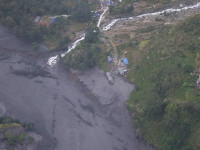
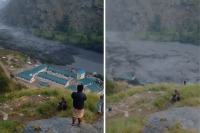
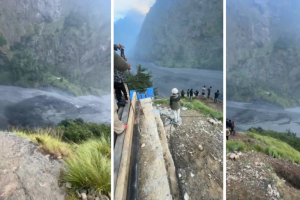
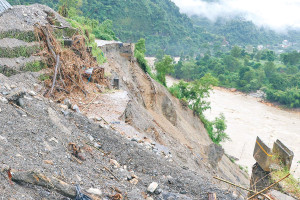
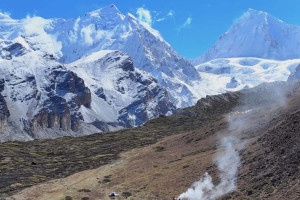
The government is preparing to present scientific evidence and data to establish the role of climate change in the devastation caused by the August 26 floods along the Bhotekoshi-Trishuli river system. A recent scientific assessment found that climate change likely contributed to the destabilisation of the glacier and rock formation on the Langtang Lirung peak that collapsed on August 26, although it was not ascertained as the sole cause.
The disaster has left at least 1,403 people dead in Nepal, according to the latest government figures, with 6,150 still missing. A preliminary government assessment estimated total damage and economic losses at Rs408 billion.
“I will be going to Doha, [for the] Asian Infrastructure Investment Bank. From then on, I think I will go to the United States—New York and Washington DC—to talk with the World Bank and the United Nations,” Wagle told the Indian news agency ANI.
However, Wagle told the Post that his visit to the United States has not yet been confirmed.
The annual meetings of the International Monetary Fund and the World Bank Group are scheduled to take place in Bangkok, Thailand, from October 12 to 18, and Wagle is planning to participate.
“In the middle of October, there’s the annual meeting of the Bretton Woods institutions in Bangkok, where I will be there,” Wagle said.
He said he would use these multilateral platforms to tell the story of Nepal’s climate-induced disaster and highlight how catastrophic events could become more frequent and intense as global temperatures rise.
Such disasters, the finance minister said, could have consequences not only for Nepal but also neighbouring countries, including India.
In Delhi, besides regular bilateral engagements, Wagle discussed the post-disaster reconstruction scenario with Indian ministers and sought possible Indian support for Nepal’s reconstruction efforts. The reconstruction process is expected to begin after the completion of the post-disaster needs assessment.
Given the scale and magnitude of the August 26 disaster, Wagle told ANI that Nepal needed to make the international community understand that the consequences of climate change were global and regional.
“So it’s a global menace. We felt it in Nepal, but the cause and the consequences are truly global and regional. I think this needs to be appreciated much more. I think that’s one purpose of these international visits that I will be undertaking,” he said.
Wagle said Prime Minister Shah would also travel to New York for the UN General Assembly and tell the international community what climate change means for poor and vulnerable countries such as Nepal.
“Our global greenhouse gas emissions are very little, but the consequences are being felt by the poor people of the country. So, this is how we intend to build up the narrative and seek assistance as well as solidarity,” Wagle said.
Foreign Ministry officials said climate change, climate crisis, adaptation, mitigation, scientific research, early-warning systems, cooperation among mountain countries, climate justice and loss-and-damage compensation would become major priorities of Nepal’s diplomacy.
“These will be the new diplomatic priorities in the days to come. In coordination and collaboration with other government agencies, we will lead climate negotiations and climate diplomacy,” a foreign ministry official said.
During his meetings with Indian External Affairs Minister S Jaishankar and Finance Minister Nirmala Sitharaman, Wagle said his first priority was to express Nepal’s gratitude to Prime Minister Narendra Modi, the Indian government and the Indian people for their support during the rescue and relief operations following the disaster.
“Our latest estimate is that around 1,400 people have perished, more than 5,000 are still missing, [and] close to 190 Indian nationals are also in that count. So it’s the ferocity of the crisis, this climate-induced crisis, that has touched many lives in South Asia but also globally,” Wagle told ANI.
“This is a shared story that we need to really tell the world—what caused this, what are the consequences, the livelihoods that have been uprooted, the massive physical and economic upheaval this has unleashed,” he said.
Wagle also addressed high-level policy dialogues in New Delhi with Indian business leaders and policymakers.
“Our immediate neighbours like India have stepped up as they did with the 2015 earthquake,” he said. “So I think the first point was around grappling with the enormity of this humanitarian crisis, this climate disaster.”
Wagle said the second priority was to communicate the scale of the damage and losses.
“The damage and loss estimates that we’ve conducted rapidly through the National Disaster Risk Reduction and Management Authority—those numbers have been vetted by the World Bank as well,” Wagle said.
He said the initial assessment put damage at around $2 billion, with additional economic losses of about $1 billion.
“But this is at replacement value. When we build back better, this is going to be in excess of $4.5 billion, $5 billion over a number of years. This will require a lot of international solidarity, international assistance, and we will count on Indian assistance, as Prime Minister Modi conveyed to our Prime Minister Balen Shah when they spoke on the telephone,” Wagle said.
“So it’s basically to cement some of these narratives, these threads, and begin this long process of seeking international solidarity and assistance,” he said.
Explaining why he chose India for his first international visit, Wagle said he wanted to begin in New Delhi because of Nepal’s close relationship with India and its immediate support following the disaster.
“I wanted my first international visit to begin from Delhi,” he said, adding that the pledges and support Nepal had received from the Indian finance and external affairs ministers would provide a basis for further cooperation.
“We’re truly grateful,” Wagle said. “I think we want to build on this as we move forward.”
Anil Giri is a Chief Sub Editor covering diplomacy, international relations and national politics for The Kathmandu Post. Giri has been working as a journalist for more than two decades, contributing to numerous national and international media outlets.




 25.89°C Kathmandu