



 22.94°C Kathmandu
.jpg)



Thu, Oct 22, 2026
Money
A flood of bad news leaves Nepal’s tourist hubs eerily quiet
Negative reports about the Bhotekoshi floods, road disruptions, and travel advisories have hit bookings in Pokhara, Chitwan and Lumbini just as the peak tourist season gets underway.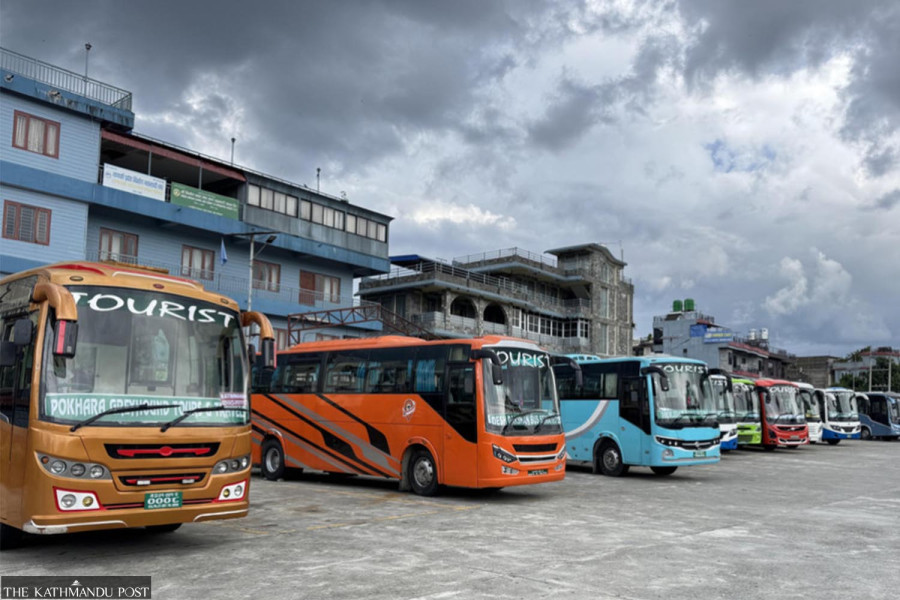
bookmark
Raju Chaudhary, Deepak Pariyar, Dipendra Baduwal & Manoj Paudel
Published at : September 8, 2026
Updated at : September 8, 2026 06:33
Chitwan/pokhara/bhairahawa/lumbini
The impact of the floods in the Bhotekoshi River is beginning to ripple through Nepal’s tourist industry, with hotels reporting a wave of cancellations just as the peak autumn tourist season gets underway.
Hotels in Pokhara, Chitwan and Lumbini say domestic and foreign tourists have cancelled their bookings following reports that have portrayed Nepal as unsafe in the wake of the August 26 disaster. Domestic travellers have also called off their plans because of difficult road conditions.
As a result, hotels in some of the country’s major tourist destinations are largely deserted during what is normally one of the busiest times of the year.
Sauraha in Chitwan, for instance, would be bustling with tourists at this time of year. This year, however, only a handful of tourists can be seen in the popular jungle destination. The Regional Hotel Association said hotel occupancy has fallen below 5 percent.
“There are hardly any tourists at the moment,” said Suman Ghimire, former president of the Regional Hotel Association Sauraha. “Hotel occupancy is below 5 percent.”
Ghimire’s Jungle Safari Lodge has 34 rooms. But after bookings were cancelled, most of the rooms are now empty, he said. Tourists have stopped travelling to Chitwan by road after the Krishnabhir section of the highway was washed away by floods.
Although the Bhotekoshi flood did not cause any damage in Chitwan, Ghimire said the destination was suffering because negative reports about Nepal had spread through travel advisories.
“There is no problem on the East-West Highway,” he said. “But tourism has been hit because reports have spread internationally portraying the situation in Nepal as disastrous.”
As alternatives to the damaged Mugling-Kathmandu section of the Prithvi Highway, the Hetauda-Kathmandu road, also known as the Kanti Lokpath, the Tribhuvan Highway and the Hetauda-Kulekhani road are operational. Tourists can use these routes to reach Chitwan. There is also no difficulty in reaching Chitwan by air from Kathmandu to Bharatpur.
Royal Tulip Chitwan Hotel, operated by KTM Hospitality, has 65 rooms. Rameshwar Sah, chairman of Royal Tulip, said 80 percent of bookings have been cancelled so far.
“The tourism sector has been severely hit by the floods,” Sah said. “Although the destinations themselves have not been affected by the floods, rumours and misleading reports about the situation have had a significant impact.”
Sauraha has 125 small and large hotels with a combined capacity to accommodate 8,000 tourists a day.
Gunaraj Thapaliya, vice-president of the Regional Hotel Association, said the impact was particularly visible in Sauraha.
“Except for a handful of Chinese tourists, there are no visitors in Sauraha at the moment,” he said.
Large hotels in Patihani and Meghauli are also waiting for tourists to return. At the Soaltee Westend Chitwan Resort in Patihani, Bharatpur, the number of guests has dropped sharply since the floods, said Choplal Pandey, general manager of the hotel.
“We are receiving messages from foreign tourists cancelling their bookings one after another,” he said. “Forty percent of bookings have already been cancelled. We became more concerned when guests also began cancelling bookings made through November.”
Pokhara, the tourist city in Kaski district, has also not escaped the impact.
Hari Bhujel, chairman of the Tourism Council, said the Bhotekoshi floods and damage to the Prithvi Highway at Krishnabhir have added to the challenges facing tourism in Pokhara.
“The tourist season for foreign visitors has begun,” he said. “But up to 30 percent of hotel bookings have been cancelled at present.”
He said the closure of the Prithvi Highway, increased airfares, inadequate flights between Pokhara and Kathmandu and the continued charging of dollar-denominated fares to foreign tourists have directly affected tourism in Pokhara.
The damage at Krishnabhir has also affected the arrival of Indian tourists travelling from Sunauli to Pokhara, then to Muktinath and on to Pashupatinath, he said.
“With the recent increase in fuel prices making airfares more expensive, the arrival of domestic tourists is also expected to decline,” he said. “However, it is necessary to convey the message to foreign tourists that destinations other than the areas affected by the floods are safe.”
Lumbini, the birthplace of Buddha, has also begun to see fewer tourists.
Lilamani Sharma, president of the Lumbini Hotel Association, said foreign tourists travelling to Lumbini via Kathmandu have been cancelling their hotel bookings. Bookings made for the main October-November season are also being cancelled, he said.
He said bookings were being cancelled because information was being circulated abroad in a way that made it appear that Nepal as a whole had been affected by the floods.
“The problem travelling to and from Kathmandu is because one or two sections of the Mugling-Kathmandu road have been damaged,” he said. “Even that situation is gradually improving.”
Khim Shrestha, operator of Hotel Suramma in Lumbini, said the government should take the initiative to communicate through foreign diplomatic missions in Nepal and international media that the situation in the country is improving and that Nepal is eager to welcome foreign visitors.
Bhavishwar Adhikari, operational manager of Hotel Hokke, a four-star boutique hotel in Lumbini, said 100 room-nights booked on various dates over a two-month period have been cancelled. He said the tourism sector would be badly affected if the government failed to immediately communicate internationally that the situation in the country was normal.
Prakash Bhattarai, operator of Shakya Guest House, said the problem was being compounded by the failure to communicate accurate information.
“One or two problems seen on the roads should not be exaggerated,” he said. “The local and federal governments should prioritise both information dissemination and repair and maintenance work to revive the tourism sector.”
Chandra Prakash Shrestha, president of Hotel Association Nepal’s Lumbini Province chapter, said Indian tourists arriving on package tours through border points such as Belahiya to visit various destinations have also been affected.
Indian tourists come to visit religious sites in the high Himalayan region. Following reports that the Himalayan region had been devastated by floods, they are understood to have cancelled their bookings.
Although tourists continue to visit border towns and nearby destinations for short stays, Shrestha said there had been a sharp decline in tourists travelling on package tours.
The tourist bus park at Mustang Chowk in Pokhara, which normally sees a steady flow of passengers from morning until night, is now deserted.
Twenty-four buses used to leave the bus park for Kathmandu in the morning and eight at night.
According to Buddhi Sagar Paudel, an employee at the Mustang Chowk branch of Prithvi Highway Bus Operators Company, 14 tourist buses used to leave from Prithvi Chowk, eight from Lamachaur, two from Hemja and two from Zero Kilometre.
At present, only tourist buses travelling to Chitwan and Lumbini are operating.
The Nepal Association of Tour and Travel Agents (NATTA) Gandaki also inspected an alternative route to bypass Krishnabhir on Saturday.
Sangita Paudel, president of NATTA Gandaki, said the association studied a route that involves crossing a suspension bridge from Krishnabhir to reach Jyāmire on the opposite side and then travelling 11 kilometres to reach Benighat.
“A diversion is currently being constructed at Krishnabhir and it is expected to come into operation within a week,” Paudel said. “But it is uncertain how long it will remain operational. If it cannot operate for a long period, the Jyamire-Benighat route could serve as an alternative.”
She said an alternative was being sought because large vehicles cannot travel along the Tribhuvan Highway from Hetauda to Naubise. The disruption to tourist vehicles has directly affected nearly 1,000 business operators and workers, Paudel said.
Meanwhile, the Lumbini Development Trust has said Lumbini, the birthplace of peace, remains completely safe and open despite the difficult situation in the country caused by the Bhotekoshi floods.
In a statement issued on Sunday, the trust said Lumbini had not been affected by the floods or the disaster and that, at a time when people were engaged in relief, rescue and assistance efforts, the Buddhist values of compassion, loving-kindness and harmony remained equally relevant. Visiting Lumbini, it said, could be meaningful for those seeking a sense of peace and spiritual energy.
“The recent floods have not affected the greater Lumbini area,” said Himal Upreti, acting member-secretary of the Lumbini Development Trust. “Lumbini, Kapilvastu, Devdaha, Ramgram and other major tourist destinations remain open to visitors.”
“The Bhotekoshi flood has created a negative message that the entire country is experiencing fear and hardship,” he said. “That is why we have to reassure the international community that Lumbini is safe and accessible.”
Deepak Pariyar
Deepak Pariyar is the Kaski correspondent for Kantipur Publications.
Manoj Paudel
Manoj Paudel is the Kapilvastu correspondent for Kantipur Publications.

Most Read from Money
Nepal travel agents threaten to stop selling Thailand trips over visa rules

Why does an hour long flight to Dhangadhi cost more than a flight to New Delhi?
Malaysia rejects Nepal’s demand to open recruitment to all manpower agencies

No school, but a graduation cap for women dairy farmers
Nepal arrests four medical service providers as Malaysia recruitment row deepens
Editor's Picks




E-PAPER | October 22, 2026

×