



 18.82°C Kathmandu
Mon, Oct 19, 2026
Money
LPG crisis deepens in Kathmandu, restaurants on the brink
Consumers spend hours searching for cylinders as the closure of the Mugling-Naubise road disrupts supplies. Restaurants warn they may be forced to shut if the shortage persists.
bookmark![]()
Nepal Oil Corporation, in a press statement issued on Sunday, said that until the Prithvi Highway resumes, LPG cylinders would be supplied after being refilled at plants in Tarai districts and transported to Kathmandu through alternative routes. Photo: Nepal Photo Library
Krishana Prasain
Published at : September 6, 2026
Updated at : September 6, 2026 22:22
Kathmandu
The cooking gas shortage has deepened in the Kathmandu Valley, with consumers saying they are being forced to return empty-handed despite queuing for hours for a cylinder.
The shortage has also pushed restaurants and small eateries to the brink of closure, as an already uncertain supply of liquefied petroleum gas has become increasingly difficult to manage.
The scarcity follows the closure of the Krishnabhir section of the Mugling-Naubise road along the Prithvi Highway, the main supply route to Kathmandu Valley. The disruption has severely affected the movement of essential goods into the capital.
Amid the shortage, LPG refilling plant operators have raised the price by Rs100 to Rs105 per cylinder, saying the cost of transporting cooking gas through alternative routes has increased.The official price of a refilled cylinder, in exchange for an empty one, is Rs2,060.
Consumer rights activists, however, have expressed concern over the price increase at a time when households are already struggling to secure cylinders.
On Saturday, Nagendra Sah, managing director of Nepal Oil Corporation, came under public criticism after he said that cooking gas was still cheaper than a kilogramme of mutton.
Consumer rights activists and restaurant operators said the remark was insensitive and argued that the state-owned supply utility should be focused on ensuring uninterrupted supplies rather than making comparisons with the price of other commodities.
Manisha Bhurtel, who works at a clothing store in the Pepsicola area, has been trying to obtain a cylinder for a month. She visits a nearby cooking gas depot almost every day.
“I am getting more anxious every day. I don’t even have an electric stove,” said Bhurtel, who lives with her family of three in a rented room.
“I have two children and a grandmother. I am worried about feeding my family,” she said.
Amrit Bhusal bought an electric stove a few months ago when it became increasingly difficult to get cooking gas.
“We were managing to prepare meals using an electric stove and LPG. Relying solely on an electric stove is not a solution as electricity is also not regular,” said Bhusal, who lives in a rented room in Imadol.
“I have two cylinders and both are empty. I have been searching for at least one cylinder for five days,” he said.
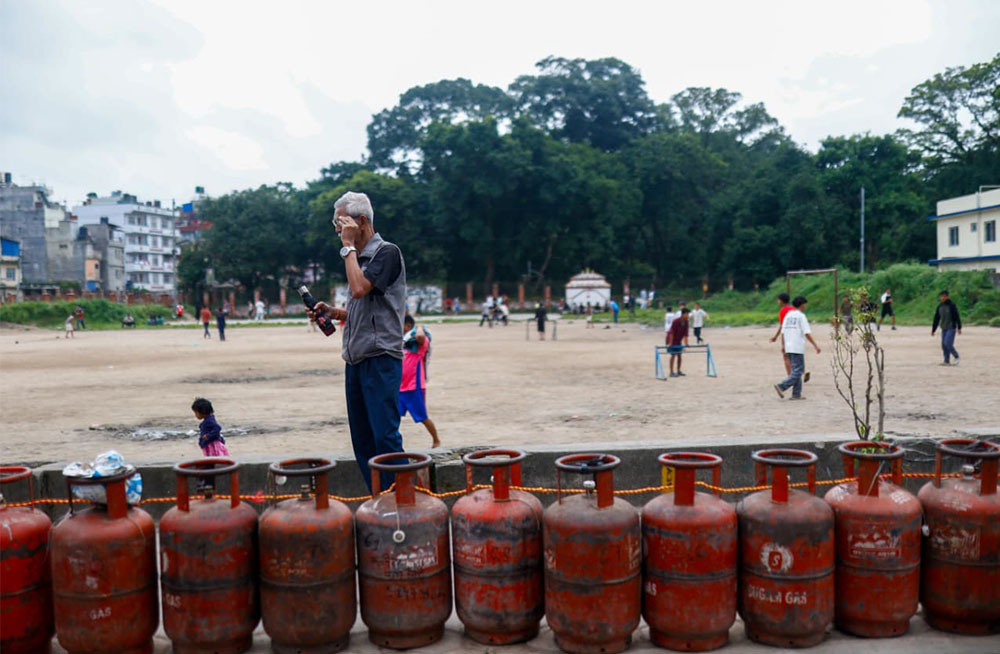
With the Teej festival approaching and relatives expected to visit, Bhusal said he was worried about how his family would manage the preparations.
“It is difficult to know how we will manage the festive preparations,” he said.
The shortage is also hitting restaurants hard.
Restaurant owners said they are on the verge of shutting down their businesses because they could not count on a regular supply of cooking gas. Nepal Oil Corporation last week said it would prioritise the distribution of LPG cylinders to household consumers.
“The dealers have stopped supplying cooking gas. The government has told us to arrange it ourselves, but that is not easy. The transportation costs are too high,” said an official at Bagaicha Restaurant, which operates multiple outlets in the Kathmandu Valley.
“There is no option other than shutting the business if the situation persists for a few more days,” the official said.
Suroj Raj Rajkarnikar, proprietor of Ghangri Café at Jhamsikhel, said his restaurant had only around two cylinders left in stock.
“The dealer from whom we used to get cylinders has stopped supplying,” he said.
Rajkarnikar said his restaurant requires about two cylinders a day.
Bishnu Prasad Dulal, senior vice-president of the Federation of Nepal Gas Distributors, said the LPG supply situation in the Kathmandu Valley would not ease until the Krishnabhir road section reopens.
The road section on the Prithvi Highway has remained closed since last Sunday, disrupting supplies to the valley and pushing up the prices of various goods as the gap between demand and supply widens.
“LPG bottling plants in the Kathmandu Valley are not able to provide sufficient cylinders. The supply is only 5 percent of the total daily demand of 35,000 to 40,000 cylinders. We are struggling,” Dulal said.
Nepal Oil Corporation, in a press statement issued on Sunday, said that until the Prithvi Highway resumes, LPG cylinders would be supplied after being refilled at plants in Tarai districts and transported to Kathmandu through alternative routes.
According to the corporation, 24,494 LPG cylinders of different brands arrived in the Kathmandu Valley through alternative routes last Thursday after being refilled at plants in various Tarai districts. The number increased to 34,134 cylinders on Friday and 29,249 on Saturday.
Despite the alternative arrangements, consumers and businesses say the supplies remain inadequate to meet normal demand in the capital.
Krishana Prasain
Krishana Prasain is a business reporter for The Kathmandu Post covering markets. Before joining The Kathmandu Post in 2018, she spent 3 years in New Business Age magazine covering business.


Most Read from Money
Nepal travel agents threaten to stop selling Thailand trips over visa rules

Why does an hour long flight to Dhangadhi cost more than a flight to New Delhi?
Malaysia rejects Nepal’s demand to open recruitment to all manpower agencies

No school, but a graduation cap for women dairy farmers
Nepal arrests four medical service providers as Malaysia recruitment row deepens
Editor's Picks




E-PAPER | October 19, 2026

×