Nepal updates water tank standards to keep up with new manufacturing technology
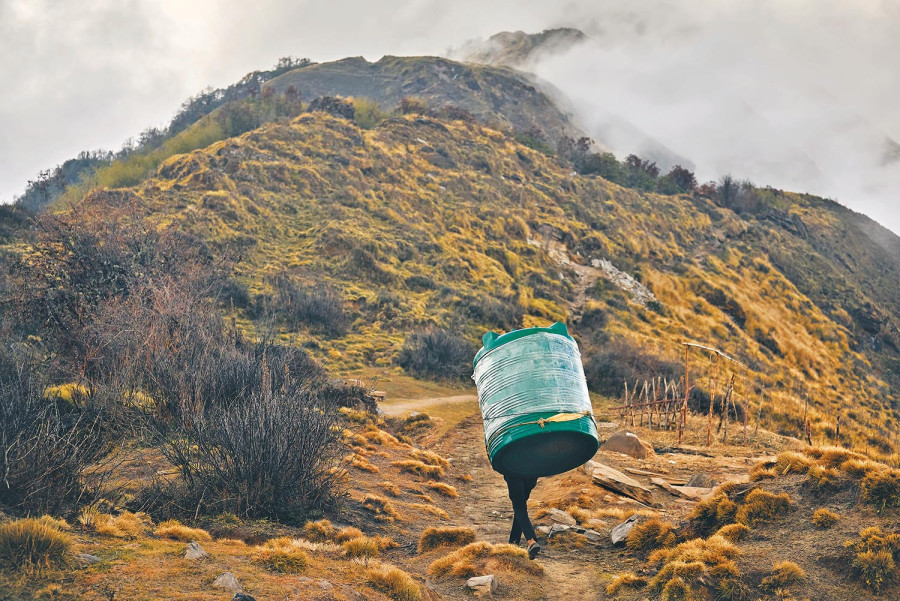
Revised draft sets stricter quality, material and testing requirements for polyethylene water storage tanks, while manufacturers urge the government to make compliance mandatory. Shutterstock
With the use of household water storage tanks rising across Nepal and growing concerns over product quality, the Nepal Bureau of Standards and Metrology (NBSM) has revised and proposed new standards for rotational moulded polyethylene water storage tanks.
The existing standard, first introduced in 1995, is voluntary. Only manufacturers that obtain the Nepal Standards (NS) certification are required to comply with its specifications.
"Microplastics and nanoplastics can leach into stored water when plastic tanks degrade due to prolonged exposure to heat and sunlight, particularly if they are not manufactured according to Nepal Standards," said Anil Shakya, director at the Nepal Bureau of Standards and Metrology.
"The revised standard has been prepared to ensure consumers have access to safe drinking water and are not deceived by substandard products," he said.
A key feature of the revised standard is the inclusion of a migration test, which determines whether plastic particles can leach from the tank material into stored water during use.
A microplastic migration test evaluates the amount of micro- and nano-sized plastic particles released from a water tank by exposing the material to distilled water or a food simulant under specified temperature and time conditions before analysing the liquid for plastic particles.
The bureau conducts the test during the manufacturing process for companies seeking Nepal Standard certification. Manufacturers are also required to carry out the prescribed tests during production, while the bureau conducts market surveillance by collecting samples from factories and retail outlets.
Polyethylene water storage tanks are not currently covered under Nepal's mandatory certification system, allowing manufacturers to produce and sell them without complying with the Nepal Standards.
To update the nearly three-decade-old specifications, the bureau formed a committee comprising representatives from its technical divisions, engineering campuses and water tank manufacturers.
"The proposed revised standard specifies that the density of polyethylene used in water tanks should range between 932 and 943 kg per cubic metre," said Shakya.
According to the draft, water tanks intended for outdoor use must be manufactured from carbon black compounded polyethylene. The carbon black content must range between 2 and 3 percent, while its dispersion must meet the testing procedures prescribed under the Nepal Standards.
The draft also allows manufacturers to use no more than 10 percent of their own reworked material generated during the production of tanks made under the same standard. However, it prohibits the use of recycled plastic waste or reprocessed material from any other source, as well as fillers, in the manufacturing process.
The polyethylene resin used to manufacture water tanks must be rotational moulding grade and stabilised with antioxidants. The antioxidants, which must not exceed 0.3 percent of the finished resin by mass, should be physiologically harmless and selected from the list approved under the Nepal Standards.
The proposed standard further requires that the tank body, lid and fittings that come into contact with water must not impart any taste, colour or odour to the water, nor have any toxic effects that could make it unsafe for consumption.
The draft allows manufacturers to produce single-layer or double-layer rotational moulded polyethylene tanks. For double-layer tanks, the inner layer must be white, while the outer layer must be black and account for at least 50 percent of the total wall thickness.
"The white inner layer makes it easier for consumers to see whether the stored water is clean or contaminated," said Shakya.
The revised draft also incorporates five internationally recognised testing methods that manufacturers will be required to follow to ensure product quality and safety.
Manufacturers have welcomed the revision, saying the previous standard no longer reflected advances in production technology and quality requirements.
"We had long urged the government to update the standard, and now the revision is in its final stage," said Pulkit Jain, director of Hilltake Group, which manufactures polyethylene water tanks.
Jain said his company has been producing water tanks in accordance with the Nepal Standards and supports the proposed revisions.
He also argued that compliance should no longer remain voluntary because of the direct implications for public health.
"Most households consume water stored in plastic tanks, so the government should make the standard mandatory," he said. "Many consumers are purchasing water tanks that do not carry the Nepal Standards certification and are of poor quality."
According to the bureau, eight manufacturers had obtained the NS certification for polyethylene water storage tanks as of mid-April.
They include Hilltake Industries of Morang, Kishan Pipe Products of Nawalparasi, Dakshinkali Plastic Industries of Jhapa, Nawa Nepal Plastic Industries of Rupandehi, Rijalco Polytank Industries of Sunsari, Om Panchapuri Industries of Banke, Nepal Sintex Industries of Chitwan and Gyani Poly Tank Industries of Rupandehi.
Krishana Prasain is a business reporter for The Kathmandu Post covering markets. Before joining The Kathmandu Post in 2018, she spent 3 years in New Business Age magazine covering business.




 15.26°C Kathmandu