



 16.79°C Kathmandu

Thu, Oct 22, 2026
Money
Supreme Court seeks government’s explanation over stalled probe into Nepal Airlines’ Chinese aircraft deal
Bench orders government agencies to explain why no investigation has been launched into the controversial procurement of six Chinese aircraft, despite billions in public losses and years of failed operations.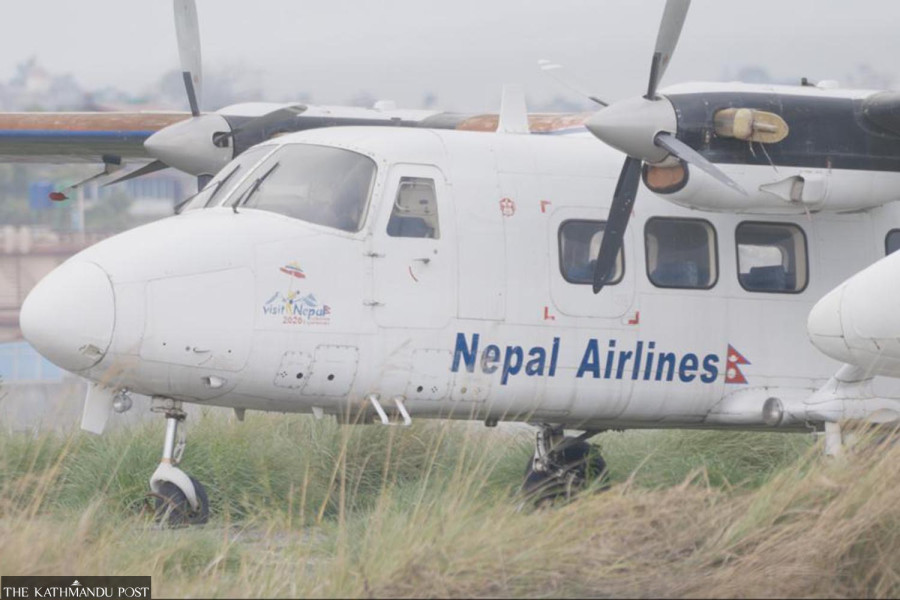
bookmark
Sangam Prasain
Published at : June 30, 2026
Updated at : June 30, 2026 18:19
Kathmandu
Nepal’s Supreme Court has ordered the government to explain why the controversial procurement and operation of Chinese aircraft by Nepal Airlines has never been investigated, nearly a decade and a half after the acquisition process began despite billions of rupees in public losses.
The June 26 order, which came in response to a petition filed a day before, has revived scrutiny of one of Nepal’s most controversial aviation procurement decisions—the purchase of six Chinese-built aircraft that were expected to transform air connectivity, particularly to remote mountain regions but instead became a costly financial burden for the national flag carrier.
The six aircraft—four 17-seater Y12E planes and two 56-seater MA60 turboprops—were once projected as the beginning of a new chapter for Nepal Airlines. The corporation even abandoned its traditional red-and-blue striped livery in favour of a more modern design as it prepared to introduce the new fleet.
But the optimism was short-lived.
The aircraft spent more time on the ground than in the air. Nepal Airlines permanently grounded its five remaining Chinese-made aircraft in July 2020 after concluding that soaring operating costs, high fuel consumption, expensive spare parts and poor commercial performance had made them financially unsustainable. One of the six aircraft had suffered a runway excursion in March 2020 at Nepalgunj airport.
Since then, the national carrier has repeatedly failed to lease or sell the planes while continuing to spend millions of rupees annually on maintenance, parking and preservation.
Purchased between 2014 and 2018 through a combination of Chinese grants and concessional loans worth Rs6.66 billion, the aircraft have remained parked at Tribhuvan International Airport, steadily depreciating while generating no revenue.
Bhesh Raj Luintel, a chartered accountant and public-interest activist, filed a writ petition at the Supreme Court on June 25 demanding a comprehensive investigation into the procurement process, arguing that the deal has inflicted billions of rupees in losses on the state.
The Office of the Prime Minister and Council of Ministers, the Commission for Investigation of Abuse of Authority (CIAA), the Ministry of Culture, Tourism and Civil Aviation, the Ministry of Finance and Nepal Airlines Corporation have all been named as defendants.
On June 26, a single bench of Supreme Court Justice Bal Krishna Dhakal issued a show-cause order directing the defendants to explain why no investigation had been initiated. The court also granted the case "legal priority", allowing it to proceed more quickly than ordinary cases.
“As cases of this nature often take years to conclude, I requested legal priority, and the court granted it,” Luintel told the Post.
“Once the court receives written responses from all the defendants, hearings on the merits of the case will begin.”
In the petition, Luintel argues that the feasibility study, technical evaluation and financial analysis conducted before Nepal Airlines purchased the Chinese aircraft proved to be fundamentally flawed, leading to massive public losses.
“Although complaints regarding this matter have repeatedly been submitted to the anti-graft body and other concerned agencies, no effective investigation, determination of responsibility or legal action has been taken to date,” Luintel said.
“Since there is no other effective legal remedy available to establish accountability for the loss of public property and initiate legal action against those involved in the study, recommendation and decision-making process, I was compelled to approach the Supreme Court.”
According to the petition, the feasibility study prepared before the procurement concluded that the aircraft were technically suitable and financially viable for Nepal's operating environment, and that assessment became the basis for the purchase.
However, actual operations produced the opposite outcome. The aircraft proved commercially unviable, operationally inefficient and practically unsuitable for Nepal Airlines, placing billions of rupees of public investment at risk.
The petition argues that the procurement of the MA60 and Y12e aircraft represents far more than a failed commercial venture. It has become a major issue involving the protection of public assets, institutional accountability and good governance.
A copy of the writ obtained by the Post raises a series of unanswered questions that, according to the petitioner, have never been addressed by the government.
When internationally proven aircraft with established commercial records were readily available, why were these Chinese-made aircraft selected instead? Who concluded that they were suitable for Nepal's geography, weather conditions, route network and market demand, and on what basis? What role did the officials and institutions responsible for preparing the feasibility study play in the procurement process?
The petition further questions why no officials have been held accountable after it became evident within a short period that the aircraft could not perform as expected and were financially unsustainable.
It also asks why aircraft that have remained unused for years continue to incur public expenditure on maintenance, security, storage and parking, and who should ultimately bear responsibility for the direct and indirect losses amounting to billions of rupees.
This is not the first legal challenge against the aircraft purchase.
In 2014, Krishna Prasad Dahal of Okhaldhunga filed a separate writ petition challenging the government's decision to procure the six Chinese aircraft.
Dahal argued that the government had failed to comply with procedures prescribed by the Public Procurement Act. He claimed that four of the six aircraft had been purchased without an international competitive bidding process, raising concerns over whether the prices were inflated and whether the deal would impose an unnecessary financial burden on the state.
The procurement process had begun years earlier.
On August 7, 2011, Nepal Airlines wrote to the Ministry of Finance requesting assistance to acquire eight aircraft through foreign grants.
In November that year, the ministry formally requested the Chinese government to provide aircraft either as grants or through concessional loans. China responded positively, expressing its willingness to provide some aircraft as grants and the remainder through soft loans.
In December 2011, the Chinese government informed Nepal that it would provide three aircraft under grant assistance and the remaining aircraft under concessional loans. The grant component was later revised from three aircraft to two.
On November 29, 2012, Nepal Airlines signed a commercial agreement with AVIC International Holdings, a Chinese state-owned enterprise, to procure six aircraft.
Under the final arrangement, China extended assistance worth 408 million Chinese yuan, equivalent to around Rs6.67 billion.
The grant component, valued at 180 million yuan (Rs2.94 billion), financed one 56-seat MA60 aircraft and one 17-seat Y12e aircraft. The remaining 228 million yuan (Rs3.72 billion) was provided as a concessional loan to purchase one additional MA60 aircraft and three Y12e aircraft.
The Y12e is a twin-engine turboprop utility aircraft manufactured by Harbin Aircraft Industry Group, formerly Harbin Aircraft Manufacturing Corporation.
The MA60 is a 56-seat turboprop airliner produced by Xi'an Aircraft Industrial Corporation.
Both manufacturers are subsidiaries of AVIC.
Operational problems emerged almost immediately after the first batch of aircraft arrived in Kathmandu under the grant programme in 2014.
The aircraft remained grounded for months because Nepal Airlines lacked trained pilots, instructor pilots, qualified maintenance engineers and an adequate supply of spare parts.
The difficulties delayed delivery of the remaining aircraft for several years.
The second batch, consisting of one MA60 and one Y12e, finally arrived in January 2017, while the final two Y12E aircraft were delivered in February 2018.
Despite eventually receiving all six aircraft, Nepal Airlines never managed to operate them successfully on a sustained commercial basis.
In 2023, the airline decided to dispose of the Chinese fleet, which insiders described as having become "an albatross around its neck."
Aviation Asset Management Inc., an independent American firm hired to assess the aircraft, valued the five remaining planes at around Rs220 million—only a fraction of their original acquisition cost—in what insiders described as a liquidation valuation designed to facilitate a quick sale.
However, fearing scrutiny from the anti-graft agency over selling aircraft at what amounted to scrap value, Nepal Airlines refrained from issuing a tender based on that valuation. Instead, it commissioned another assessment. Even after multiple attempts, the airline has failed to find buyers for the aircraft.
Luintel said the continued inaction of government agencies and the anti-graft body, despite mounting evidence of enormous financial losses, possible policy-level corruption and serious negligence in public decision-making, raises fundamental questions about governance and accountability.
“If investigations, accountability and legal action are not pursued even after public property has suffered losses of billions of rupees, what remains of the constitutional commitment to the rule of law, public accountability and corruption control?” Luintel said.
“An impartial, independent and comprehensive investigation into all these questions has now become indispensable in the public interest and for upholding the rule of law.”
Given the gravity of the issues involved, the continuing financial losses and the broader public importance of the case, Luintel requested the court to hear the petition on a priority basis.
“It is respectfully requested that this writ petition be accorded priority and that an early hearing and decision be granted,” the petition states.
Sangam Prasain
Sangam Prasain is Business Editor at The Kathmandu Post, covering tourism, agriculture, mountaineering, aviation, infrastructure and other economic affairs. He joined The Kathmandu Post in October 2009.


Most Read from Money
Nepal travel agents threaten to stop selling Thailand trips over visa rules

Why does an hour long flight to Dhangadhi cost more than a flight to New Delhi?
Malaysia rejects Nepal’s demand to open recruitment to all manpower agencies

No school, but a graduation cap for women dairy farmers
Nepal arrests four medical service providers as Malaysia recruitment row deepens
Editor's Picks




E-PAPER | October 22, 2026

×