



 22.11°C Kathmandu

Mon, Oct 19, 2026
Money
Trouble not over for Nepal Airlines, despite revenue growth
Revenue reached an estimated Rs23.4 billion last fiscal year, but expenses may have exceeded it by Rs1 billion, contrary to the prime minister’s upbeat assessment.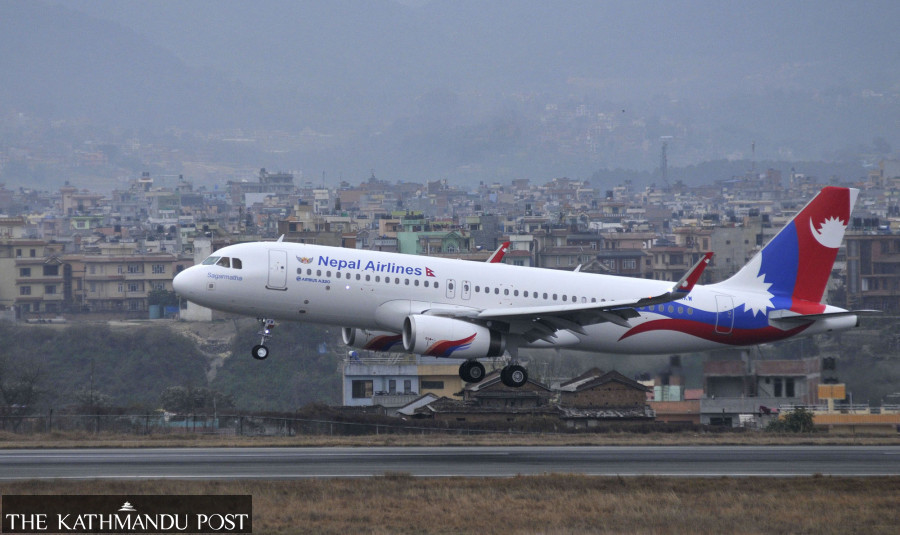
bookmark
Suraj Kunwar
Published at : August 14, 2026
Updated at : August 15, 2026 07:09
Kathmandu
Prime Minister Balendra Shah recently highlighted what he called encouraging signs of recovery at the national flag carrier, Nepal Airlines Corporation.
In a social media post, Shah said the airline had generated Rs6.27 billion in revenue in just four months, achieved an 86 percent occupancy rate and repaid Rs1.06 billion in loan instalments.
But the airline’s own preliminary annual figures paint a not-so-rosy picture.
Nepal Airlines (NAC) estimates that it generated around Rs23.40 billion in revenue in the last fiscal year, while its gross expenses may reach Rs24.40 billion. That would leave the airline with a deficit of about Rs1 billion for the year, despite the increase in revenue.
The corporation has yet to compile its final financial statements. Archana Khadka, the NAC’s corporate director and spokesperson, said income and expenditure figures from several stations were still being compiled. The preliminary figures should therefore not be treated as final, she said, adding that both revenue and expenses could rise once the accounting is completed.
Even so, the preliminary figures indicate that the NAC’s revenue in the fiscal year 2025-26 rose by about 12.5 percent from roughly Rs20.50 billion the previous year. The increase suggests that the airline is getting more business, but its inability to tame expenses continues to undermine its finances.
The NAC had set a far more ambitious target in its budget for the last fiscal year. It projected a total revenue of Rs37.85 billion against an expenditure of Rs37.72 billion, with an expected surplus of about Rs125 million. The preliminary actual revenue is therefore substantially below the budget target.
Ground handling remains a key revenue source
Ground handling remains one of the NAC’s most important sources of income. The airline estimates that it earned around Rs5.71 billion from the service in the last fiscal year, up from about Rs5.04 billion the previous year.
Khadka said the number of international flights had fallen temporarily because of the West Asian conflict, but the impact did not last long. Revenue from ground handling has since increased as more international airlines have begun operating in Nepal, she said.
Around 30 international airlines currently fly to Kathmandu. The NAC provides ground-handling services to most international carriers at the Tribhuvan International Airport, with the exception of Air India.
The corporation had budgeted a Rs7.92 billion ground-handling revenue for the fiscal year. The preliminary actual figure, however, is well below that target.
The latest data shows that while the NAC has managed to expand revenue, it has struggled to keep expenditure under control. The problem is not new. The airline has increased its income in recent years, but repayments on its loans, interest costs, aircraft maintenance and operating expenses have continued to weigh heavily on its balance sheet.
According to the Office of the Auditor General, NAC’s total revenue rose from Rs9.46 billion in the fiscal year 2020-21 to Rs24.21 billion in 2022-23. Despite that growth, the corporation has continued to post losses. It recorded a loss of around Rs1.51 billion in the fiscal year 2023-24, according to the auditor general’s report.
Debt remains NAC’s biggest problem
NAC’s biggest financial burden is its debt.
The corporation borrowed from the Employees Provident Fund and the Citizen Investment Trust to purchase four Airbus aircraft. Repayment of the principal and interest on those loans has become a major strain on the airline’s finances.
According to NAC records, it has so far repaid Rs16.54 billion on the loans taken to purchase the four aircraft. Its preliminary records show that about Rs46.22 billion in liabilities related to those loans remains outstanding. Including other borrowings, NAC’s total debt is estimated at around Rs51 billion.
Khadka said there are some discrepancies between the debt figures maintained by the NAC and those recorded by the lending institutions.
The airline is seeking to reduce its interest burden and restructure its debt, said executive chairman Maheshwor Bhakta Shrestha. NAC is also exploring the possibility of replacing some of its expensive borrowing with loans carrying lower interest rates.
Shrestha said discussions had already been held with the Employees Provident Fund and the Citizen Investment Trust.
The airline borrowed Rs34 billion from the two institutions to purchase the four Airbus planes. It has been paying interest rates of as much as 10.5 percent on those loans. The corporation had projected financial expenses of around Rs4.10 billion for the fiscal year 2025-26 alone.
The corporation believes that reducing its interest burden would narrow the gap between its operating revenue and expenditure and provide some room for financial recovery.
A fleet too small to support expansion
NAC’s operating capacity is also constrained by the condition of its fleet.
The corporation has 11 aircraft, including five Chinese-made planes. Only six are currently operational: two Twin Otters, two narrow-body aircraft and two wide-body aircraft.
Several aircraft have remained grounded for extended periods, limiting the airline’s ability to expand services and make full use of its fleet.
The carrier has repeatedly identified fleet expansion as necessary for increasing both domestic and international services. Its programme for the fiscal year 2025-26 included plans to add narrow-body craft for international routes and study the possibility of leasing aircraft where necessary.
Those plans, however, did not move forward.
Under its budget projections, the NAC planned to operate 2,520 international flights using two Airbus A330s and two A320s and carry more than 865,000 passengers. For domestic services, it had planned 5,174 flights using two Twin Otters.
The airline’s failure to expand its fleet while some existing aircraft remain grounded has limited its ability to increase revenue, even as demand for air travel grows.
The NAC management nevertheless argues that the recent increase in revenue is a positive sign.
Khadka said the income growth should be viewed as an encouraging development. But a sustained financial turnaround will require more than higher revenue, Shrestha said.
The new management is seeking to pursue three objectives simultaneously: increase revenue, control operating costs and reduce the cost of servicing NAC’s debt.
For an airline carrying around Rs51 billion in debt and operating only six of its 11 aircraft, that will be a considerably harder task than the recent rise in revenue figures alone might suggest.
Suraj Kunwar
Suraj Kunwar is a senior correspondent with over two decades experience covering Aviation, Tourism and Mountaineering. He received the IFJ Tolerance Award in 2005.




Most Read from Money

Nepal travel agents threaten to stop selling Thailand trips over visa rules

Why does an hour long flight to Dhangadhi cost more than a flight to New Delhi?

Malaysia rejects Nepal’s demand to open recruitment to all manpower agencies

No school, but a graduation cap for women dairy farmers

Nepal arrests four medical service providers as Malaysia recruitment row deepens
Editor's Picks




E-PAPER | October 19, 2026

×