Flood-hit women entrepreneurs determined to rebuild their businesses
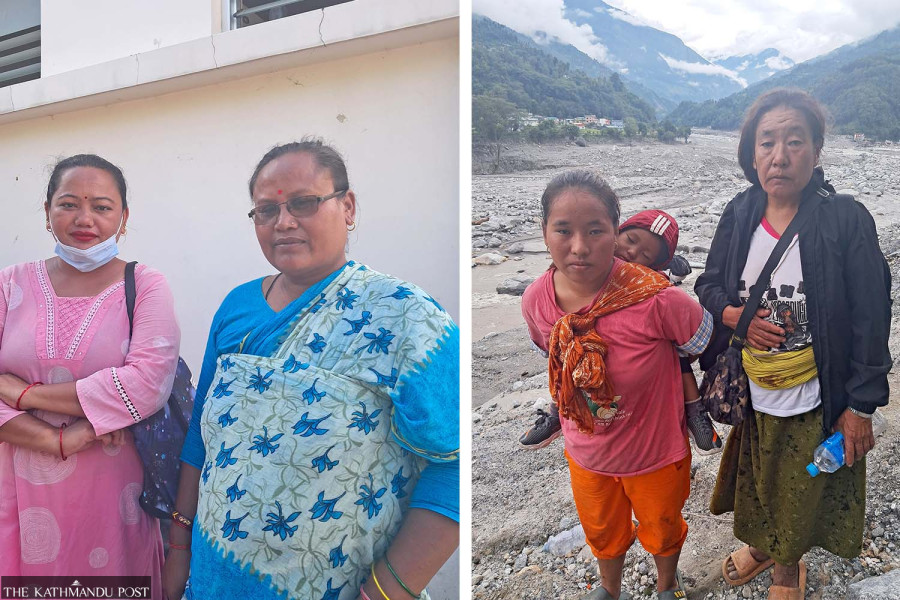
With family members dead or missing, many women see the need to rise up and find work to support their children and remaining ones. Januka Mijar ran a shop selling madal drums in Bidur, Nuwakot; Premgeeta Kumari Tharu operated a motor parts shop and a garage in Bidur; Nangtang Gyalmo Tamang and her daughter, Ranju, ran shops in Bidur. The August 26 floods swept away their businesses and belongings. Aarya Chand/TKP
For 22 years, Januka Mijar ran ‘Jasmina Madal Pasal’ on the banks of Dhobikhola in Bidur Municipality, Nuwakot. She started the shop with a small room and little capital, and gradually made madal, a folk musical instrument, the source of her family’s income.
The first five or six years went to accumulating materials and setting up the shop. Gradually, business grew. The Mijar couple supported their family, including a son and a daughter, with their business.
On the morning of August 26, Januka arrived at her shop as usual. She had 62 madals ready to send to Kathmandu. She began packing them. Her husband had gone across the Trishuli river to collect hide, a raw material for madal.
Then police began announcing over loudspeakers that the river was flooding.
Januka looked outside. The river was flowing as usual. Unmoved, she returned to work.
“Then my sister-in-law started shouting, ‘Run, run!’ She told me, ‘You will die, come up quickly.’ Only then did I leave the madals and run towards higher ground,” Januka recalled her response as waves came crashing down the Trishuli river.
There was a sudden explosion-like sound. The old concrete bridge was swept away. “As we ran, it felt as if the river was chasing us. When the water hit my feet, my legs started shaking,” Januka shared.
“When I finally reached the higher ground and looked back, I saw the three-and-a-half-storey building where my shop was being carried away. Twenty-two years of hard work disappeared into the river in two minutes. I survived by two seconds.”
The 62 madals and raw materials were swept into the Trishuli. Including cash and jewellery, Januka estimates her loss at more than Rs1 million to Rs1.5 million.
“Everything I had built over 22 years was washed away. The flood brought us down to zero,” she said. “I keep telling myself that I have to live and raise my children. Neither my stomach nor my circumstances allow me to sit idle.”
As many as 1,451 people, including foreign tourists and pilgrims, have been confirmed dead and more than 5,700 people are missing in the August 26 flashflood triggered by a glacial collapse in Nepal’s Langtang Lirung peak. Mud and debris flow devastated riverside communities in Rasuwa, Nuwakot and Dhading districts in the matter of hours.
The government has announced a monthly housing allowance of Rs15,000 for displaced families who lost permanent homes and choose to rent a room or house rather than stay in government holding centres. But there is no clear arrangement for people like Januka, who rented commercial space or ran small businesses from rented rooms.
Market places such as Devighat, Trishuli Bazar, Dhunge, Sole, Tupche, Bhainse and Betrawati in Nuwakot stand heavily damaged. Many of those marketplaces had attracted a significant number of traders from other districts and villages in the upper regions. They are now going from ward offices, the District Administration Office and the Cottage and Small Industries Office to register details of their losses.
Some women who lost family members, homes, businesses and property have been forced to take shelter in holding centres. They share their readiness to work hard if necessary to feed their children. There is little likelihood of resuming their original businesses immediately.
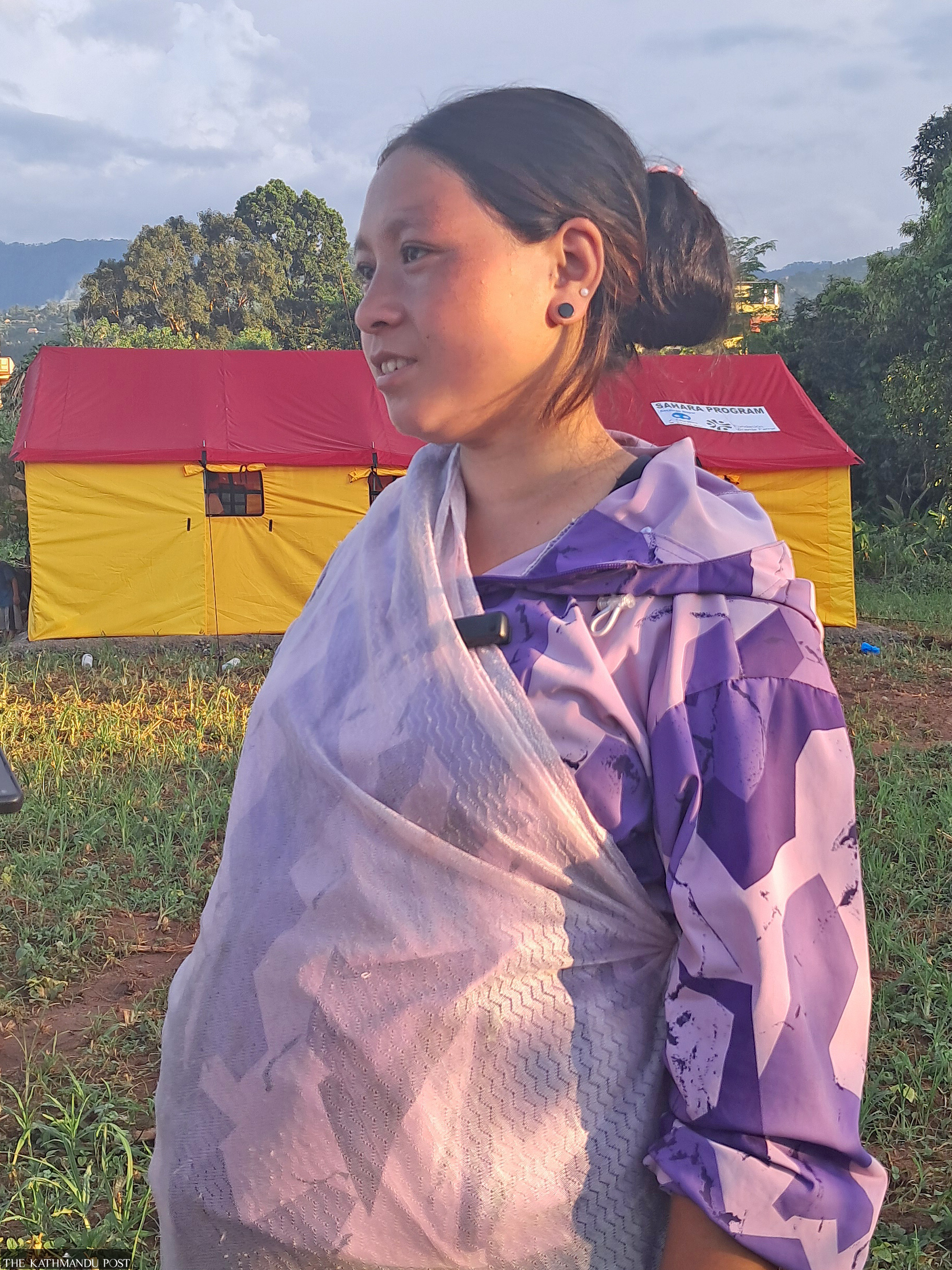
Pemba Dechhen Tamang, who made a living running ‘Smarika Khaja Ghar’ in Haku of Rasuwa’s Aamachhodingmo Rural Municipality, is one of many women entrepreneurs displaced by the disaster. She had opened the eatery in her five-year-old daughter’s name, and it had become the family’s main source of income and a basis of their financial independence.
Seven months pregnant, Pemba was working inside the shop when she heard that the flood had swept through her village in Chilime. She collapsed. Her husband worked at the Chilime hydropower project, and her uncle carried her as they fled. Although Pemba survived, she feels alone as her husband remains missing.
“He worked at the hydropower project,” she said at the Litto holding centre in Pipalatar. Thirteen members of her family have been missing in the floods. After a gruelling three-day journey, Pemba was rescued by a Nepali Army helicopter and taken to the holding centre.
“Because my husband is missing, I cannot even think about what I should do now,” said Pemba. “But I keep thinking that I have to do something for my children. I can run a small eatery as I have the experience.”
Rather than a large grant, she wants the government to build them a permanent home and manage her children’s education. “I could restart the eatery and move forward.”
As she gathers strength to rebuild life for her children, Pemba is frustrated that landlords are reluctant to rent her a room or shop even though she is willing to pay rent because she is a flood survivor. She has the responsibility of caring for her daughter, unborn child, mother-in-law, sisters-in-law and a brother.
According to the Nuwakot District Administration Office, more than 2,000 small traders, shops and household businesses have been directly affected in the disaster.
“About 300 industries, firms and shops have so far reported damage to us after the floods in Nuwakot,” said Ramesh Kumar Shrestha, an officer at the industry development branch of the Nuwakot-based Industry, Commerce, Tourism and Transportation Office. “The figure includes both complete and partial damage. We have not separately categorised how many of those businesses were run by women.”
In Rasuwa, Binda Paneru, an enterprise development facilitator, said around 300 small businesses in tourism, agriculture and construction in Gosainkunda and Uttargaya have been affected. “There are no large industries here, so the main impact has been on small and home-based businesses,” she said.
In Dhading, officials recorded direct effects on 160 small shops, hotels and other firms in Galchhi, Gajuri, Benighat and Siddhalek. Chudamani Puri, chief at the Industry and Commerce Office, estimated the district’s total economic loss at Rs458.43 million.
Premgeeta Kumari Tharu, who ran ‘Navadurga Motor Parts’ and a garage from rented premises near the road to Bandre in Bidur, says she lost goods and capital worth about Rs2.4 million to Rs2.5 million. She came to Nuwakot from Birgunj in 2016 and built the business on her own after her husband’s death.
Pemba Dechhen Tamang had an eatery in Haku, Rasuwa. Aarya Chand/TKP
“I keep going to government offices seeking relief and support, but they tell me that the relief is only for homeowners whose houses were washed away,” she told Kantipur while she was visiting the District Coordination Committee office in Bidur. Women entrepreneurs like her who live in rented spaces feel that they have been discriminated against.
“I am waiting for a way to revive the business so I can pay for my children’s education and daily expenses,” said Tharu. “The flood washed away my goods and capital, but it could not wash away my courage or my determination to become self-reliant again.”
A roof and a collateral-free loan would make it easier for her to start all over again.
At Devighat, Sanu Nepali Koirala and her sister-in-law Renuka Nepali lost both their businesses and homes. Sanu, 32, sold fruit from a roadside cart while Renuka ran a cosmetics and tailoring shop.
The flood swept away their house, clothes, sewing machines, cosmetics and fruit cart. Nine members of Sanu’s family are now living under tarpaulins near Chandra Jyoti Secondary School.
“If someone gives me a little support, I still have the courage to sell fruit and support my family. But right now I have only the courage but not a cart nor the money to invest,” said Sanu.
They say a permanent home on safer land would give them a chance to rebuild. Renuka’s husband is working in Dubai. “We do not want to depend on relief forever. We want a way to earn by our own labour,” said Renuka. “We worry about tomorrow. Instead of only giving relief, it would help us if the government created conditions in which we could work again.”
At Lamidanda in Bidur, 60-year-old Nangtang Gyalmo Tamang and her daughter Ranju lost two shops. They estimate their losses at Rs8 million to Rs9 million. Their shops and home were the family’s main source of income. Nangtang’s husband, Buddha Babu Tamang, remains missing.
Even in such circumstances, Ranju and her mother have not lost the determination and courage to rebuild their business and stand on their own feet again. “If I could start a small shop or some business again, it would help pay for my mother’s treatment and our daily needs,” said Ranju.
The losses are unfolding as transport and access to markets remain disrupted. Prakriti Mainali, a Nuwakot-based entrepreneur and founder of Shakti Milan Nepal, says women affected by the floods need to be counted and supported as entrepreneurs, not only as relief recipients.
“Individual women entrepreneurs often struggle to make their voices heard by the government, so the federation of Nepal cottage and small industries, the Federation of Nepalese Chambers of Commerce and Industry and other umbrella organisations should raise their concerns,” she said. The priority should be to collect data on affected women entrepreneurs, identify their needs and provide small grants and resources, she demanded.
The floods and landslides have damaged the environment for doing business. “But if affected women have skills and are ready to return to work, they should be given an opportunity for reinvestment in the first phase of recovery,” said Mainali. “This will help not only their economic condition but also their mental wellbeing.”
The Bagmati provincial government says its immediate focus remains on rescue, relief and psychosocial counselling. Asim Ghising Lama, spokesperson for the Office of the Chief Minister and Council of Ministers, said the province had previously provided fee waivers for women registering industries and run grant programmes for women’s empowerment. Health services are currently being provided through local hospitals, Ayurvedic centres and health offices, he said.
Once the immediate relief work is over, the government will move ahead with programmes to revive small entrepreneurship and women’s empowerment, said Lama.
Januka Mijar of Bidur is unsure how her livelihood will be rebuilt in the madal business after so much devastation. “Madals are played for enjoyment. But who will be in a mood for celebration after all this?” she asks.
Aarya Chand is a reporter at The Kathmandu Post covering social issues. Before moving to the social beat, Chand was an intern covering culture and lifestyle for the Post.




 24.07°C Kathmandu