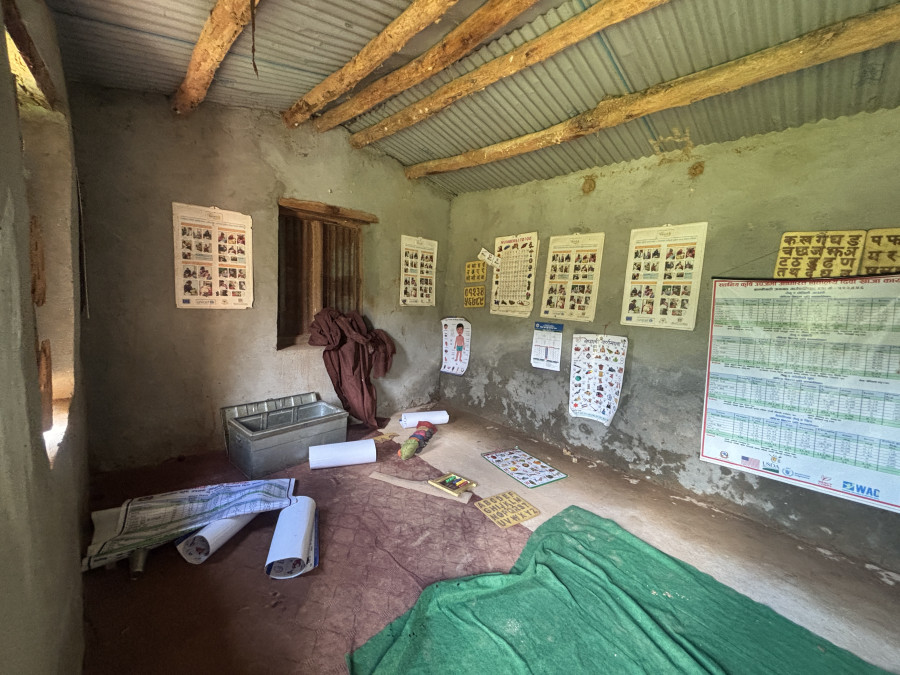
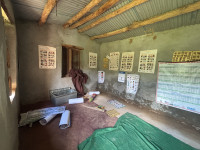
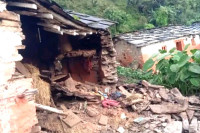
Declining births, out-migration and a shift towards smaller families are leaving early childhood centres short of pupils and forcing some schools to close. An early childhood development centre lies closed and partly in ruins in Kailashkhola, Bannigadhi Jayagadh Rural Municipality -4, Achham. Educational materials have been left scattered inside the damaged centre. Menuka Dhungana/TKP
Until a few years ago, the Bhagawati Early Childhood Development Centre in Achham often reverberated with the laughter and chatter of children. Now it has fallen silent.
The classrooms that were once filled with children now stand empty. With enrollment dwindling, the centre was merged with another, leaving the building unused.
Teertha Shah, 57, who spent 17 years teaching at the centre, is a witness to the change. When she started, more than 25 children barely fit into the classroom. The number dwindled year after year until the centre was eventually merged.
“By 2018-19, that number had fallen to eight, and the municipality merged the centre,” Shah said. It has since closed altogether.
After the merger, Shah moved to the early childhood centre at Kunti Secondary School in ward 1. She now teaches at another centre at Radha Secondary School in ward 4.
Only elderly people are left in the villages. “I have watched the villages lose people, and the schools fall silent,” said Shah.
With fewer children in villages, many early childhood centres like Bhagawati are being merged or closed. Some of their buildings and other facilities have been left unused.
Data recorded by all 10 local units in Achham, accessed through the District Health Information System (DHIS-2), show that the number of live births recorded has fallen in many parts of the district over the past three years.
Births are falling in the villages, and there are already too few children even at the early childhood level. The impact is being felt all the way up to secondary schools.
In Panchadewal Binayak Municipality, 274 live births were recorded in the fiscal year 2023-24, compared with 275 in 2024-25 and 207 in 2025-26. In Ramaroshan Rural Municipality, the number fell from 287 to 250 and then to 225. In Sanfebagar Municipality, data including records from Bayalpata Provincial Hospital show 535 live births in 2023-24, 471 in 2024-25 and 341 in 2025-26. In Mangalasen Municipality, which includes the district hospital, the number fell from 551 to 528 and then to 519.
Over the same period, live births in Kamalbazar Municipality fell from 207 to 154 and then to 145; in Dhakari Rural Municipality from 346 to 306 and then to 263; and in Turmakhand Rural Municipality from 319 to 281 and then to 250. Bannigadhi Jayagadh Rural Municipality was an exception, with the numbers almost unchanged: 78 live births in 2023-24, 77 in 2024-25 and 78 in 2025-26. In Mellekh Rural Municipality, live births fell from 233 to 190 before rising to 214. In Chaurpati Rural Municipality, the figure dropped from 245 to 221 before returning to 245.
The Health Office in Achham said the figures do not show the same trend across all local units. But they indicate that live births have declined in many parts of the district in recent years.
At the same time, families are continuing to leave the villages.
Padam Bahadur Bohara, ward 9 chair of Mangalasen Municipality, said the number of families actually leaving is far higher than the official migration figures suggest.
“Fewer people are registering their migration, but many more are leaving their homes,” Bohara said. “Most are moving to the Tarai or India. In the past, couples would have four or five children. Now they have one or two.”
He said his ward, which has a population of about 2,700, now sees only four or five births in an entire year. “Fewer children are being born in the villages,” he said. “We are already seeing the effect in early childhood centres. The same impact is beginning to reach schools.”
The shortage of children in early childhood centres is now beginning to affect the future of schools themselves.
Deepak Bhandari, chief of the education section at Mangalasen Municipality, said 61 early childhood centres were operating in the municipality before falling enrolment forced some to merge. Only 44 remain.
“Every year, we are having to merge early childhood centres,” Bhandari said. “In the previous academic year, we said centres could operate with as few as ten children. This academic year, the threshold was reduced to five. But we still found centres that lacked even five.”
There are 472 early childhood centres in Achham operated with federal grants. They have 7,098 children enrolled in the current academic year.
Under the government standard, each centre should have 25 children. That would put the expected enrolment across 472 centres at about 11,800, leaving a shortfall of roughly 4,700 children.
The decline is now reaching basic education.
Birendra Khadka, chief of the education section at Mellekh Rural Municipality, said Kalika Basic School in ward 6 had already been closed for a lack of students. The Laligurans Early Childhood Development Centre in ward 8 has also been merged.
Kal Bhairab Basic School in Hattikot now has only eight students, he said, while Malika Basic School, which teaches up to Grade 3, has just three.
Merging schools with low enrolment is also difficult because of the distances between them, Khadka said. “Secondary schools may survive for a few more years, but early childhood centres and basic schools are already in crisis.”
The number of schools in Achham has also fallen as enrolment declines.
Madan Bista, a technical assistant and acting chief of the Education Development and Coordination Unit in Achham, said the district had 526 schools two years ago. After the merger, that number has fallen to 416.
Of those, 57 teach only grades 11 and 12, 101 run up to grade 10, 157 operate grades 6 to 8, and 101 offer grades 1 to 5. The district has 61,969 students in 416 schools in the current academic year, down from about 69,000 in the 2025 academic year. That means roughly 8,000 fewer students in a single year.
“Student numbers have been falling by about 8,000 annually for the past five years,” Bista said. “In 2016-17, there were about 96,000 students in the district. In about a decade, we have lost about 35,000.”
The pattern starts with fewer children in villages. That first reduces enrolment at early childhood centres, then cuts the number entering grade 1. A few years later, the effect moves up through basic and secondary education.
For Sharada Budha, a parent from ward 7 of Mellekh Rural Municipality, shrinking families are another major factor behind the emptying schools, alongside migration.
More parents are moving their children out of villages in search of better education and opportunities, Budha said. “People are increasingly choosing smaller families. Having more than two children is becoming less common.”
Parents are also taking their children to cities in search of better education and opportunities. That is why village schools are gradually emptying, she explained.




 22.21°C Kathmandu