Bidya Bhandari’s return may give UML’s power struggle a new twist
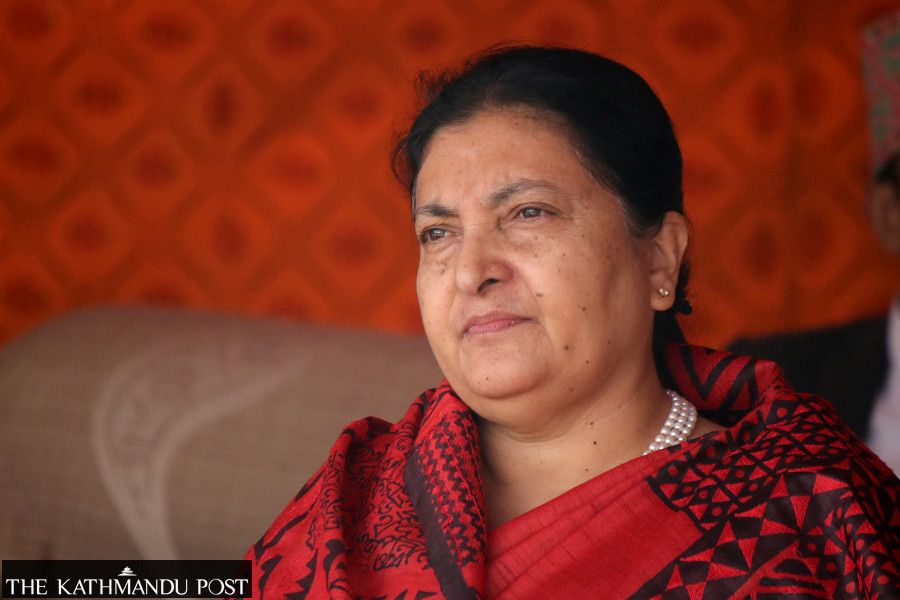
UML’s electoral drubbing has brought her back at a moment when the UML chief is under pressure to rethink his leadership. She spent eight years as the country’s President and returned to the party after a decade. Post file photo
Former president Bidya Devi Bhandari’s return to an influential position in the CPN-UML, barely a year after the party put her membership on hold, has brought into focus the changing power dynamics between her and party chair KP Sharma Oli.
The UML central committee meeting that ended Thursday nominated Bhandari as a senior leader, placing her in second place in party hierarchy. The decision, however, has raised questions because the current UML statute does not provide for a post called ‘senior leader.’
Bhandari's return follows a year of dispute over whether she should resume party politics after two terms as the country’s President. She announced her return to active party politics a year ago.
In May this year, the UML secretariat restored her membership. Her latest elevation gives her a formal place near the top of the party hierarchy, although it does not give her voting rights, according to UML leader Binda Pandey.
“Last year, the former president was subjected to such humiliation. Now she has been brought back and accorded the honour of second rank,” said Pandey after the central committee meeting. “This was done under the chair’s authority, not under the party’s rules and statute.”
The decision comes as the UML is facing a wider debate over its leadership and organisational direction following its poor performance in the March 5 general elections. Several senior leaders have argued that the party needs changes in its policies, organisation and leadership. The issue has put pressure on Oli, who has so far resisted calls for leadership restructuring.
In June last year, Bhandari announced that she had renewed her membership and was returning to active politics. At a function, she said had reunited with the UML family.
The announcement immediately became a major internal issue. Bhandari had indicated that she was prepared to seek a leadership role in the party, while Oli was preparing for the UML’s 11th general convention. The central committee subsequently decided to keep her membership in abeyance.
The dispute deepened during the party’s statute convention in September 2025. The UML removed the 70-year age limit and the two-term limit for party chair, clearing the way for Oli to seek another term. The party later elected him chair for a third consecutive term at its general convention in December last year.
Bhandari, who served as President for two consecutive terms from 2015 to 2023—renounced her state benefits to re-enter active party politics, citing her 45-year association with the UML. Her political career in UML began after the death of her husband Madan Bhandari in a vehicle accident in Dasdhunga in 1993. She was elected as a Central Committee member at the 6th National General Convention, retained her seat at the 7th General Convention and was elected Vice-Chairperson at both the 8th and the 9th general conventions.
The change in Bhandari’s position has come after her relationship with Oli improved following the UML’s electoral setback.
The March parliamentary election dealt a serious blow to the party. Oli lost his Jhapa-5 seat, while several senior UML leaders were defeated. The results intensified questions inside the party about accountability and leadership, with some senior figures subsequently calling for organisational and leadership reform.
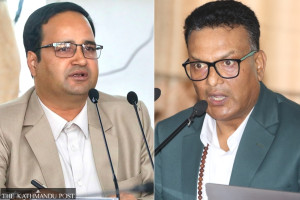
The current leadership dispute is no longer confined to Bhandari’s political comeback. Vice-chair Bishnu Paudel and General Secretary Shankar Pokhrel, among others, have argued that the UML needs reforms after its electoral defeat. Pokhrel has proposed a system for developing and transferring leadership across generations.
Against this backdrop, Bhandari and Oli have resumed communication. Bhandari visited Oli at his Gundu residence in April while he was recovering from surgery. Their subsequent discussions eventually led to the restoration of her membership and her latest appointment.
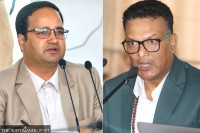
A UML office-bearer told Kantipur that Oli may also be using Bhandari’s return as a strategic move in the party’s ongoing internal power struggle. “If he is eventually forced to step down, he may be trying to send a message that there is someone like Bidya who could succeed him,” the office-bearer said. “It appears he has played a card against Bishnu Paudel and Shankar Pokhrel.”
Pandey, meanwhile, questioned the significance of creating a position outside the statute.
“A post that does not exist in the statute has been created for the former president. It is a position without voting rights,” she said. “What difference will bringing her into the second rank make in the life of the UML?”
She argued that the party’s focus should be on public issues rather than positions. “The question is how many issues affecting the people have you raised and will raise,” she said. “Women’s leadership cannot be developed merely by bringing a woman into a committee. The party should at least be able to say it will run campaigns against violence against women and speak against caste discrimination. People want results, but we are too focussed on positions.”
Pandey’s criticism reflects a broader disagreement within the UML over whether organisational change should also mean changes in leadership. The party says its recent central committee meeting was aimed at strengthening internal unity and preparing a plan for revival and consolidation. But several leaders have continued to call for policy and leadership restructuring.
Bhandari’s elevation comes at a time when the UML is trying to project unity while confronting demands for internal change. General Secretary Pokhrel said the latest central committee meeting had reviewed past shortcomings and prepared a roadmap for improvement and transformation.
“The meeting was extremely important for strengthening internal unity and preparing concrete plans for the party’s revival and consolidation,” said Pokhrel in a statement. “We have seriously reviewed our shortcomings, pledged not to repeat them and prepared a roadmap for reform and transformation.”
Meanwhile, Ishwar Pokhrel, a former senior vice-chair of the UML who challenged Oli for the party chair at its 11th general convention, has been nominated to the Standing Committee.
The central office-bearers’ meeting nominated Ishwar Pokhrel to the Standing Committee. The Central Committee will approve the Standing Committee and Politburo.
Similarly, former deputy general secretary Pradeep Gyawali, former House Speaker Devraj Ghimire and former deputy speaker Shivamaya Tumbahamphe are also set to join the Standing Committee. Kashinath Adhikari, Tham Maya Thapa and Lal Babu Pandit are also expected to be selected as Standing Committee members.




 23.73°C Kathmandu