Nepal’s economy fails to keep up with political transformation: Experts
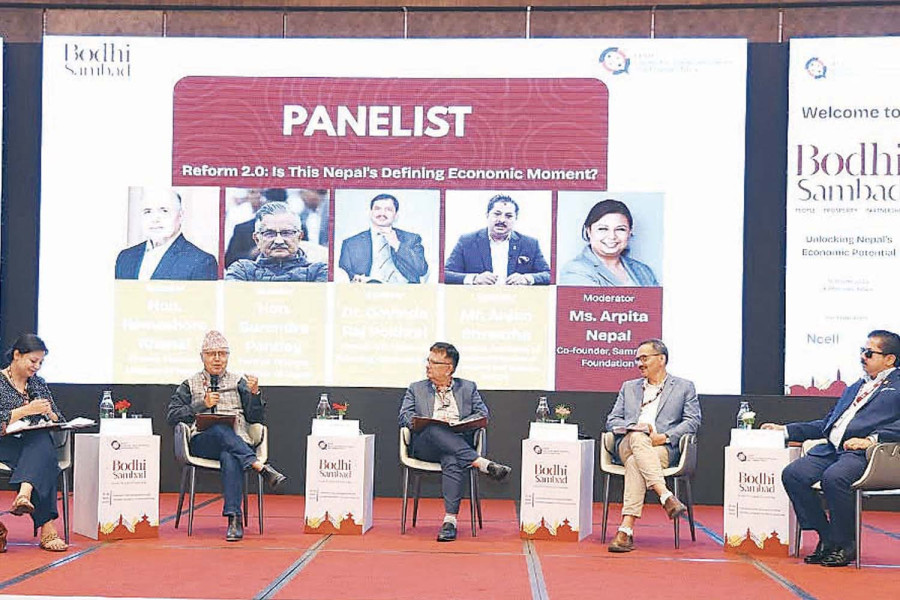
Business leaders and policymakers call for deeper institutional reforms, policy stability and full implementation of past recommendations to unlock Nepal’s economic potential. Panellists at the Bodhi Sambad 2026 dialogue that started in Kathmandu on Tuesday. Handout photo
Despite sweeping political transformations over the past decades, Nepal has failed to achieve a corresponding economic transformation due to weak institutions, policy instability and poor implementation of reforms, experts said on Tuesday.
Speaking at “Bodhi Sambad”, a dialogue forum hosted by the Centre for Social Innovation and Foreign Policy in Kathmandu, policymakers and business leaders stressed the need for structural reforms and warned against recurring policy inconsistencies and delays in implementing recommendations.
“Over the past decades, we have witnessed changes in the political system. We have seen changes in governments. We have seen changes in the constitution,” Finance Minister Swornim Wagle said while addressing the event. “But one thing that has not changed sufficiently is the institutional structure through which the economy and the state are governed.”
“We weakened our institutions. We made policies unstable. We distorted the incentive structure. As a result, access, protection and influence became more valuable than production, innovation and competition,” he said.
According to Wagle, Nepal’s biggest challenge is not financial but institutional and psychological.
“Our greatest failure is not merely economic; it is political-economic,” he said.
Wagle argued that expensive elections, opaque political fundraising and cadre-based party structures have gradually transformed politics from public service into an investment.
“As a consequence, policy corruption, state capture and crony capitalism began to become institutionalised,” he said.
Instead of rewarding entrepreneurship and innovation, a culture emerged in which opportunities were secured through political access and personal connections, he added.
“When an economy is based on access and protection rather than production and competition, it cannot deliver long-term prosperity. It benefits only a limited group and increases social dissatisfaction, which we are witnessing today.”
During a panel discussion titled “Reform 2.0: Is This Nepal’s Defining Economic Moment?”, former finance secretary and minister Rameshore Khanal said Nepal’s debt situation remains manageable despite a rapid increase in borrowing over the past decade.
“Every year, the government spends only about 1.3 percent of its revenue on debt repayment,” Khanal said.
By comparison, debt servicing accounts for around 14 percent of government revenue in Laos and roughly 8 to 9 percent in Cambodia.
Nepal is nowhere near bankruptcy because it cannot repay its debt, Khanal said. “Our corridor is still relatively comfortable. However, the walls on both sides are somewhat narrow, which means the corridor itself is narrow.”
He noted that a large portion of Nepal’s external debt consists of highly concessional loans from multilateral lenders such as the World Bank, while comparatively costlier loans from countries including China and India make up a smaller share.
“The current situation is not alarming,” he said. “However, if one examines the time-series data, debt stock has nearly doubled since 2017 within a relatively short period.”
Govinda Pokhrel, former vice-chairman of the National Planning Commission, urged policymakers to adopt a realistic approach to economic self-reliance and international trade.
“No matter how much we talk about self-reliance, except perhaps in agriculture, we should not claim complete self-sufficiency in every area,” Pokhrel said. “In reality, we are interdependent.”
He stressed the need to identify strategic sectors carefully and negotiate trade agreements more deeply and effectively.
Former finance minister Surendra Pandey highlighted the poor performance of state-owned enterprises, saying many continue to drain public resources.
“Among the 45 state-owned enterprises, 16 are heavily loss-making,” Pandey said. “The rest are partly profitable and partly loss-making. If we look at the accumulated figures, most of them remain in deficit, even though some report annual profits in terms of cash flow.”
He said Nepal must decide whether commercial enterprises should be left to the private sector and competitive markets or managed through privatisation, divestment or strategic partnerships.
“Different modalities have been tried over the years, but most have failed,” he said.
Pandey noted that proposals to revive some state-owned enterprises had resurfaced and were even included in an earlier reform agenda. However, after discussions before the budget, the government chose not to pursue that path.
“The finance minister clarified that reviving loss-making enterprises was not the intention, and the current budget contains no such provision,” he said.
Anjan Raj Shrestha, president of the Federation of Nepalese Chambers of Commerce and Industry, said Nepal has undergone major political and social changes, but economic transformation has remained elusive because it has rarely been treated as a national priority.
“One thing that has remained unchanged is the economy,” Shrestha said. “Economic transformation was never made the central agenda of successive governments.”
He recalled that the private sector had proposed the establishment of an Economic Reform Commission, which later submitted a series of recommendations to the government.
“Our expectation was that after forming such a large commission, if the intention was truly to bring change, then the recommendations would be implemented in their entirety,” Shrestha said.
“Instead, we were told that they would be implemented gradually and systematically. That is where doubts arise. It seems to me that the same old mindset has resurfaced.”
Krishana Prasain is a business reporter for The Kathmandu Post covering markets. Before joining The Kathmandu Post in 2018, she spent 3 years in New Business Age magazine covering business.




 25.92°C Kathmandu