Everest permits steady but revenue climbs to record
Fee hike drives historic earnings. The season is marked by icefall danger, drone controversy and high-profile summit bids. Officials at the Department of Tourism say there is no fixed deadline for issuing permits, but most climbers secure them by the first week of May, barring a few late applications from professional expeditions. Photo: Courtesy of Seven Summit Treks
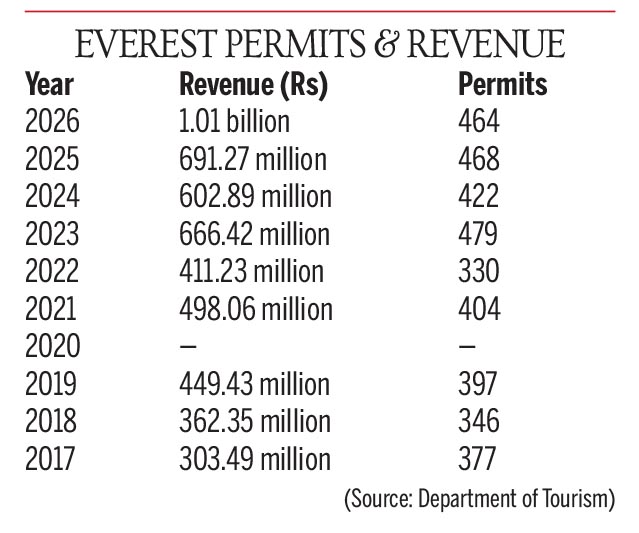
As many as 464 fee-paying climbers have been issued permits to scale Mount Everest this spring, making it the third-highest number on record. However, government earnings have reached an all-time high, with revenue touching Rs1.01 billion as of Wednesday.
Officials at the Department of Tourism say there is no fixed deadline for issuing permits, but most climbers secure them by the first week of May, barring a few late applications from professional expeditions.
“If there hadn’t been the Iran war, the number of Everest aspirants could have reached a record,” said Ram Krishna Lamichhane, director general of the department. “But in terms of revenue, it’s a historic high.”
The surge in earnings follows Nepal’s decision to raise the royalty fee for foreign climbers attempting Everest via the standard route to $15,000 from $11,000, effective September 1, 2025—a 36 percent increase. For Nepali climbers, the spring season fee has doubled from Rs75,000 to Rs150,000.
According to the department, Chinese climbers top the list with 100 permits, followed by 67 Americans, 58 Indians, 32 from the United Kingdom, 18 Russians and 14 Australians, among others. Expedition operators say numbers from China have risen after restrictions on climbing Everest from the northern side.
The 2026 spring season began with a major obstacle in the Khumbu Icefall, where a massive and unstable serac blocked the route below Camp I, delaying operations for weeks.
A report by the Sagarmatha Pollution Control Committee (SPCC), which is responsible for route fixing up to Camp II, said the serac measured around 55 metres in length, 37 metres in width and 28 metres in height. The ice structure developed multiple cracks, posing a constant risk of collapse and making route selection extremely hazardous.
The danger became evident when part of the serac collapsed onto the route early Tuesday morning, injuring four individuals heading towards Camp II for acclimatisation. Among them, Sherpa guide Pemba Tenduk Sherpa and Indian climber Nimish Kumar Singh were seriously hurt and later airlifted to Kathmandu for treatment at HAMS Hospital.
Both were partially buried under ice and debris before nearby Sherpas rushed to rescue them. Video footage circulating on social media showed rescuers digging frantically with limited equipment, as essential snow shovels were not immediately available, heightening the risk.
After a 19-day delay, the route was finally opened on April 28, bringing relief to hundreds of climbers and guides waiting at base camp.
Despite the breakthrough, authorities warn that risks remain. The SPCC has enforced strict safety measures, particularly in the so-called “rockfall point” section. Climbers have been instructed to move quickly through hazardous zones, minimise loads, cross ladders one at a time and remain clipped into safety lines at all times.
The season has also been clouded by controversy over the use of drones. The deployment of drones on Everest—initially seen as a tool for improving safety and waste management—has sparked debate over regulatory and geopolitical concerns.
Tensions escalated after the government abruptly banned operations by Airlift Technology, involving Chinese-made DJI drones, on April 30. The suspension was lifted on Tuesday, but the episode exposed the fragile balance between innovation and security oversight in high-altitude operations.
Meanwhile, preparations for summit attempts are progressing.
According to Gyanendra Shrestha, a government representative at base camp, route fixing had reached Camp III by Tuesday and could be completed within a week.
“The first summit window has been planned for May 18 to 22,” he said.
Several climbers are aiming for record-setting feats this season.
Veteran Sherpa guide Kami Rita Sherpa is attempting his 32nd ascent of Everest, extending his own world record. British climber Kenton Cool is targeting his 20th summit, which would be the highest number by a non-Sherpa.
Among the more unusual expeditions, Australian climber Oliver Foran has begun a “sea-to-summit” journey, cycling 1,150 kilometres from India’s coast before heading to base camp. The endurance challenge echoes the historic 1990 climb by Tim Macartney-Snape, who first completed Everest from sea level.
Foran is partnering with the Australian organisation Youturn, aiming to raise $200,000 to support youth mental health services.
In another ambitious attempt, a 36-year-old American long-distance runner plans to summit Everest without supplemental oxygen and at record speed, adding to the growing list of high-risk, high-profile expeditions this season.
Sangam Prasain is Business Editor at The Kathmandu Post, covering tourism, agriculture, mountaineering, aviation, infrastructure and other economic affairs. He joined The Kathmandu Post in October 2009.




 18.61°C Kathmandu