



 14.58°C Kathmandu

Mon, Oct 19, 2026
Money
Hanging ice wall stalls Everest route, sparks safety fears
Record permit numbers collide with unstable Khumbu Icefall conditions, raising risks of delays and deadly congestion.
bookmark![]()
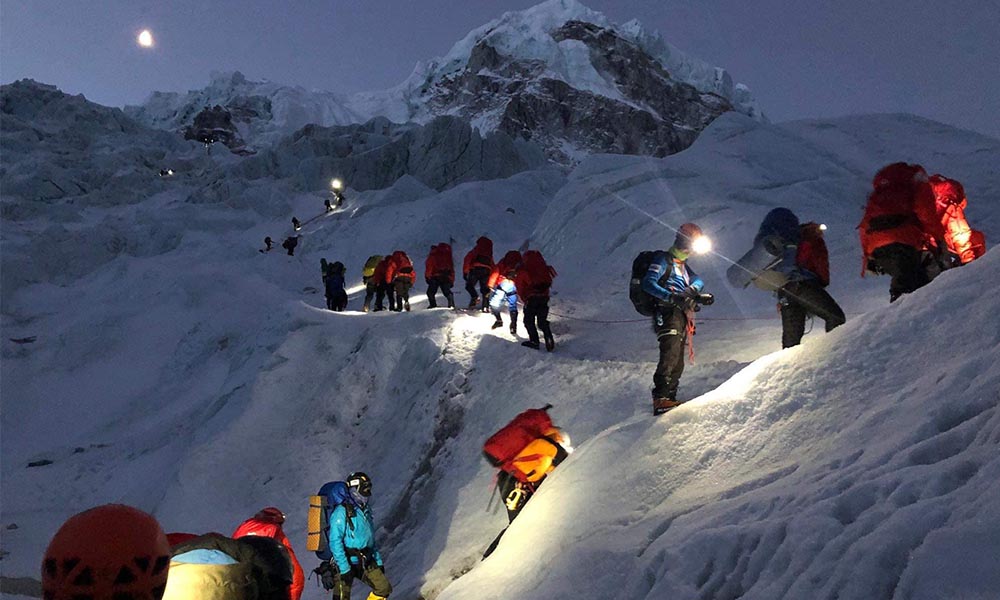
Climbers must navigate it in darkness, typically between 3 am and 5 am, when freezing temperatures hold the ice more firmly in place. Photo: Courtesy of Seven Summit Treks ![]()
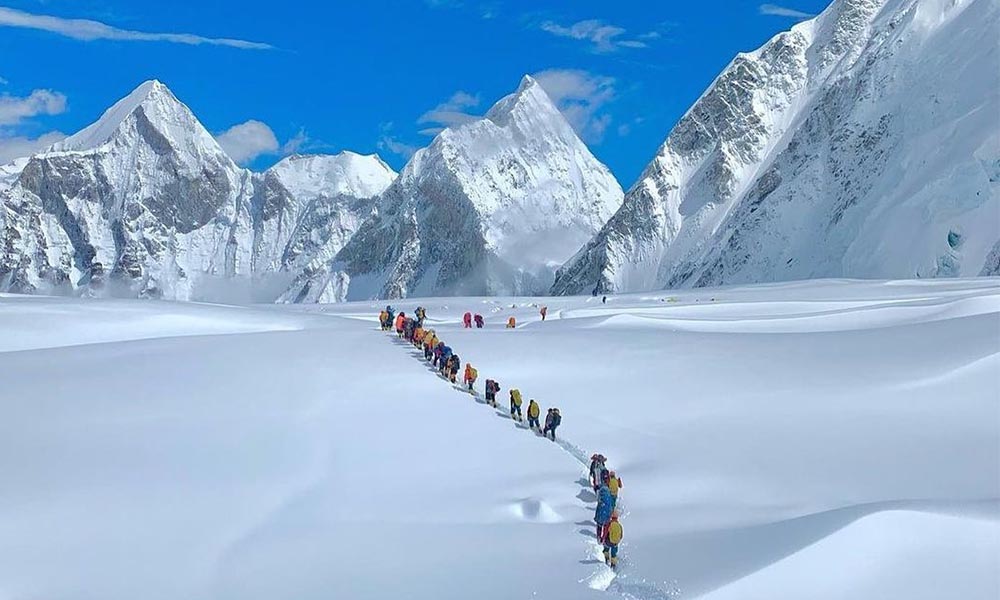
As of Thursday, the government has issued climbing permits to 410 individuals, putting this year close to the all-time high of 479 permits recorded in 2023 Photo: Courtesy of Seven Summit Treks
Sangam Prasain
Published at : April 23, 2026
Updated at : April 24, 2026 15:31
Kathmandu
A massive wall of ice—millions of tonnes suspended high above the Khumbu Icefall—has brought Nepal’s Everest climbing season to an uneasy impasse, forcing expedition leaders, Sherpa guides and government officials into a tense waiting game.
For the past two weeks, the highly skilled “icefall doctors”—the Sherpa team tasked with fixing ropes and ladders through the most dangerous section of the world’s tallest peak—have held back. Their hesitation is not routine caution. It is driven by a looming threat: a giant, unstable serac hanging precariously near the route to Camp I, which could collapse without warning and unleash a deadly avalanche.
“This is not something you can fix or move,” said Himal Gautam, spokesperson for the Department of Tourism. “It’s natural. We can only wait and assess.”
That uncertainty now casts a shadow over what was expected to be another record-breaking spring season on Everest. As of Thursday, the government has issued climbing permits to 410 individuals, putting this year close to the all-time high of 479 permits recorded in 2023. The numbers signal strong demand despite global economic and geopolitical headwinds—but they also heighten the stakes.
If the route through the Khumbu Icefall is delayed much longer, climbers could be forced into a compressed climbing window later in the season. That, experts warn, may recreate one of Everest’s most persistent dangers: human traffic jams at extreme altitude.
The Khumbu Icefall is often described as a frozen river of ice, stretching roughly a kilometre above base camp at 5,364 metres. It is a constantly shifting labyrinth of towering ice blocks, deep crevasses and fragile snow bridges. Climbers must navigate it in darkness, typically between 3 am and 5 am, when freezing temperatures hold the ice more firmly in place.
Once the sun rises, the entire landscape begins to change. Ice softens, cracks widen, and hanging glaciers start to shed. Movement becomes perilous.
Even under normal conditions, the Icefall is widely considered the most dangerous section of the southern route to Everest’s summit. This year, the danger is amplified.
“The serac is huge—around 300 metres below the Camp I (6,056 metre)—and it’s directly above a key section of the route,” said Rishi Bhandari, general secretary of the Expedition Operators Association of Nepal. “Any vibration or shift could trigger an avalanche.”
The risk is not theoretical.
The Khumbu Icefall has a long and deadly history.
On April 18, 2014, a collapsing serac triggered an avalanche that buried 16 Sherpa guides, one of the deadliest single accidents in Everest’s history. The tragedy forced the cancellation of that year’s climbing season and led to a redesign of the route to reduce exposure to such hazards.
A decade later, the fear of a similar disaster looms again.
In response to the current situation, the Department of Tourism convened a multi-stakeholder meeting on Thursday, bringing together government officials, expedition operators and technical experts.
The meeting concluded with a decision to deploy both national and international specialists to assess the ice formation through aerial and ground inspections.
“We will wait for two days and review the report,” Gautam said. “Based on the findings, we will initiate ‘Plan B’ if necessary.”
What that Plan B might look like remains unclear.
Some high-altitude guides have proposed installing 10 to 15 additional ladders to bypass the most dangerous section. But even that workaround carries significant risk, particularly if it involves passing beneath or near the unstable ice mass.
Mingma Chiri Sherpa, chairman of the Khumbu Pasanglhamu Rural Municipality, which includes the Everest region, said local authorities have urged caution.
“There is too much risk right now,” he said. “We have suggested waiting for at least a week to see if the ice melts or shifts. If not, an alternative route must be considered—but any movement in that area could trigger an avalanche.”
The problem is that alternatives are limited. The Icefall’s geography leaves little room for safe detours, and building a new route would require additional manpower, time and exposure to danger.
Thaneshwor Guragain, manager at Seven Summit Treks, Nepal’s largest expedition operator, said the delay is already affecting planning.
“The season has started late,” he said. “If we need to create an alternative route, it will require more resources and more risk. Right now, everyone is in a wait-and-see mode.”
That waiting comes at a cost.
Everest expeditions follow a tightly choreographed sequence. First, icefall doctors establish the route up to Camp II (6,400 meters) using ladders and fixed ropes. Then, a separate rope-fixing team ascends higher, securing the path to the summit.
Porters and Sherpas ferry oxygen cylinders, tents and supplies to the upper camps. Climbers, meanwhile, begin their acclimatisation rotations—gradually moving up and down the mountain to adapt to thinning air.
Any delay at the Icefall disrupts this entire chain.
If the route opens late, climbers may be forced to make summit pushes within a narrower weather window in mid-May, when conditions are typically most favourable. That compression can lead to congestion not just in the Icefall but also in the “death zone” above 8,000 metres, where oxygen levels are critically low and delays can turn fatal.
Images of long queues near the summit—climbers waiting for hours in sub-zero temperatures—have become emblematic of Everest’s overcrowding problem in recent years. Experts fear a repeat.
Bhandari, the general secretary of the Expedition Operators Association, said the industry is deeply concerned.
“We have briefed the government about the risks,” he said. “If the ice does not stabilise within a few days, we must seriously consider alternatives. But the reality is—no one knows what the safest alternative is.”
Technology may offer limited support. Operators plan to deploy aerial drones to transport ropes, ladders and other equipment to higher sections of the mountain. The drones can also help map the terrain and identify potential routes, reducing the need for workers to spend extended periods in hazardous zones.
Still, drones cannot solve the fundamental problem: the unpredictable nature of a living glacier.
Past experience offers little reassurance. In the autumn of 2019, a climber encountered a similar ice formation on Everest. According to Guragain, that structure took nearly two years to fully melt.
“So we cannot assume this will resolve quickly,” he said.
Nepal has received an encouraging number of climbers, particularly on Everest, despite the surge in cost of travel and expedition triggered by the West Asia war. Nepal has also raised the fee of climbing Everest by $400 per person to $15,000.
Despite the uncertainty, the commercial momentum behind Everest remains strong. The government has already collected $5.98 million in permit fees this season, the highest revenue collected from Everest so far.
According to the operators, closure of Everest from China was the key reason behind the surge, with climbers from China leading the numbers at 98, followed by Americans (49), Indians (46) and British nationals (28).
The resilience of mountaineering stands in contrast to other segments of Nepal’s tourism industry, which have faced setbacks this year. While trekking bookings have declined sharply in April, expedition operators report that high-altitude climbing demand remains steady.
“Expedition bookings are intact,” said Pemba Sherpa, executive director of 8K Expeditions, in a recent interview. “Everest is still drawing climbers.”
But for now, the world’s highest peak is holding them at bay.
At base camp, beneath fluttering prayer flags and the constant rumble of shifting ice, climbers wait.
Sherpa guides scan the glacier for signs of movement. Icefall doctors study the towering serac, weighing risk against necessity.
Above them, the frozen wall remains suspended—silent, immense, and unpredictable.
Sangam Prasain
Sangam Prasain is Business Editor at The Kathmandu Post, covering tourism, agriculture, mountaineering, aviation, infrastructure and other economic affairs. He joined The Kathmandu Post in October 2009.

Most Read from Money
Nepal travel agents threaten to stop selling Thailand trips over visa rules

Why does an hour long flight to Dhangadhi cost more than a flight to New Delhi?
Malaysia rejects Nepal’s demand to open recruitment to all manpower agencies
No school, but a graduation cap for women dairy farmers
Nepal arrests four medical service providers as Malaysia recruitment row deepens
Editor's Picks




E-PAPER | October 19, 2026

×