



 19.27°C Kathmandu

Mon, Oct 5, 2026
Money
Ancient Kapilvastu was a planned fortified city, but tourism neglect keeps it in the shadows
Archaeological evidence confirms Tilaurakot’s urban sophistication dating back to the eighth century, yet poor connectivity and weak policy links with Lumbini leave the historic district struggling with poverty.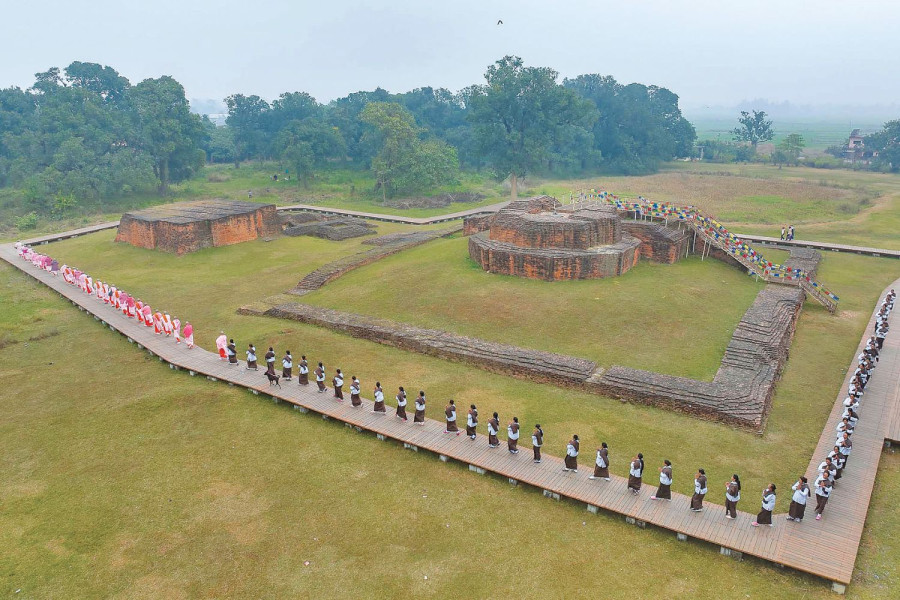
bookmark
Manoj Paudel
Published at : March 5, 2026
Updated at : March 5, 2026 07:44
Kapilvastu
The ancient Shakya capital of Kapilvastu was, until around 2,500 years ago, one of South Asia’s most systematically planned and well-organised cities. Excavations, studies and research conducted over the past 12 years by a joint team of archaeologists and experts from Durham University in the United Kingdom, Nepal’s Department of Archaeology, and the Lumbini Development Trust have confirmed this.
Laboratory tests carried out in Britain, including soil analysis and carbon dating, revealed the site’s great antiquity. Yet despite its immense archaeological and historical significance, the site today lies in a dilapidated and neglected state, reduced in many places to ruins.
Excavations have uncovered evidence of an organised urban settlement and residential structures. Within Tilaurakot, remains dating to around the time of the Buddha have been found, including roads, drainage systems, defensive fortification walls and traces of human habitation. Large structural foundations, wells and ponds have also been discovered at various points.
Findings mentioned in the travel accounts of the fifth-century Chinese pilgrim Faxian and the seventh-century monk Xuanzang are gradually being corroborated through archaeological evidence. According to senior archaeologist Kosh Prasad Acharya, the discovery of the city’s historical layout has firmly established the historical authenticity of Tilaurakot.
Historical records state that Lord Buddha was born over 2,500 years ago. Archaeologists say that even before his birth, during the period when Prince Siddhartha spent his childhood and youth in Tilaurakot, the area had already begun evolving from a village into a growing settlement.
Homes were built with thatched roofs, mud walls and wooden or bamboo posts. Post holes and remnants of mud structures from that era have been found at multiple locations. Samples collected in 2015 for scientific chronological analysis confirmed human settlement in the area dating back to the eighth century BCE. Based on the excavation findings and scientific tests so far, Professor Robin Coningham of Durham University, the lead archaeologist, said Tilaurakot was a well-planned fortified city.
Despite its importance, studies show that tourists visiting Tilaurakot Palace tend to stay only briefly before leaving. Research involving visitors identified four types of tourists, who on average spend just 39 minutes at the site.
A joint team from Durham University, Nepal’s Department of Archaeology and the Lumbini Development Trust conducted this study alongside ongoing excavations, with support from the Japanese Trust Fund. The findings show that visitors spend only about Rs110 on average. Of those arriving in groups averaging 15 people, over 90 percent leave after a short visit. Only 7 percent stay in Taulihawa, while more than 70 percent return to Lumbini.
Kapilvastu district holds immense tourism potential. It is often described as a museum of historical, archaeological, cultural and natural sites. Besides Tilaurakot—the palace of King Suddhodana and the place where Prince Siddhartha spent 29 years of his youth—the district includes Niglihawa, where Emperor Ashoka visited during pilgrimage and marked the birthplace of Kanakamuni Buddha; Gotihawa, associated with the birthplace of Krakuchhanda Buddha; Sagarhawa, the site of the massacre of the Shakyas; and Nigrodharama (Kudan), where the Buddha met his parents for the first time after attaining enlightenment.
Other sites such as Arorakot, Dhamnihawa Stupa, Sisahaniya and Chetharadehi also lie within the district. A 2016 study identified 136 sites of historical, archaeological and cultural significance along the banks of the Banganga river alone.
Kapilvastu is not only significant for peace and spiritual tourism but is also considered a paradise for birds. The country’s second-largest bird sanctuary, Jagdishpur Lake, is located here and provides habitat to the highest number of waterfowl in Nepal. From the lush plains of the Tarai to the gleaming Himalayan ranges visible in the distance, the region offers unique ecotourism attractions.
Yet Kapilvastu has largely failed to reap tourism benefits. In 2025, when 150,000 tourists from foreign countries other than India visited Lumbini, only 46,000 visited Tilaurakot. Of the 270,000 Indian tourists who came to Lumbini, just 19,000 travelled to Tilaurakot. Similarly, while 700,000 Nepali visitors went to Lumbini, only 42,000 reached Tilaurakot.
Tourism is Nepal’s vital industry, linked to national development, economic growth, cultural preservation and employment generation. However, due to the failure to effectively connect Tilaurakot with Lumbini, the district has been unable to maximise tourism gains. A lack of policy clarity, infrastructure improvement, network expansion and mobilisation of local resources has left Tilaurakot in the shadows.
Despite its tourism potential, the district continues to suffer from poverty. Although the 15th periodic plan aimed to reduce absolute poverty to 10 percent by fiscal year 2023-24, the target was not achieved.
The 16th five-year plan, approved in 2024, now aims to reduce absolute poverty to 12 percent by 2028-29. The fourth living standards survey showed that 45,031 people in Krishnanagar, 40,904 in Maharajganj, 38,587 in Shivaraj and 36,824 in Kapilvastu Municipality were living below the poverty line, ranking them among the poorest local units in the country.
Taulihawa, which had made significant development strides until the early 1980s, has gradually faded since then. Development failed to keep pace with time, and political rivalry and lack of coordination among district leaders have slowed progress.
Once emerging strongly after the end of the Rana regime, the old city of Taulihawa now appears isolated and neglected, its historical identity fading. Previously ahead of Butwal and Bhairahawa in development, it now lags far behind as those cities have surged ahead.
Poor road connectivity hindered trade and business growth. Local entrepreneurs say they have struggled merely to sustain their households rather than expand their enterprises. Reduced movement of people and the lack of efforts to resolve structural issues pushed the city further into obscurity.
After the Pokhara–Butwal–Sunauli road was constructed, opportunities expanded rapidly in Butwal and Bhairahawa. Migration from the hills increased, businesses and industries flourished, and educational institutions opened.
In contrast, Taulihawa failed to attract industries or investment. With limited employment and educational opportunities, new residents stopped coming, said local resident Chandrakant Sharma, adding that since falling behind, Taulihawa has yet to recover.
Manoj Paudel
Manoj Paudel is the Kapilvastu correspondent for Kantipur Publications.



Most Read from Money

In Nepal’s premium rental market, the dollar is everywhere but on paper
Malaysia weighs raising minimum wage to RM2,000
All three major Nepal-China crossings hit by monsoon disruptions ahead of Dashain
Why was Nepal’s stock market shut on Monday
Nepal lost Rs10 billion in India’s import squeeze. New Delhi seeks investigation before easing curbs
Editor's Picks

What triggered the Rasuwa flood? Scientists piece together a complex chain of events

The floods keep coming. Nepal keeps starting over

In a settlement destroyed by the Bhotekoshi flood, a disabled couple offer strangers the little they have

Nepal working on detailed assessment as Bhotekoshi flood reconstruction could cost up to $5 billion

Rabindra Dhant gave Nepal a reason to smile. Now his camp wants real action behind the praise
E-PAPER | October 05, 2026

×