



 14.81°C Kathmandu
Sat, Oct 24, 2026
Money
Buffalo meat exports to China delayed as factory awaits EIA clearance
Rs21 billion Chinese-backed project in Sindhuli pushes target to September; producers warn Nepal’s buffalo population and milk market pose major hurdles.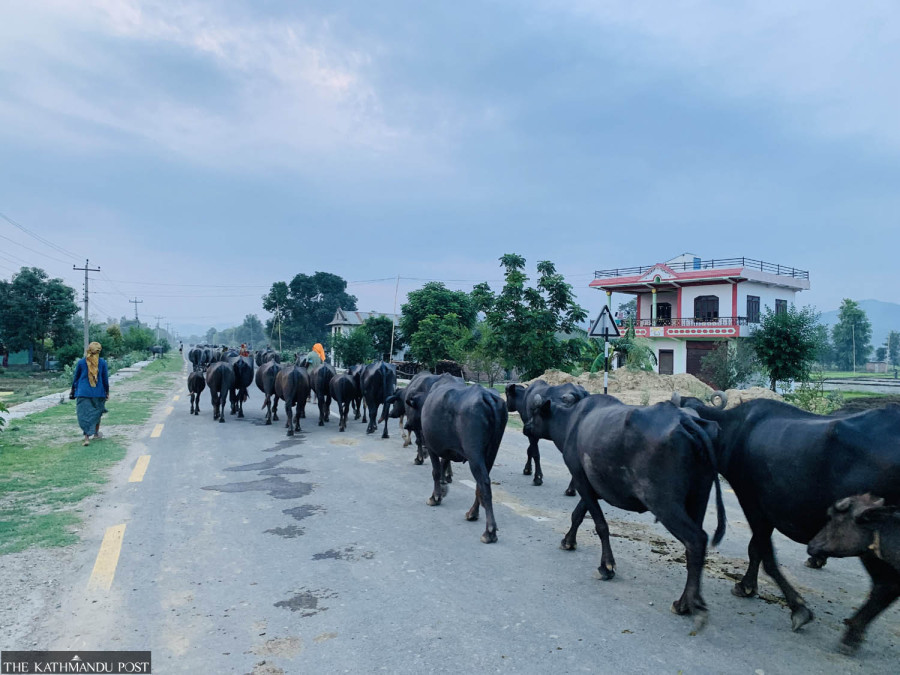
bookmark
Post Report
Published at : February 17, 2026
Updated at : February 18, 2026 06:50
Kathmandu
Nepal’s much-publicised plan to export buffalo meat to China has been pushed back by at least three months, with producers citing delays in land acquisition and disruption caused by September’s Gen Z movement.
The export was initially scheduled to begin in June, but promoters now say shipments are likely to start only from September.
“Land acquisition has been completed and construction of the labour quarters is about to finish. We are waiting for the finalisation of the Environmental Impact Assessment for factory construction. The contractor has said the factory construction will be completed within six months,” said Navin Kumar Sharma, chairman of Himalayan Food International, the private firm exporting the meat.
The processing plant is being built in Marin Rural Municipality in Sindhuli district. The factory will occupy 55 bighas of land, while an additional 85 bighas has been allocated for buffalo quarantine facilities.
Sharma said the company has secured approval for Chinese investment worth Rs21 billion and may seek additional clearance if further funding is required. Of the approved amount, nearly Rs2 billion has already been spent, including Rs1 billion for land acquisition and around Rs500 million for equipment purchases and labour quarters. The remaining expenditure has gone into design and preparatory works.
In December 2024, China expanded trade opportunities with Nepal beyond traditional handicrafts by opening its market to water buffalo meat. The development followed then-prime minister KP Sharma Oli’s official visit to China, during which Beijing agreed to allow meat imports from Nepal.
Earlier, on December 16, 2023, Himalayan Food International signed a business-to-business agreement in Kathmandu with Shanghai Ziyan Food to export buffalo meat. Chinese authorities have described the agreement as part of their “soft trade diplomacy” and signalled plans to import up to $1.5 billion worth of buffalo meat annually from Nepal, calling it a potential “game changer” in bilateral trade.
According to Sharma, total Chinese investment in Nepal’s meat sector is expected to reach around Rs27 billion, covering both meat processing and animal rearing components.
The company plans to export 900 tonnes of buffalo meat daily, which would require nearly 7,000 buffalos each day. Export pricing will be determined three months prior to shipment and is expected to be slightly higher than the domestic wholesale rate.
Buffalo sourced from across the country will be brought to Sindhuli for a month-long quarantine before processing. Most districts fall within foot-and-mouth disease-prone zones, except for two municipalities in Sindhuli and Ilam, making quarantine a necessary step before export.
The company will outsource buffalo procurement to the Buffalo Initiative Network, a non-profit organisation tasked with coordinating supply.
“There is a 12-member team from the Buffalo Initiative Network identifying buffalos across the country. The team is also encouraging farmers to expand buffalo rearing and coordinating with financial institutions to facilitate loans,” Sharma said.
The organisation will oversee vaccination and overall animal health. Buffalo rearing initiatives have reportedly begun in several districts in anticipation of increased demand.
However, producers acknowledge that Nepal’s current buffalo population is insufficient to meet the projected export target.
“Nepal currently has around 3 million buffalos. To sustain exports to China at the planned level, we would need about 10.5 million. Before scaling up meat exports, we must first address the milk market, as increased buffalo production will lead to surplus milk,” Sharma said.
The warning comes at a time when Nepal’s dairy sector is struggling. For the past several years, dairy farmers have faced delays in payments, with both state-owned and private processors failing to clear dues on time. High production costs, shrinking household incomes and weak demand for dairy products have compounded the crisis.
At present, the market receives around 3.1 million litres of milk daily. Of this, approximately 1.3 million litres is handled by the private sector, 200,000 litres by the Dairy Development Corporation, and around 1.5 million litres flows through the informal sector.
Buffalo farming in Nepal is concentrated mainly in the Tarai region. It takes roughly two years for a buffalo calf to mature for meat production, indicating that scaling up supply will require long-term planning and sustained investment.
Sharma said that once construction formally begins, the company will prioritise securing agreements for milk marketing to manage potential oversupply resulting from expanded buffalo rearing.
After the factory is completed, Chinese officials will conduct an inspection before exports can commence. The Nepal government will formally invite Chinese inspectors once construction is finished, he said.
The meat will be cooked at 70 degrees Celsius and exported in frozen form, according to company officials.
Before the Covid-19 pandemic, Himalayan Food International exported buffalo meat to Vietnam, which often served as a re-export hub to China.
Buffalo meat accounts for 27 percent of Nepal’s total meat output and contains 20.23 grams of protein per 100 grams, higher than most other commonly consumed meats.
Production stood at 189,517 tonnes in 2019–20, dipped slightly to 188,172 tonnes in 2020–21, and reached a high of 194,090 tonnes in 2021–22. However, output fell sharply to 116,503 tonnes in 2022–23, the lowest level in nearly 25 years.
Nepal’s live buffalo population, which was 3.7 million two decades ago, increased to 5.3 million in 2018–19. But the number has since declined significantly, reaching a 30-year low of 3.08 million in 2022–23.

Most Read from Money

Why does an hour long flight to Dhangadhi cost more than a flight to New Delhi?
Nepal travel agents threaten to stop selling Thailand trips over visa rules
Malaysia rejects Nepal’s demand to open recruitment to all manpower agencies

No school, but a graduation cap for women dairy farmers
Nepal arrests four medical service providers as Malaysia recruitment row deepens
Editor's Picks




E-PAPER | October 24, 2026

×