Cooking gas shortage persists in Valley ahead of polls
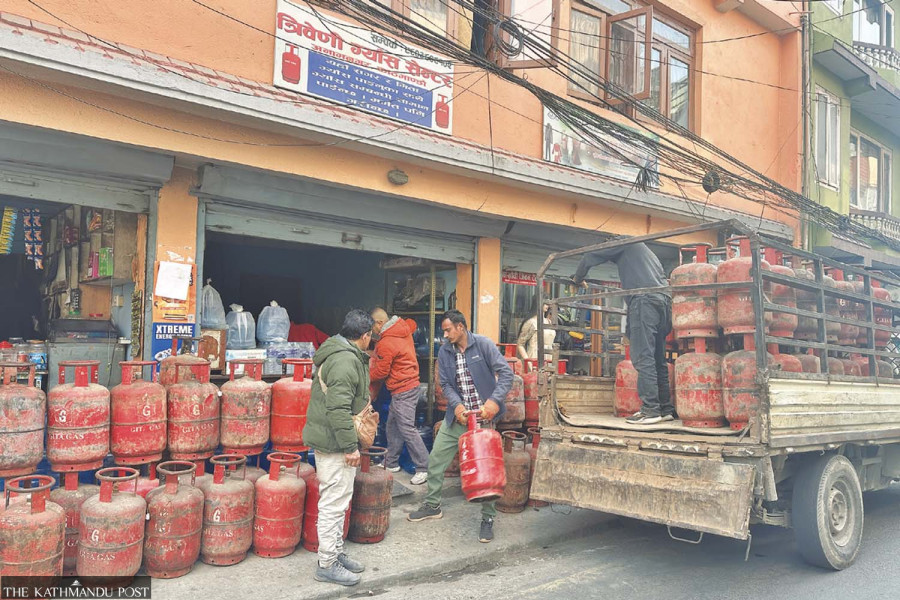
NOC blames high demand and refinery disruption, consumer groups allege market irregularities as inspections begin. Customers exchange empty cooking gas bottles with filled ones, at a depot in Anamnagar. Bibek Pokhrel/TKP
An ongoing shortage of cooking gas in Kathmandu Valley, just weeks ahead of the general election, has left thousands of households struggling and raised concerns about possible political repercussions if the situation is not normalised soon.
For the past three weeks, consumers across the Valley have reported difficulties in obtaining liquefied petroleum gas (LPG) cylinders, despite repeated assurances from the state-owned Nepal Oil Corporation (NOC) and LPG suppliers that supplies remain normal.
The shortage has disrupted daily life, forcing many families to queue for hours or search multiple outlets for a refill.
With elections approaching, insiders warn that a prolonged crisis could affect public sentiment and have political consequences if authorities fail to ease the situation in time.
In a public notice issued on Monday, NOC said it had made available contact numbers of major LPG brands reportedly facing shortages in the market, including Nepal Gas, Everest Gas, Sai Baba Gas and Shree Krishna Gas in the Kathmandu valley.
The corporation urged consumers to directly contact the companies concerned or purchase cylinders directly from factories if they face difficulties in the retail market.
According to NOC, the supply strain is primarily due to high demand. In its press statement, the corporation said that among the 23 LPG bottling plants operating in the Valley, several are dispatching around 40,000 cylinders to the market daily.
Currently, about 110 LPG bullets—large tankers transporting gas—are entering Nepal from India every day, the corporation said. NOC has also provided a hotline number for consumers to report shortages or irregularities in the market.
Diwan Bahadur Chand, president of the Nepal LP Gas Association, said LPG imports are arriving in line with daily consumption needs. “We are submitting details to the corporation on how much gas each factory has imported and how much has been supplied to dealers,” he said.
Chand maintained that consumers unable to find cylinders in the market can directly visit bottling plants, including the Nepal Gas facility in Balaju, where gas is being made available. “If anyone cannot find cooking gas, they can go directly to the factory and get it,” he said, adding that the company has also published relevant information on its official website.
However, he acknowledged that it may take some time for the market to fully stabilise. “All the imports are being immediately consumed. The previous shortfall must also be met as consumers have started to panic,” Chand said. “For this, additional LPG bullets need to be imported, and we are working on that.”
According to the association, around 100 LPG bullets enter Nepal daily, of which about 40 are supplied to Kathmandu. Despite this, consumers in the Valley—and increasingly in Pokhara—continue to report shortages.
Industry representatives have attributed the supply disruption to maintenance work at the Barauni refinery in India during November and December. The temporary shift to an alternative refinery created logistical challenges, including delays in obtaining transport permits, which they say affected regular supply.
NOC Deputy Director Manoj Kumar Thakur said Nepal’s monthly demand for LPG stands at around 45,000 tonnes. To address the current situation, the corporation has arranged an additional 2,000 tonnes, he said.
“As people panic, they start hoarding cooking gas, which artificially increases demand,” Thakur said.
He noted that there are over 10 million LPG cylinders in circulation across the country. Of these, around 3 million are with consumers, 3 million are at bottling plants for refilling, and another 3 million are in the market distribution chain. Filling 3 million cylinders requires approximately 45,000 tonnes of LPG per month, he added.
According to insiders, the shortage initially began with Nepal Gas, which holds the largest consumer base. Supply disruptions during the Barauni refinery maintenance, combined with internal conflicts within the company, affected its distribution network.
The unavailability of Nepal Gas cylinders triggered panic among consumers, contributing to what officials describe as a “shortage-like situation”.
The LPG association insists that hoarding at the dealer level is not possible due to storage and distribution constraints. However, consumer rights activists have alleged irregularities in the market.
Prem Lal Maharjan, president of the National Consumers Forum, questioned the official claim that supplies are normal. “If NOC and the LPG association say supply is normal, then where is the problem? Why are consumers struggling to get a cylinder?” he asked.
Maharjan said the forum has received complaints that some small dealers are charging extra fees to exchange cylinders of one brand for another, taking advantage of the shortage. “Dealers are reportedly demanding additional payments to swap brands. This is an unscrupulous practice and must be investigated,” he said.
The forum lodged a formal complaint with the Department of Commerce, Supplies and Consumer Protection ten days ago, urging immediate intervention if any foul play is found in the market.
Maharjan also blamed NOC for failing to act in time to prevent the crisis from escalating and hinted at political repercussions if the situation is not resolved soon.
In response, the department on Monday formed five dedicated inspection teams to conduct market monitoring focused on major LPG producers and suppliers. The teams will collect data on supply volumes, market availability, purchase and sales records, and any additional charges imposed during cylinder exchanges.
Officials said that if any irregularities are found during inspections, penalties will be imposed in coordination with NOC and the Nepal Bureau of Standards and Metrology.
On Tuesday, the department issued another statement urging stakeholders to take immediate steps to ease supply in the market. It called on NOC to strengthen coordination, ensure effective transportation, and guarantee equitable distribution of available LPG stocks.
The department also urged major LPG companies to expand production capacity to meet full demand and asked dealers and retailers to ensure fair and equal distribution.
Despite these measures, consumers continue to face uncertainty as the shortage drags into its fourth week. With the March 5 elections on the horizon, pressure is mounting on authorities to restore normalcy and prevent the supply crunch from deepening further.




 25.92°C Kathmandu