Clean energy push gains policy backing, but financing gap slows transition
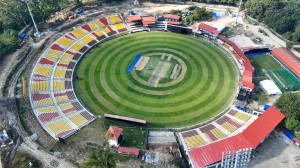
Despite near-universal electrification and new regulations, experts warn Nepal remains heavily dependent on fossil fuels as clean energy projects struggle to access finance. Nepal’s largest solar farm, located in Nuwakot district. Post file photo
The government says it has been introducing laws for renewable energy and prioritising its use in policies, strategies, programmes and projects. Clean energy producers, however, say the sector continues to suffer from a lack of adequate financing.
Participants at the “National Forum on Clean Energy in Action: Decarbonising Nepal’s Economy,” organised by the Alternative Energy Promotion Centre on the occasion of International Clean Energy Day, said on Tuesday that Nepal remains heavily dependent on traditional and fossil fuels despite ongoing efforts to transition to clean energy.
“Electrification has reached 99 percent of households. In rural areas where transmission lines have not reached, we have moved forward with electrification through alternative energy promotion,” said Chiranjeewee Chataut, energy secretary at the Ministry of Energy, Water Resources and Irrigation. “The Sustainable Energy Challenge Fund being implemented through the Central Renewable Energy Fund has made tremendous achievements in renewable energy projects.”
In areas where it is difficult to build transmission lines, 100 percent of households will be electrified using solar, wind and bioenergy, he said.
Chataut added that a draft action plan on energy efficiency has been prepared and the ministry is collecting feedback from stakeholders. A green hydrogen policy has also been prepared and is under discussion through a committee, and is expected to reach its final stage soon.
To make carbon trading more manageable, the government recently approved the Carbon Trading Regulation, 2025, creating the basic legal framework for carbon trade. Officials said the regulation is expected to support emission reduction, promote renewable energy and minimise the impacts of climate change.
The regulation covers carbon project development, emission reduction, carbon buying and selling, and implementation mechanisms, according to government representatives.
Participants stressed that diversifying energy sources to ensure energy security requires a balanced energy mix, including increased shares of wind, bioenergy and solar energy.
“We have prepared the Energy Development Roadmap, 2024, and the energy mix has been clearly mentioned in it,” said Chataut. A separate law on renewable energy and energy efficiency had already been submitted to Parliament before the House was dissolved. “The law was a priority, and we will request its approval by resubmitting it once Parliament is formed.”
Narayan Prasad Adhikari, deputy executive director of the Central Renewable Energy Fund, said electricity accounts for only about 10 percent of Nepal’s total energy consumption.
“When we talk about net-zero emissions, the current reality is that more than 80 percent of Nepal’s energy consumption is based on thermal energy,” he said. “This means we are still using traditional biomass energy and imported fossil fuels.”
Participants noted that while the share of traditional energy is declining, it is being offset by increased fossil fuel imports. Because Nepal’s transition has not been sustainable in that sense, they said the key question is how the country should proceed in the coming years.
“Our policies and their implementation have focused more on the supply side—essentially supply-side controls,” said Adhikari. “Now it seems necessary to move towards demand-side management. The Energy Ministry, Nepal Electricity Authority and the Alternative Energy Promotion Centre can jointly create an enabling environment.”
Nawa Raj Dhakal, executive director of the Alternative Energy Promotion Centre, said the centre has reached more than 3.7 million households, although some figures may be repetitive as the centre works across electrification, clean cooking, enterprise, health, education and agriculture.
He said the centre has supported 132 electric vehicle charging stations by providing viability gap funding (VGF) to private developers, creating infrastructure capable of charging 513 vehicles at a time and consuming up to 22 megawatts of electricity simultaneously.
For decarbonisation in the agriculture sector through electric and solar-powered systems, 227 institutions have benefited, resulting in a reduction of 48,071 tonnes of carbon dioxide emissions, Dhakal said.
“All this work has been done through the Central Renewable Energy Fund,” he added. “But there is a huge need for finance.”
Veronique Lorenzo, the European Union ambassador to Nepal, said the Global Gateway is Europe’s strategy to boost smart, clean and secure connections in digital, energy and transport sectors. Through the initiative, the EU provides financing with international financial institutions to de-risk investments by offering guarantees and technical assistance.
“In Nepal, this has mainly been done through energy generation, transmission and distribution projects supporting the green transition,” she said. “We have an ongoing pipeline of more than €60 million in grant funding.”
“Historically, what we have leveraged so far in Nepal amounts, according to our calculations, to about €3 billion,” Lorenzo said, adding that the EU is paying close attention to mainstreaming green finance in commercial banks. She cited a project implemented by the International Finance Corporation called Accelerating Climate-Smart and Inclusive Infrastructure in South Asia.
Prakash Kumar Shrestha, vice-chairperson of the National Planning Commission, said Nepal’s transition to green, clean energy would also help create a green economy.
The country has made strong progress in hydropower, increasing generation from around 500 megawatts in the past to about 4,000 megawatts now. With several projects in the pipeline, production is expected to reach 5,000 megawatts soon.
Electrification has helped reduce petroleum imports, but not enough, Shrestha said, noting that the country’s trade deficit continues to widen. To build capacity and competitiveness in energy production, he stressed the need for cheaper and more accessible loans across sectors.
Energy development will boost economic output and enhance Nepal’s competitive capacity, he added.




 13.77°C Kathmandu
%20copy.jpg&w=900&height=601)