



 22.94°C Kathmandu

Thu, Oct 22, 2026
Money
Wildlife drove farmers away, lemons bring them back
As crop damage by wild animals forces farmers to abandon traditional occupation and migrate, lemon farming emerges as a profitable and wildlife-resistant alternative across Bethanchok and Bhumlu rural municipalities.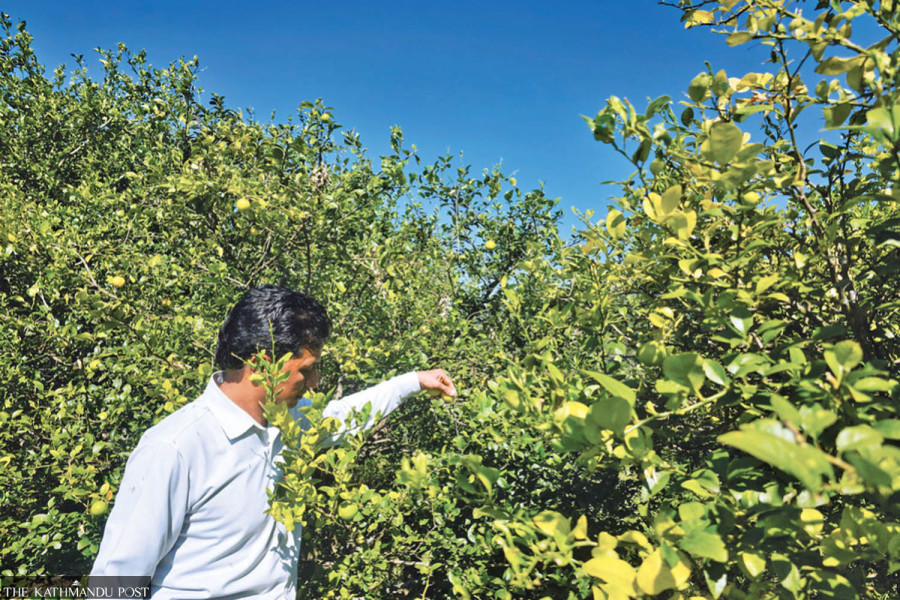
bookmark
Jyoti Shrestha
Published at : January 15, 2026
Updated at : January 15, 2026 07:23
Kavre
Farmers in Phaimarang of Bethanchok Rural Municipality-1 in Kavrepalanchok were once busy growing maize during the monsoon and mustard and buckwheat in winter. But after 2013, farming these traditional crops became increasingly difficult as wild boars, porcupines, bears, and monkeys repeatedly destroyed fields before harvest.
Frustrated by constant crop loss, local resident Ramesh Prasad Timilsina migrated with his family to Panauti eight years ago.
“Before the maize cobs even formed, wild boars and porcupines would destroy everything,” Timilsina said. “Even after staying up all night lighting fires and making noise, we couldn’t harvest more than 25 percent of the crop.”
His 15 ropani land in the village now lies idle. Of the 40 households in Phaimarang, only 12 remain, while the rest have migrated to nearby towns, mainly Panauti.
“The main reason for migration is wildlife terror, but education and employment opportunities have also led to the village becoming empty,” said Madhusudan Timilsina, ward chair of Bethanchok–1.
Gokul Gautam of Chilaune Danda in the same ward shares a similar story. Despite guarding his fields day and night, he failed to protect his crops from wild animals and left the village a year and a half ago. He is now cultivating vegetables on two ropanis of rented land in Panauti Municipality–8.
“I’ve been forced to leave my own land barren in the village,” Gautam said.
The problem extends beyond Bethanchok–1. Across Kavrepalanchok, wildlife damage has pushed many farmers to either abandon agriculture or seek alternative crops. In Bethanchok Rural Municipality–6, farmers have turned to lemon cultivation after discovering that wild animals largely avoid the crop.
Anjali Adhikari of Tar in Bhugdeu, Bethanchok-6, no longer worries about her fields. She has been growing lemons for seven years, and neither bears nor wild boars have damaged her orchard.
“About 10 years ago, one or two farmers planted five to seven lemon saplings, and wild animals didn’t touch them,” she said. “That encouraged me to start lemon farming.”
Adhikari planted 300 lemon trees on six ropanis of land. The trees began bearing fruit after three years, and for the past three years she has been earning between Rs500,000 and Rs600,000 annually.
“When I grew maize, I earned only Rs80,000 to Rs100,000, and sometimes nothing at all because of wildlife damage,” she said, adding that lemon farming brings at least double the income.
“A single lemon tree can produce continuously for 30 years, which makes it very profitable,” she added.
Encouraged by higher returns and reduced risk, even farmers who had left their land unused are now returning to agriculture. Seventy-two-year-old Kehar Singh Lama of Tarka, Bethanchok–6, had abandoned maize cultivation after repeated damage by bears and wild boars. Inspired by his neighbours, he planted 400 lemon trees on four ropanis seven years ago.
For the past four years, Lama has been earning around Rs500,000 annually. Over seven years, he has earned nearly Rs2 million from lemon farming. After annual expenses of about Rs50,000, most of the income goes into savings.
“Sometimes monkeys try to climb the trees, but the thorns prick them and they run away,” he said. “When we planted maize, wheat, or mustard, they left nothing.”
According to Madhusudan Dahal, chief of the Agriculture Section of Bethanchok Rural Municipality, most farmers are planting Sunkagati, an improved lemon variety well-suited to the area’s ample sunlight and favourable climate.
After repeated appeals from farmers, the provincial government recommended lemon farming as an alternative. In Falante, most farmers planted 50 to 60 subsidised lemon saplings, which began producing fruit within four years. As a single tree can remain productive for 20 to 25 years, farmers found lemons far more profitable than maize.
Land that had remained uncultivated for years is now being brought back into use.
In Bhumlu Rural Municipality–8, Prem Bahadur Bhujel of Gharikhet, who is also the rural municipality chair, planted 600 Sunkagati lemon trees on 20 ropani.
“Following agricultural experts’ advice that lemons are safe from wildlife, I started commercial lemon farming,” he said. The trees began bearing fruit within three years, and last year alone he earned about Rs700,000. With proper weeding, pruning, irrigation, and fertilisation, lemons can provide stable income for two to three decades, he added.
Under last year’s policies and programmes, Ward 6 was declared a lemon pocket area with Rs150,000 allocated in the budget. In the previous fiscal year, 79 farmers received free lemon saplings. In the current fiscal year, Rs300,000 has been allocated for lemon farming, Dahal said.
Bhumlu Rural Municipality has also prioritised lemon cultivation, allocating Rs150,000 under a Lemon Pocket Area Management Programme. Farmers have received training on cultivation techniques, pruning, disease and pest control, along with access to tools, tractors, and subsidised saplings.
Farmers in settlements such as Falante, Jamune, and Pauwa are now expanding lemon farming commercially, with many already earning steady income.
District agriculture data show that over the past five years, the area under lemon cultivation and total production in Kavrepalanchok have more than doubled. In fiscal year 2020-21, lemons were grown on 255 hectares, producing 2,480 tonnes. In 2021-22, production rose to 4,635 tonnes from 302 hectares. Although production declined in 2022-23, with 3,256 tonnes harvested from 402 hectares, output rebounded in 2023-24 to 4,485 tonnes from 579 hectares.
In 2024-25, lemon cultivation expanded to 632 hectares, producing 5,051 tonnes. Kavrepalanchok now accounts for 8.45 percent of Nepal’s total lemon production.
Lemons are sold fresh and also processed into pickles, candy, titaura, and citric products. Entrepreneur Kamala Lama said one kilogram of lemon pickle can fetch up to Rs1,500, with the demand strong and growing.
Jyoti Shrestha
Jyoti Shrestha is the Kavre correspondent for Kantipur Publications.

Most Read from Money

Nepal travel agents threaten to stop selling Thailand trips over visa rules

Why does an hour long flight to Dhangadhi cost more than a flight to New Delhi?
Malaysia rejects Nepal’s demand to open recruitment to all manpower agencies

No school, but a graduation cap for women dairy farmers

Nepal arrests four medical service providers as Malaysia recruitment row deepens
Editor's Picks




E-PAPER | October 22, 2026

×