



 19.48°C Kathmandu

Thu, Oct 22, 2026
Money
Thorgeli Jaggery turns sugarcane into a year-round livelihood in Gulmi
Named after the village of Thorga, the jaggery brand is carving out its own market identity and supporting hundreds of farmers.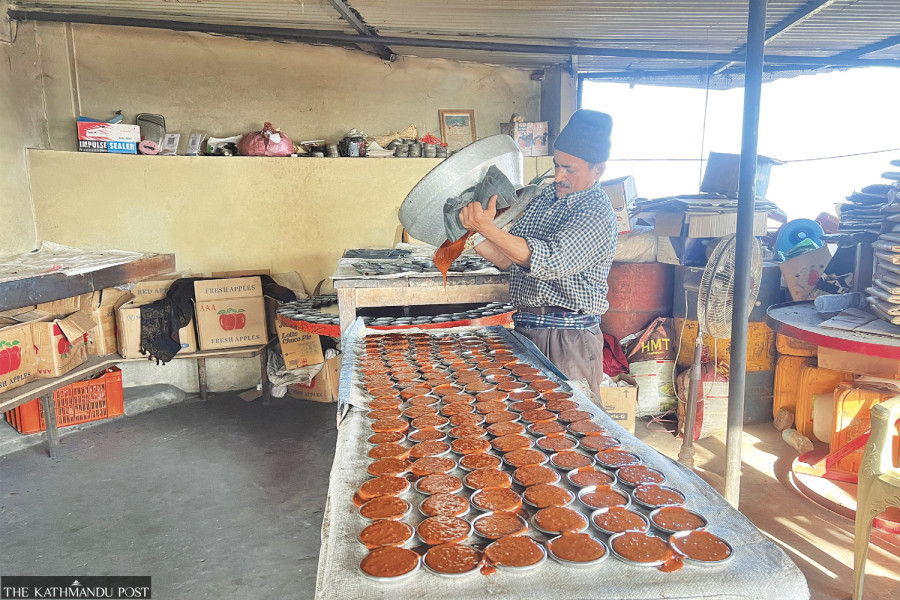
bookmark
Santosh Mahatara
Published at : January 13, 2026
Updated at : January 13, 2026 06:59
Gulmi
Neither winter nor monsoon determines the pace of work here.
Farmers do not have to wait for a fixed crushing season either. Sugarcane juice pressed at the right time is cooked into molasses that lasts the whole year, and that molasses is further refined into jaggery as needed. The finished product rarely needs storage.
Gulmi’s “Thorgeli Jaggery,” named after the village of Thorga, renowned for its sugarcane, has already carved out its own identity in the market, enjoying steady demand throughout the year. With no serious marketing constraints, sugarcane farming in the area is becoming increasingly attractive to farmers.
Cholanath Gyawali, a sugarcane farmer, in ward 3 of Rurukshetra Rural Municipality, has been growing sugarcane for generations.
About nine years ago, he expanded production to 85 ropani [4.32 hectares], leasing 45 ropani [2.29 hectares] in addition to his own land. His fields grow several varieties including Kalagandh, Rato Koser, Jitpure-5 and local strains. Using a modern large-scale machine, he can crush a significant quantity of cane at once.
Six workers are employed on a daily basis, rising to 12 to 15 during the peak season.
His annual turnover reaches around Rs25 million. After expenses, he retains roughly half as net income. He sells both molasses and jaggery in the local market, with about 9 tonnes marketed annually. According to him, there are no market-related problems.
Gyawali says sugarcane farming can be highly profitable if farmers rely on their own efforts rather than waiting for subsidies.
Those who depend solely on grants do not last long, he says, but farmers who work independently with limited support can sustain the business. The only serious challenge he points to is damage caused by monkeys, while other problems are minimal.
He has been gradually expanding the ancestral occupation and hopes for effective solutions to protect crops from wildlife.
Top Bahadur Poudel, who has been working on Gyawali’s farm for the past three years, says the jaggery produced here is entirely organic.
Sugarcane is crushed, the juice is cooked into molasses, and the molasses is further cooked into jaggery without any additives. According to him, Thorgeli jaggery is commonly taken as a gift to Pokhara and Kathmandu.
In the same ward, Shishir Gyawali of Thorga runs the Gyawali Agriculture and Livestock Farm, expanding sugarcane cultivation on 20 ropani [1.02 hectares] of land.
Though his family has grown sugarcane for generations, he has scaled it up over the last five years.
He earns around Rs400,000 to Rs500,000 annually from sugarcane, selling both molasses and jaggery. He says he shifted away from traditional crops, but faces persistent problems from monkeys and crop damage.
He sells about 35 quintals of jaggery annually at Rs280 per kilogram and reports no difficulty in marketing.
To maintain productivity, he rotates crops every five to seven years.
Sugarcane is cultivated commercially on sloping land previously used to grow maize, wheat and mustard.
He believes no other crop matches sugarcane in returns. Since he also practises livestock farming, fodder availability has not been an issue. His farm employs two to three workers daily and four to five during the season, with family members also actively involved.
Earlier, oxen were used for crushing cane, but modern machines have gradually been added. The farm now operates a diesel-powered crusher.
In the same locality, Gangadhar Gyawali has been cultivating sugarcane for seven years on 11 ropani [0.56 hectares. A ropani is 0.05 hectares] of land that previously grew maize and mustard. He says products sold under the Thorgeli jaggery name fetch better prices.
By selling molasses alone, he saves around Rs300,000 annually. During the season, five to seven workers are needed daily. According to him, sugarcane farming is ten times more profitable than traditional crops, and quality seed is available through subsidies.
Beyond individual farms, Thorga, a village renowned for its sugarcane, now hosts the Thorgeli Jaggery and Molasses Industry operated through the Ruru Multipurpose Cooperative.
The cooperative includes 134 sugarcane farmers and currently produces jaggery and candies. Quality testing and packaging are done at the plant, with farmers directly sharing profits and losses.
Bhesh Raj Gyawali, chairman of the cooperative, said the factory was set up with support from Rurukshetra Rural Municipality, Heifer International, the Cottage and Small Industries Office, and the Agriculture Knowledge Centre in Gulmi.
Seven people are employed daily, including during the season. The industry purchases sugarcane at Rs11 per kg and sells processed jaggery at Rs275 per kg. Products are marketed in Thanpati, Baletaksar and Ridi, while jaggery-based candies sell at Rs400 per kilogram.
The factory handles procurement, transportation, collection, crushing, juice extraction, cooking, and the production of molasses, jaggery and other value-added products.
Annually, it purchases 270 tonnes of sugarcane and sells 19.49 tonnes of jaggery, 6,262 litres of molasses and 482 kilograms of candy. Total annual income stands at Rs6.427 million against expenses of Rs4.527 million, leaving a net profit of Rs1.9 million.
Only lab-tested products are sent to the market.
Farmers affiliated with the factory cultivate sugarcane on around 178 hectares, and interest has increased since the cooperative began operations. The plant produces five to six quintals of molasses and jaggery daily using modern crushing and cooking technology.
Including individual and cooperative efforts, sugarcane is grown on nearly 203 hectares. Together, farms and cooperatives produce around 40 tonnes of jaggery annually, with comparable volumes of molasses, while the market for candies produced by the factory is steadily growing.
Yadu Gyawali, chairperson of the Rurukshetra Rural Municipality, said Thorgeli jaggery is steadily building a distinct identity. It is increasingly popular as a gift and souvenir, and the municipality has introduced incentive programmes to motivate farmers.
Support includes subsidies, organic fertiliser, technical assistance, market promotion and cooperative-based integration.
“Efforts are also underway to strengthen labelling, packaging and branding to ensure quality and better market access,” he said.

Most Read from Money

Nepal travel agents threaten to stop selling Thailand trips over visa rules

Why does an hour long flight to Dhangadhi cost more than a flight to New Delhi?
Malaysia rejects Nepal’s demand to open recruitment to all manpower agencies

No school, but a graduation cap for women dairy farmers

Nepal arrests four medical service providers as Malaysia recruitment row deepens
Editor's Picks




E-PAPER | October 22, 2026

×