



 14.81°C Kathmandu
Sat, Oct 24, 2026
Money
Nepal, Bangladesh resume talks on preferential trade deal after years of deadlock
Commerce secretary-level meeting in Dhaka to revisit tariff disputes, trade facilitation, transit routes and investment cooperation.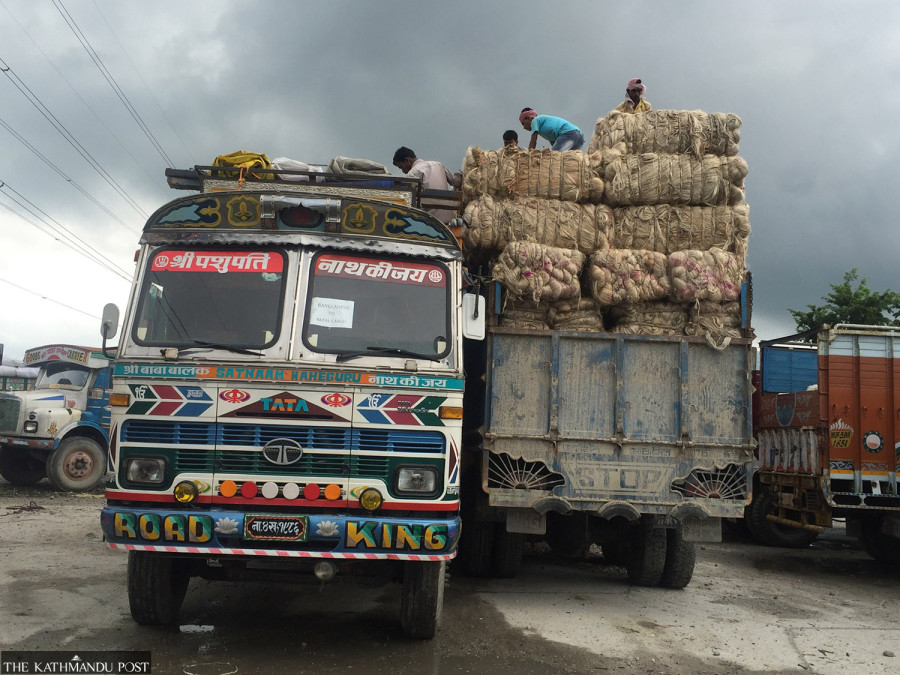
bookmark
Post Report
Published at : January 11, 2026
Updated at : January 12, 2026 06:59
Kathmandu
Nepal and Bangladesh are set to resume commerce secretary-level talks in Dhaka, reopening long-pending issues, most notably the proposed bilateral preferential trade agreement (PTA) and the list of goods to be covered under it.
The two-day meeting, scheduled to begin on Tuesday, will be co-chaired by Nepal’s Commerce Secretary Ram Prasad Ghimire and Bangladesh’s Commerce Secretary Mahbubur Rahman. Officials say the talks aim to strengthen economic relations and boost sub-regional connectivity.
The last such meeting, the sixth Nepal–Bangladesh commerce secretary-level dialogue, was held virtually in October 2020. At the time, the two sides agreed in principle to sign a bilateral PTA for the first time since the establishment of diplomatic relations in 1972. However, disagreements over tariff and para-tariff issues prevented the negotiations from reaching a conclusion.
An official at Nepal’s Ministry of Industry, Commerce and Supplies told the Post that Kathmandu will again push for the removal of high tariff and para-tariff charges imposed by Bangladesh on Nepali goods as a precondition to signing the PTA.
In 2020, Bangladesh had sought the PTA amid growing trade and services between the two countries. Nepal, however, insisted on the elimination of so-called “other duties” levied by Bangladesh on all imports, arguing that these hidden charges significantly raise the cost of Nepali exports.
A preferential trade agreement allows member countries to grant preferential market access to selected products. As an original member of the World Trade Organisation, Bangladesh is permitted to impose such other duties. Nepali officials say that when these are added to regular tariffs, total charges on Nepali exports can reach as high as 130–132 percent. Bangladesh has been reluctant to remove these duties, citing potential revenue losses.
Before a PTA can be finalised, Nepal must also prepare a list of potential exportable goods. Officials say frequent changes in government over the past year delayed this process.
“In every bilateral meeting, Bangladesh says it will remove tariff, para-tariff and other duty charges, but this has not materialised in practice,” said an industry ministry official. “We have updated the list of potential goods compared to earlier rounds, and this will be finalised during the meeting.”
According to officials, a PTA can only be concluded after field studies and a detailed analysis of potential export and import items. The continued imposition of countervailing and other duties has made Nepali products less competitive in the Bangladeshi market.
Beyond the PTA, the two sides will also discuss broader trade and investment cooperation. Nepal has already forwarded a draft Bilateral Investment Agreement to Bangladesh, which will be taken up during the talks. Transit and connectivity issues, including the use of inland waterways, are also on the agenda.
“Bangladesh has already provided the Rohanpur–Singhabad port of call, and Nepal may discuss utilising the port,” the official said.
The Rohanpur–Singhabad railway route is seen as an additional trade corridor between Nepal and Bangladesh, enabling the transit of bulk and container cargo through India. It is expected to complement existing road links and seaport access via Chittagong and Mongla, with the potential to reduce transit time and costs, although procedural bottlenecks remain.
Officials said discussions may also cover other possible railway connectivity options. Sanitary and phytosanitary (SPS) measures will be another key focus, aimed at easing non-tariff barriers by harmonising standards for food, plant and animal products, strengthening quarantine systems and relaxing rules for organic goods.
The issue of visas for Nepali students and businesspeople will also be raised. Bangladesh does not currently provide visas on arrival to Nepali nationals in these categories.
Nepal’s total trade with Bangladesh stands at Rs5.84 billion. According to the Department of Customs, Nepal’s exports to Bangladesh rose by 20 percent in the last fiscal year ended mid-July, compared to the previous fiscal year 2023-24, reaching Rs666.15 million.
Nepal’s major exports to Bangladesh include cane molasses extracted or refined from sugar, red lentils, hand-operated floor sweepers, medicinal and aromatic plants, raw khayer, bran, sharps and other cereal residues, and seeds of fruits and vegetables.
Imports from Bangladesh surged 55.7 percent to Rs5.18 billion during the same period. Nepal mainly imported raw jute, medicaments, potatoes, toilet paper, lead-acid batteries, rusks, juice, hair oil, yarn, textiles and fibre, and chocolate.
According to a 2023 study by the South Asia Watch on Trade, Economics and Environment (SAWTEE), Nepal’s exports to Bangladesh remain extremely limited. In 2022, Nepal’s exports to the country stood at just $4.4 million.
The study notes that although Nepal’s exports to Bangladesh rose sharply between 2006 and 2010—peaking at $66.5 million in 2008—they have been on a gradual decline since. While Bangladesh’s share in Nepal’s export destinations increased during the 2007–2010 period, Nepal’s exports to Bangladesh have remained negligible in terms of its overall global exports for most of the past two decades.
Nepal’s imports from Bangladesh, by contrast, have recorded a steady rise since 2006. Imports increased from a low of $1.5 million in 2006 to $65.9 million in 2022, reaching a peak of $128.9 million in 2021. Despite this growth, imports from Bangladesh still account for well below one percent of Nepal’s total global imports, indicating limited overall trade integration.
The SAWTEE study further highlights that Nepal’s exports to Bangladesh suffer from a lack of product diversification. Exports are heavily concentrated in a single commodity—lentils—which on average account for 89.5 percent of Nepal’s total exports to Bangladesh. Nepal’s top ten export items together make up 98.5 percent of total exports to the Bangladeshi market.
Reflecting this narrow export base, agricultural goods dominate Nepal’s export basket to Bangladesh. Agricultural products account for about 99 percent of Nepal’s average exports to Bangladesh, with the category of fruits, vegetables and plants alone constituting roughly 91 percent of the country’s average exports during the 2017–2021 period.




Most Read from Money

Why does an hour long flight to Dhangadhi cost more than a flight to New Delhi?

Nepal travel agents threaten to stop selling Thailand trips over visa rules
Malaysia rejects Nepal’s demand to open recruitment to all manpower agencies

No school, but a graduation cap for women dairy farmers
Nepal arrests four medical service providers as Malaysia recruitment row deepens
Editor's Picks




E-PAPER | October 24, 2026

×