Contractors blast government over mass termination of ‘sick’ infra projects
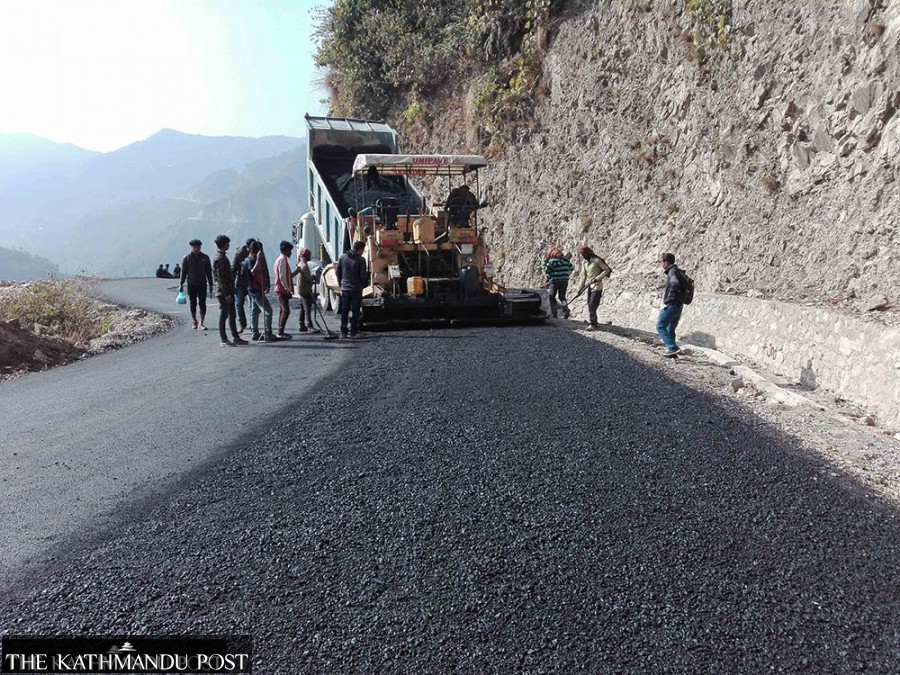
Say move politically motivated and could trigger legal disputes, stall development and cause wider economic fallout. The physical infrastruture ministry recently published a notice announcing the termination of 235 road and bridge contracts. Post file photo
The Federation of Contractors’ Associations of Nepal has accused the current government of breaching its mandate by terminating a large number of infrastructure project contracts, claiming the move is politically motivated and risks pushing projects into prolonged uncertainty.
At an interaction titled Impact of termination of infrastructure project contracts, organised by the Society of Economic Journalists–Nepal in Kathmandu on Monday, federation president Rabi Singh said the termination of so-called sick projects by the Ministry of Physical Infrastructure and Transport was neither fair nor based on objective assessment.
Singh alleged that Physical Infrastructure Minister Kulman Ghising’s decision to terminate contracts was driven by political interests rather than a genuine effort to resolve long-stalled projects. “These moves will attract legal consequences and leave projects in limbo,” he said.
The ministry recently published a notice announcing the termination of 235 road and bridge contracts. Of the nearly 2,800 projects under the ministry, around 300 have been identified as problematic.
Singh argued that before terminating contracts that have remained stalled for years, the government must first conduct a serious study into the reasons behind the delays.
Contracts that can be regularised should be continued by allowing existing construction companies to complete the work, he said, adding that termination should be treated as a last resort after all corrective measures fail.
The federation also criticised provisions in the Public Procurement Act that require contractors to pay the full remaining contract amount if a project is terminated.
According to Singh, this has paradoxically contributed to projects remaining stalled, as termination becomes both financially punitive and legally contentious.
“Nearly 90 percent of contracts are stalled or terminated due to the incompetence of appointing authorities, unnecessary project announcements by political leaders, delays in land acquisition, and [government’s] failure to clear hand over construction sites on time,” Singh said.
He added that despite raising these concerns with the minister, the federation was told that sick contracts would be terminated regardless of the consequences.
Participants at the interaction warned that widespread termination of contracts could disrupt the economic cycle and undermine national development.
They said such decisions affect cash flows across the construction sector, banking system and labour market, ultimately impacting the broader economy.
Government officials, however, said multiple structural problems contribute to projects becoming sick.
These include inadequate annual budget allocations, frequent design changes, differences in site conditions, unresolved utility issues, difficulty in procuring construction materials, local obstructions, natural disasters and weak project management by contractors.
Misuse of project funds, failure to mobilise capital and manpower, and insufficient reinvestment in ongoing projects were also cited as key factors.
“Our objective is not to terminate contracts, because it is an extremely difficult process,” said Keshav Kumar Sharma, secretary at the Ministry of Physical Infrastructure and Transport. “The objective of both parties should be to complete the work.”
Sharma said contracts are awarded with the expectation of successful completion, and terminating large construction contracts involving multiple stakeholders is far more complex than breaking simple agreements.
Under existing legal provisions, if a contract is terminated, the remaining work must be completed and any additional cost recovered from the original contractor. He acknowledged that this requirement is often impractical and irrational, making termination legally risky and pushing parties towards court disputes.
Re-awarding terminated contracts also requires multiple approvals and consumes time, Sharma said, adding that contractors are generally reluctant to take over abandoned projects. “We have only a few examples where this process worked smoothly,” he said.
Former Physical Infrastructure Ministry secretary Arjun Jung Thapa said frequent changes in government are a major reason projects turn sick.
Priorities set by one government are often abandoned or underfunded by the next, resulting in budget cuts or complete withdrawal of funding for ongoing projects.
Thapa also pointed out structural weaknesses within the construction sector, noting that around 90 percent of contractors operate informally without adequate corporate offices or engineering capacity. Many enter the sector assuming it is easy money, he said, acknowledging that some contractors do deserve penalties.
At the same time, Thapa admitted shortcomings on the government side. Environmental clearances can take years, significantly delaying projects, and there have been instances of misconduct by government officials.
The problem of sick contracts has worsened since the early 2000s. In 2018, the Commission for the Investigation of Abuse of Authority (CIAA) began closely examining the issue.
By February 2019, it had identified 1,848 sick project contracts nationwide, including around 966 under the Department of Roads alone.
According to officials, the CIAA played a largely supportive role, focusing on resolving and completing projects rather than punishing stakeholders. The commission monitored progress every two to three months and directed authorities to identify the root causes behind stalled contracts, emphasising cooperation to bring projects to closure.




 26.87°C Kathmandu