



 14.81°C Kathmandu
Sat, Oct 24, 2026
Money
Gold’s rally continues as investors seek safe haven amid global uncertainties
Bullion has surged about 70 percent this year, driven by geopolitical tensions, the US rate cuts, strong central bank buying and robust investment demand.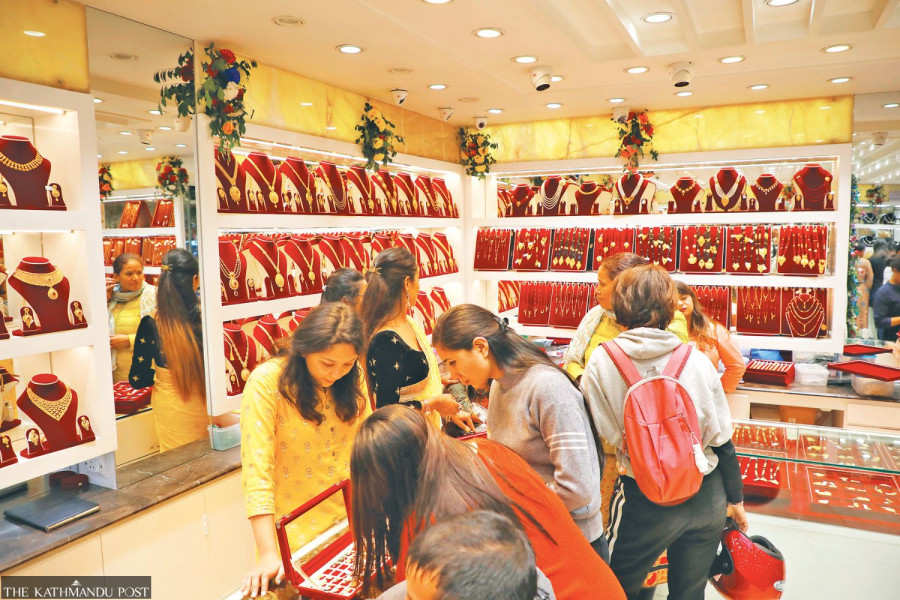
bookmark
Post Report
Published at : December 26, 2025
Updated at : December 27, 2025 07:45
Kathmandu
Nepal’s gold dealers have predicted a further bullish trend, just as the precious metal surged to a new high of Rs269,300 per tola in the local bullion market on Friday.
Arjun Rasaili, president of the Federation of Nepal Gold and Silver Dealers Association, said they have estimated gold prices to cross the Rs300,000 mark within the first four months of 2026, triggered by various external factors like geopolitical tensions and the US rate cuts.
International media reports say that gold prices surged to a record high in early Asian trading on Friday, buoyed by safe-haven demand and rising expectations of further interest rate cuts by the US Federal Reserve. Spot gold rose 0.5 percent to $4,501.44 per ounce, after touching a record peak of $4,530.60 earlier in the session.
Bullion has surged about 70 percent this year, driven by geopolitical tensions, the US rate cuts, strong central bank buying and robust investment demand.
International market analysts are predicting gold rising towards $5,000 per ounce next year.
Silver in Nepal was priced at Rs4,565 per tola on Friday.
The festive season of Christmas and New Year, when the trend of gifting gold and silver coins is common in the international market, has contributed to the rise in prices, said Rasaili. Besides, the buying and selling of paper gold in the international commodity market is huge and will further contribute to the surge in gold price.
Paper gold refers to financial instruments that represent ownership of gold without the need to physically hold the metal.
Gold is a popular hedge against currency market volatility. It has traditionally moved in the opposite direction to the US dollar, since weakness in the US currency makes dollar-priced gold cheaper for holders of other currencies and vice versa.
US President Donald Trump's trade tariffs have sparked a global trade war, rattling currency markets.
The policy decisions of global central banks also influence gold's trajectory. Lower interest rates reduce the opportunity cost of holding gold since it pays no interest.
Large buyers and institutional investors usually buy gold from big banks. Prices in the spot market are determined by real-time supply and demand dynamics. Spot gold is the current market price at which gold can be bought or sold for immediate delivery.
London is the most influential hub for the spot gold market, largely because of the London Bullion Market Association. The association sets standards for gold trading and provides a framework for the over-the-counter market, facilitating trades among banks, dealers, and institutions.
China, India, the Middle East and the United States are other major gold trading centres.
The gold and silver import sharply jumped by 444.64 percent in the first five months of the current fiscal year ended in mid-December compared to the same period last fiscal year.
According to the Department of Customs, Nepal imported 23,689 kg of gold and silver worth Rs21.35 billion during the review period. The country imported 22,745 kg silver worth Rs4.97 billion and 944 kg gold for Rs16.37 billion during the review period.
The import surge is due to people turning to investing in gold and silver considering a safe haven amid the country's deepening political uncertainty and a gloomy investment climate.
Bullion traders said that the market faced scarcity of silver during September-October.
Market experts say the share market and real estate sector continue to underperform, leaving investors wary after years of scandals, corruption, and policy turbulence. As other avenues stall, many are turning to gold as a safe-haven asset despite its historically high prices.
A general practice is that when banks cut interest rates, investors directly invest in gold. Inversely, when the rate is hiked, investors sell gold and deposit the amount in a bank.
Globally, the sale of gold jewellery is down almost due to the sharp rise in price and the scenario is similar in Nepal, bullion traders say. Currently, nearly 10–15 kg of gold is being transacted in the market daily.
“Bullion traders are buying only 5–10 kg of gold from banks while the rest of the demand is being met with purchases from customers,” said Rasaili.
The reverse trend of selling gold by customers has increased on the high prices. “We are buying 7–8 kilos of gold daily from customers. People who have made small investments in gold are also coming to sell due to the rise in price and people owning old jewellery are also coming to sell gold.”
The reverse trend of selling gold by customers increased from mid-December when the price started inclining from Rs250,000 per tola.
Demand for silver is also growing in the domestic market as the price is breaking everyday records.





Most Read from Money

Why does an hour long flight to Dhangadhi cost more than a flight to New Delhi?

Nepal travel agents threaten to stop selling Thailand trips over visa rules

Malaysia rejects Nepal’s demand to open recruitment to all manpower agencies

No school, but a graduation cap for women dairy farmers
Nepal arrests four medical service providers as Malaysia recruitment row deepens
Editor's Picks




E-PAPER | October 24, 2026

×