Shallow and deep borewells fail during drought in Madhesh
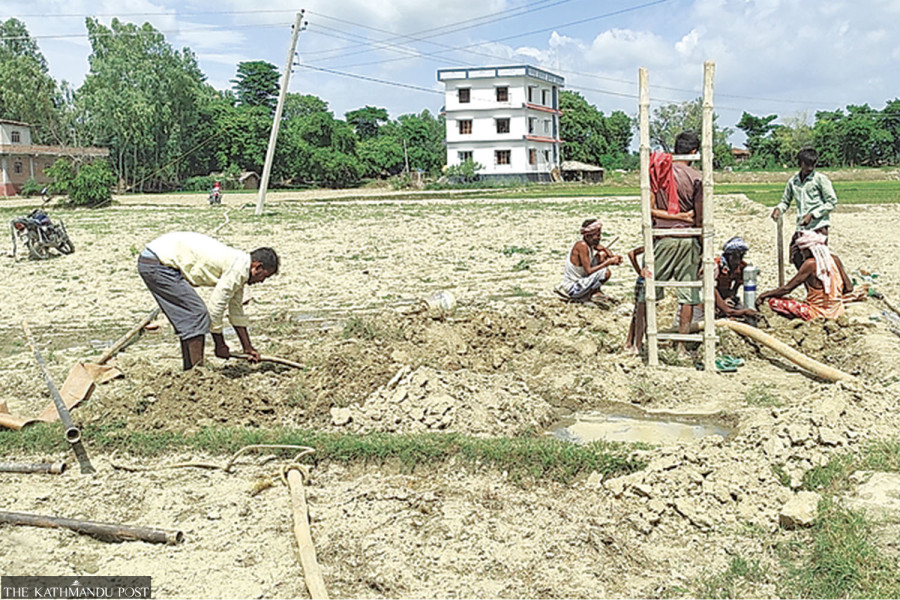
Budget shortage leaves long-defunct deep borewells unrepaired. Besides, technical faults, transformer theft, lack of pipelines, and absence of active local user committees have kept many borewells idle. Installing a single deep borewell costs close to Rs10 million, while a shallow tubewell costs between Rs300,000 and Rs400,000. Post file photo
Every year, farmers across the country follow an unwritten agricultural calendar: paddy transplantation begins in June and must be completed by mid-August.
Last monsoon, however, farmers in Madhesh Province faced an acute drought right during the transplantation season. With little to no rainfall even in the monsoon months, it became impossible to transplant paddy on time in dry fields.
In Madhesh, known as Nepal’s food basket, farmers who had access to small and large deep borewells around their fields managed to transplant paddy. Those without such access were forced to rely solely on rainwater.
Madhesh province has around 9,000 small and large deep borewells installed with government funding. Of these, nearly 1,500 are inoperational. Due to funds shortages, most of them are broken and abandoned.
Despite such extensive irrigation infrastructure, farmers in Madhesh were seen lamenting during the transplantation season. Deep borewells installed at a cost of millions of rupees have remained unrepaired and shut down for nearly a decade.
Installing a single deep borewell costs close to Rs10 million, while a shallow tubewell costs between Rs300,000 and Rs400,000. Even after such heavy public investment, farmers are still forced to depend on rainfall during droughts, leaving fields barren due to lack of water.
Officials complain that the failure to operate newly installed and old deep borewells, shallow tubewells, and small deep borewells across all eight districts of Madhesh has turned a massive state investment into water poured onto sand.
The Groundwater Resources and Irrigation Development Division Office in Sarlahi has installed 68 deep borewells in Rautahat since fiscal year 2018–19. Under the Tarai-Madhesh Groundwater Irrigation Programme, 15 borewells were installed through the Navin Yantrik Sinchai Project in Sukepokhari, and 55 small borewells through the Federal Drinking Water and Sanitation Project in Birgunj.
Altogether, 138 borewells were installed across 19 local units in Rautahat. Of these, 23 have broken down, according to the office. Due to lack of budget, repairs have not been carried out.
According to the Agriculture Knowledge Centre in Rautahat, paddy is cultivated on around 35,000 hectares in the district. This year, transplantation was delayed. As most deep borewells were shut down due to lack of maintenance, farmers could not cultivate on time despite the presence of irrigation structures.
Farmer Ram Lachan Sah said they failed to benefit because the installing agencies left works incomplete. “A deep borewell meant to irrigate 40 bighas of land has turned into a wasted investment,” he said. “Borewells installed at a cost of millions are shutting down one after another.”
The Sarlahi division office reported that out of 68 deep tubewells installed in Rautahat, 17 are completely non-operational and six are partially operational.
Since drilling was done without electrification, many borewells could not be brought into use. Office chief Anupama Dhakal said installing a single deep borewell costs around Rs10 million when electricity, pipelines, and other components are included.
Deep and shallow tubewells installed at huge costs remain unrepaired due to budget shortages.
Near Badeharwa Bridge in Gaur Municipality, a deep borewell has not operated for over a decade. In some places, borewells are shut because transformers were stolen; in others, groundwater has depleted. Uncontrolled extraction of groundwater has lowered the water table, causing borewells to fail during periods of low rainfall.
In Madhav Narayan Municipality-3 of Rautahat, water from a deep tubewell irrigation system stopped flowing after six hours, said local farmer Ram Bahadur Yadav. In Chandrapur Municipality-8, borewells drilled near Bagmati Irrigation Project canals were abandoned without being operational. Many borewells lie idle.
While broken borewells remain unrepaired, investment continues in installing new ones. As new borewells are added every year, water scarcity during dry seasons has become even more severe. Farmers are increasingly worried due to the lack of reliable irrigation.
In Rajdevi Municipality-7, Mudbalwa, irrigation problems arose because a deep tubewell was non-operational.
Installed in 2008 by the Agricultural Mechanisation Promotion Centre, the tubewell has been shut for three years after its transformer was stolen.
The facility, capable of irrigating 60 bighas, was built with a government investment of Rs4.8 million. The District Administration Office has written to the Nepal Electricity Authority to reinstall the transformer.
According to the Groundwater Irrigation Development Division Office in Lahan, technical faults, transformer theft, lack of pipelines, and absence of active local user committees have kept many borewells idle.
In Rautahat, 46 deep borewells have been installed, but only 28 are operational, said information officer Dipika Sah of the Siraha division office. Problems include transformer theft, unpaid electricity bills, delayed maintenance, and disputes among users.
The Agriculture Knowledge Centre in Siraha estimates around 1,000 shallow tubewells in the district.
“No matter how many borewells are installed, farmers still depend on rainfall,” said Narendra Kumar Mahaseth, chief of the knowledge centre. Only 89 percent of the 54,000 hectares of paddy land in Siraha was transplanted this year. Many borewells installed two decades ago still lack electrification, pipelines, and user committees.
On August 23, the government declared Madhesh a drought-affected region and announced plans to install 500 deep borewells.
Chief Minister Krishna Yadav said that although the plan was announced earlier, no progress has been made. He said all non-operational borewells would be repaired and brought back into use to ensure farmer relief even during future droughts.
Across Madhesh, hundreds of shallow and deep borewells remain non-functional.
Large investments have gone to waste due to neglect in maintenance and electrification. Engineers say budget cuts after irrigation offices came under provincial governments have worsened the situation, leaving farmers exposed to recurring drought despite massive infrastructure spending.




 15.26°C Kathmandu