



 14.81°C Kathmandu
Sat, Oct 24, 2026
Money
Farmers in Kailali struggle to sell paddy
In Nepal’s farwest, most farmers have not been able to sell their paddy at a fair price despite the government announcing the minimum support price.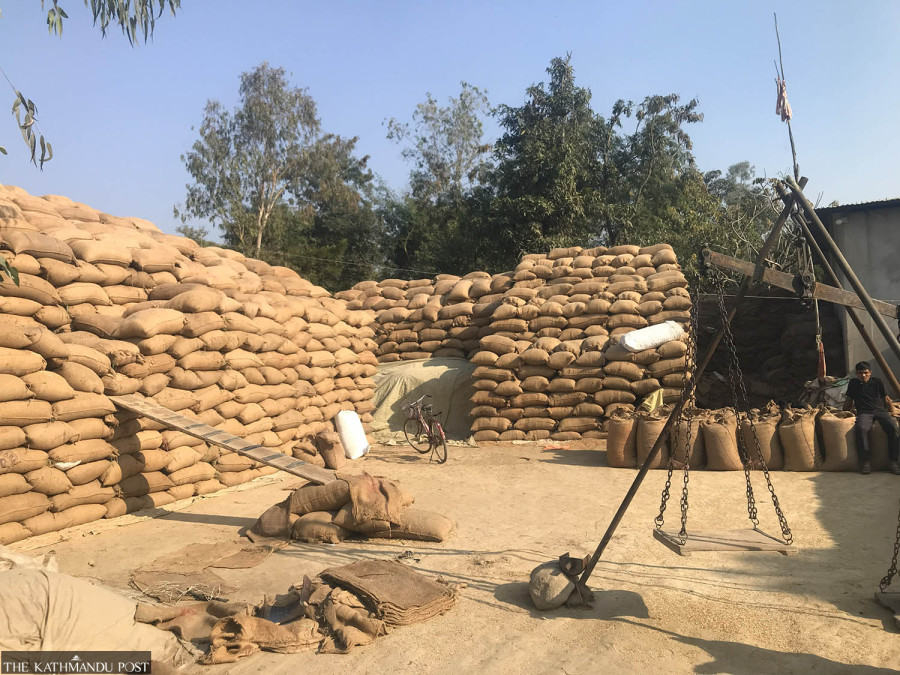
bookmark
Arjun Shah
Published at : December 13, 2025
Updated at : December 14, 2025 07:12
Kailali
Every morning, when Bhagiram Chaudhary of Bhajani Municipality-3, Padariya, wakes up, he is reminded of his losses—having been forced to sell his paddy to traders at rates far below the government-fixed price.
“I had already sold 20 quintals of paddy to traders at a low price of Rs2,500 per quintal to cover immediate expenses for wheat farming. I still have 50 quintals of paddy stored at home. Now the price has dropped further to Rs2,300,” said Bhagiram Chaudhary, a farmer of Bhajani Municipality-3, Padariya.
“I’m worried that the paddy at home will be ruined by rats. Now, even at a low price, I have no choice but to sell.”
In Kailali, most farmers have not been able to sell their paddy at a fair price.
Some have had to sell it to local traders at a lower rate. This year, the Food Management and Trading Company Limited had set the purchase price of coarse paddy at Rs34.63 per kg.
However, the company has stopped buying, claiming that the allocated quota for paddy purchase has been over. Farmers, meanwhile, are still unable to sell their paddy.
“About 200 farming families in our village haven’t been able to sell their paddy and are storing it at home,” said Ram Swarup Chaudhary, a farmer from Padariya and chairperson of the Pashupati Tole Development Committee, formed by Bhajani Municipality. “I sold 20 quintals to a trader, but I still have 10 quintals left.”
Chaudhary added that collective efforts by the development committee to sell paddy to the Food Company were unsuccessful.
Although the government set the selling price of coarse paddy at Rs34.63 per kg, farmers are currently forced to sell to traders at Rs23 per kg.
“We have no option but to sell paddy at the rate offered by the traders,” said Dhani Kumari Chaudhary, another farmer from Padariya. “We couldn’t sell it to the Food Company at all.”
Farmer Kanhaiyalal Dagaura is always in trouble. Cultivating one hectare costs Rs10,000.” When it’s time to sell, we have to sell at the price set by the traders. What could be more ironic for farmers than this?” he asks.
Last year, the Food Company had set quotas of 55,000 quintals for Kailali and 15,000 quintals for Kanchanpur.
This year, the quota was reduced to 35,000 quintals in Kailali and 5,000 quintals in Kanchanpur.
Dipak Thapa, head of the provincial office of the Food Management and Trading Company, said that the quotas were met within about two weeks of starting purchases.
“Last year, paddy purchase did not meet the quota, so the government reduced it this year,” Thapa said.
Farmers say selling paddy to the Food Company is very difficult.
First, the quota is low. Second, there is no guarantee that the paddy delivered to the Food Depot will be purchased.
With lower quota, farmers need connections to sell their paddy.
Moreover, the payment from the Food Company is not prompt. “We transport paddy from afar at our own expense, but the employees sometimes return it saying it’s not clean,” said Dhani Kumari Chaudhary. Farmers suspect that traders buy paddy from them at low prices and sell it to the Food Company at higher rates.
Thapa, the provincial head, said that even though the quota for paddy purchases in Kailali and Kanchanpur was set at 40,000 quintals, the company purchased 45,824 quintals to accommodate farmers’ demand.
“In Kailali, the quota was 35,000 quintals, but we purchased 38,948. In Kanchanpur, the quota was 5,000 quintals, but we purchased 6,876,” he said.
According to Thapa, out of a nationwide quota of 700,000 quintals, only 120,000 quintals of paddy was purchased last year. This year, the quota was set at 170,000 quintals.
Last fiscal year, 56,527 quintals of rice were sold from Dhangadhi and 5,000 quintals from Kanchanpur. The Food Company buys paddy, processes it in its mill, and sells rice, mostly in the remote areas.
The company purchases less paddy and buys rice from traders.
Thapa said that even though only 38,000 quintals of paddy will be purchased this year, rice demand will be met by purchasing rice through tenders from traders.
The collusion between the Food Company and traders forces farmers to sell paddy at low prices.
The provincial office stated that the Food Company distributes rice in the far-western region through five branches, two depot offices, and 60 sales centers across nine districts.
According to Ghanashyam Chaudhary, head of the Kailali Agricultural Knowledge Center, paddy this year was cultivated on 68,541 hectares in Kailali, producing 308,434 tonnes.
Arjun Shah
Arjun Shah is the Kailali correspondent for Kantipur Media Group.



Most Read from Money

Why does an hour long flight to Dhangadhi cost more than a flight to New Delhi?
Nepal travel agents threaten to stop selling Thailand trips over visa rules
Malaysia rejects Nepal’s demand to open recruitment to all manpower agencies

No school, but a graduation cap for women dairy farmers
Nepal arrests four medical service providers as Malaysia recruitment row deepens
Editor's Picks




E-PAPER | October 24, 2026

×