EV imports drop 12 percent as floods and landslides disrupt northern trade routes
Import of internal combustion four-wheelers—buses, cars, jeeps, and vans—grows 69.04 percent in the first quarter. The customs yard of Chobhar Dry Port in Kathmandu is full of electric vehicles imported from China in this file photo. Post file photo
The import of electric vehicles (EVs) declined by 12 percent in the first three months of the current fiscal year compared to the same period last fiscal, mainly due to the months-long trade halt at northern border points following floods and landslides.
As EV imports dropped, internal combustion engine vehicles outpaced them in terms of quantity during the review period. But in terms of total value, EV imports continued to dominate.
According to the Department of Customs, Nepal imported 2,712 EVs—including buses, microbuses, cars, jeeps, and vans—worth Rs6.52 billion in the first quarter. In contrast, the country imported 3,616 fossil-fuel vehicles worth Rs4.26 billion.
Interestingly, the import of internal combustion four-wheelers, including buses, cars, jeeps, and vans, rose 69.04 percent in the same period.
According to an Associated Press report, passenger car sales in China slowed in October, even for leading electric vehicle makers like BYD and Tesla, as automakers cut prices to stay competitive in an increasingly crowded market.
In October, BYD’s overall sales dropped nearly 12 percent year-on-year to 441,706 units as the company pushed expansion in overseas markets—including the UK—to offset fading demand in China amid fierce domestic competition.
The report also noted that China plans to halve its tax exemption for electric and hybrid vehicles starting next year.
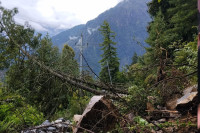
In Nepal, cross-border trade with China through Rasuwagadhi and Tatopani has remained almost paralysed for four months, leaving hundreds of containers stranded on the Chinese side.
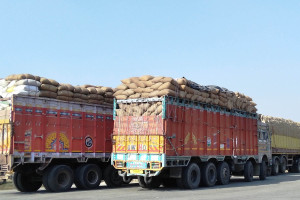
With the Miteri Bridge still under repairs after being swept away in July and China dispatching only a handful of containers daily, trade from the northern border has come to a near standstill. Traders say their festive and winter goods—including EVs—have been stuck for months, causing heavy financial losses.
Nearly 900 containers remain stranded in Khasa on the Chinese side.
EV traders say they have had an especially difficult time meeting festive demand this year.
“With the crucial border point remaining closed for months, it became difficult to import EVs and meet customer demand during the festive season,” said Yamuna Shrestha, managing director of Cimex Inc, the authorised distributor of BYD in Nepal. “Thankfully, we had the option to bring BYD vehicles from the Korala border.”
Nearly 1,400 BYD EVs have been imported through Korala since Dashain. “The Korala border point lacks infrastructure, but we managed to bring BYDs all the way from Upper Mustang, which also shows that EVs can go anywhere in the country,” she added. However, she noted that festive sales did not grow compared to last year, as vehicles did not arrive as expected.
Traders have been diverting their shipments, including EVs, through the Korala route, and vehicles continue to arrive from there. Shrestha said her company plans to continue imports until December, before temperatures drop in the high mountains.
“We still have pending bookings for EVs from the NADA Auto Show and the festive season,” said Puskar Ojha, vice president of the Nepal Automobile Dealers Association. “With Rasuwagadhi closed and limited movement at Tatopani, we haven’t been able to deliver or sell EVs as per customer demand.”
Construction of a Bailey bridge is underway and expected to be operational by mid-November.
Around 90 newly imported EVs were either swept away or severely damaged by flash floods earlier this year. Most of the affected vehicles were imported by Chaudhary Group and included high-end models such as Skywell.
In the fiscal year ending mid-July, Nepal had imported around 9,000 electric vehicles via the Kerung border alone. These included popular passenger brands like BYD, MG, Skyworth, Jaguar, and KYC, as well as commercial models like King Long.
During the review period—or the first quarter of the current fiscal year—the country imported 557 EVs through the Tatopani border, while most of the imports came from Korala.
Out of the total EV imports in the first quarter, Nepal brought in 2,029 EVs worth Rs4.9 billion from China and 463 EVs worth Rs955.4 million from India. The remaining vehicles were sourced from Thailand, the UK, Germany, South Korea, and the United States.
Imports of four-wheelers, including passenger buses, microbuses, and private vehicles, rose 27.04 percent year-on-year until mid-July. EV imports alone increased by 23.33 percent.
Of the 22,907 four-wheelers worth Rs50.88 billion imported into Nepal last fiscal year, 16,701 were electric vehicles valued at Rs41.23 billion.
Two major auto shows held in August also saw a surge in public interest and bookings for electric vehicles. The Nepal Automobile Importers and Manufacturers Association (NAIMA) Auto Show and the Nepal Automobile Dealers Association (NADA) Auto Show both reported strong turnout and encouraging sales despite supply bottlenecks.




 24.12°C Kathmandu