



 19.27°C Kathmandu

Mon, Oct 5, 2026
Money
Ride-Hailing riders demand uniform fare as price gaps trigger tensions
Fuel price hikes and inconsistent pricing across platforms spark protests, with riders warning of escalating risks and calling for regulation and social protection.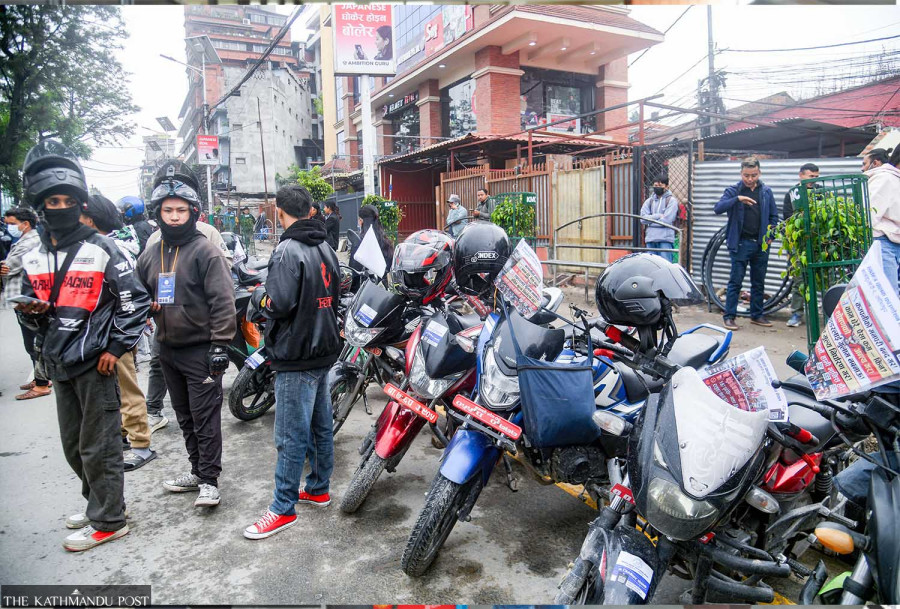
bookmark
Krishana Prasain
Published at : April 1, 2026
Updated at : April 1, 2026 14:09
Kathmandu
Riders working in different ride-hailing service companies have demanded uniformity in fares, saying disparities in charges have heightened risks as customers increasingly vent their ire at them, knowingly or unknowingly.
Following the rise in fuel prices triggered by the ongoing conflict in West Asia, companies have unilaterally increased rates, resulting in significant mismatches in fares for the same destination across different platforms.
“The petrol price has increased twice in a month, but the fare has not been adjusted accordingly. Similarly, rates are not uniform among service providers,” said Peshal Kumar Khaptari Magar, spokesperson for the Pro-Riders Group, an ad hoc body formed by riders working across companies.
According to riders the Post spoke to, growing differences in fares among service providers are not only misleading customers but also exposing riders to potential conflict.
“The ride-sharing app decides the fare, but customers blame us for charging high prices. For the same destination, fares differ across companies,” Magar said. “Our demand is that fares should be standardised and determined scientifically.”
“Our demand is that fares should be uniformly increased by Rs27 per kilometre by all companies,” he added.
The group has also called for health security for riders, the establishment of a labour fund, and stricter regulation of ride-sharing companies—particularly international firms operating in Nepal.
Riders have been protesting since last Monday, wearing black ribbons and organising sit-ins and rallies.
“We conducted a protest rally and submitted a memorandum to the District Administration Office, the Prime Minister’s Office, and the Transport Ministry on Tuesday,” said Magar. “If our demands go unaddressed, we will launch stricter protests, including shutting down servers or locking company offices.”
Riders currently receive between 10 and 20 percent commission per ride, depending on company policies.
According to the group, more than 60,000 two-wheeler riders are providing services across the Kathmandu Valley.
A 2024 report titled “Nepal’s Gig Economy and its Implication on Labour Participation and Income Distribution,” published by the Asian Productivity Organisation, shows that Nepal’s gig economy has grown significantly over the past decade, contributing around 7 percent to the country’s GDP.
Data from the Online Labor Index indicates that 49 percent of Nepal’s online freelance workforce is engaged in software and technology development services. Expanding internet access has enabled gig workers to operate even from remote areas, creating new employment opportunities across the country.
Advances in technology have also improved communication and collaboration between employers and gig workers, boosting efficiency in the sector.
However, Nepal’s gig economy remains largely unregulated, with persistent issues such as job insecurity, lack of social protection, and the absence of standardised working conditions, including payment systems.
Experts say clear legal frameworks and efforts to integrate the gig economy into the national economy could help address these challenges.
Ride-hailing companies, meanwhile, acknowledge that rising fuel prices are putting pressure on drivers and the broader ecosystem. For many drivers, fuel remains the single largest operating cost, directly affecting daily earnings.
Rita Pokharel, country representative of inDrive Nepal, said in an email that the company has not introduced a fixed fare increase.
Unlike traditional ride-hailing platforms that rely on static or algorithm-based pricing, inDrive uses a peer-to-peer pricing model where passengers and drivers negotiate fares directly. This allows prices to adjust dynamically based on real-time market conditions, including fuel costs, demand, and trip distance.
“To provide immediate support during this period, inDrive has implemented a temporary 0.01 percent service fee in Kathmandu, allowing drivers to retain nearly 100 percent of each trip’s value,” she said. The company has also introduced targeted measures such as reduced commissions on selected rides and performance-based incentives.
Ride-sharing companies say that when operating costs rise, drivers naturally seek higher fares to maintain sustainable income levels.
At the same time, passengers are facing broader cost-of-living pressures, which can affect their willingness to pay higher transport fares—creating a structural challenge for the industry in balancing affordability with driver earnings.
Nepal’s ride-hailing sector has expanded rapidly, with a large and diverse pool of drivers operating across multiple platforms. In such a competitive environment, pricing flexibility, cost efficiency, and transparent policies are crucial to maintaining stability for both drivers and passengers.
inDrive says it provides insurance coverage of up to Rs800,000 in case of death or permanent disability and up to Rs80,000 for medical expenses, applicable to both drivers and passengers during rides.
Yango Nepal, another major player, said it operates a dynamic pricing model that adjusts fares in real time based on demand and supply conditions.
“This ensures that prices remain fair for users while allowing partner drivers to benefit during peak demand periods,” said Santosh Pandey, country head of Yango Nepal.
“In Nepal, we are closely monitoring market conditions—especially the impact of rising fuel prices and driver sentiment. Where necessary, we are making targeted fare adjustments, particularly for longer trips, to ensure drivers can earn more per trip,” he said.
“We will continue to evaluate the situation and make further adjustments as needed to support partner drivers.”
Yango provides insurance coverage of up to Rs300,000 for medical expenses and Rs1 million in case of accidental death. The company also said it currently does not charge commissions to drivers.
According to ride-sharing firms, a growing number of electric vehicles are now being used across both two-wheelers and four-wheelers on their platforms, driven by rising environmental awareness, supportive policies, and improving charging infrastructure.
Fuel prices have surged sharply amid ongoing tensions in West Asia and the broader Middle East, with petrol prices rising by Rs30 per litre in nearly a month to reach Rs187 per litre.
Krishana Prasain
Krishana Prasain is a business reporter for The Kathmandu Post covering markets. Before joining The Kathmandu Post in 2018, she spent 3 years in New Business Age magazine covering business.

Most Read from Money
In Nepal’s premium rental market, the dollar is everywhere but on paper
Malaysia weighs raising minimum wage to RM2,000
All three major Nepal-China crossings hit by monsoon disruptions ahead of Dashain
Why was Nepal’s stock market shut on Monday
Nepal lost Rs10 billion in India’s import squeeze. New Delhi seeks investigation before easing curbs
Editor's Picks

What triggered the Rasuwa flood? Scientists piece together a complex chain of events

The floods keep coming. Nepal keeps starting over

In a settlement destroyed by the Bhotekoshi flood, a disabled couple offer strangers the little they have

Nepal working on detailed assessment as Bhotekoshi flood reconstruction could cost up to $5 billion

Rabindra Dhant gave Nepal a reason to smile. Now his camp wants real action behind the praise
E-PAPER | October 05, 2026

×