With Mayor Shah, we expect to expand support base among educated urban class
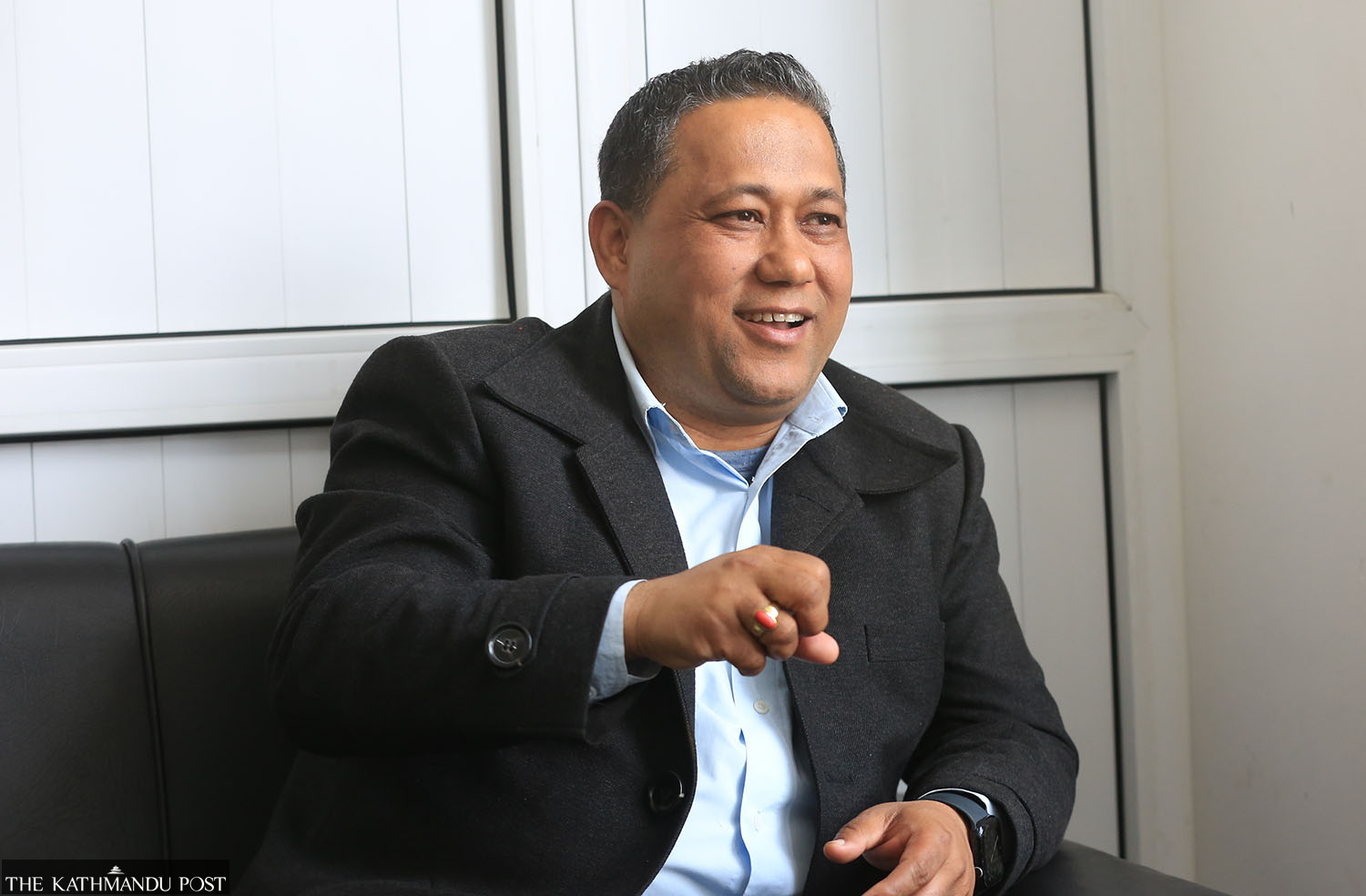
Chairman Rabi Lamichhane has committed not to intervene in government functioning if Balendra Shah becomes prime minister. Shishir Khanal, a key RSP negotiator Dipen Shrestha/TKP
The Rastriya Swatantra Party and Kathmandu mayor Balendra (Balen) Shah’s team on Sunday morning reached a unity agreement, heralding a radical shift in Nepal’s political landscape. The Post’s Thira Lal Bhusal and Purushottam Poudel sat down with former lawmaker Shishir Khanal, a key RSP negotiator, to inquire how the deal was sealed.
How did the talks with Mayor Shah start and the unity become possible?
For the past several weeks, Balenji’s team and we were in conversation. It started after we got some indication of interest from the mayor. The first indication from his team was mostly around the fact that they would only support alternative forces, that would include Gen Z and other major stakeholders from alternative forces, including Kulman Ghising. They were ready to support those who could bring everyone together. That was the initial communication that had come through. Based on those communications, we had initially engaged with Ghising, Bibeksheel, and other alternative forces, including Gen Z groups. Over time, it appeared that Mayor Balen himself might jump into national politics. As those indications became more apparent, we started direct engagement with his team members.
As we passed through rounds of conversations over the last month and a half, one of the tricky points had been determining the position he [Shah] needed to join the party. But at the time our chairperson was in jail. Even arranging a conversation between them was challenging. Once our chairperson came out of the jail on bail, it became easier to expedite the talks. Over the past week, there were several rounds of conversations, which eventually led us to this outcome.
At times, talks appeared to have stalled. Could you explain the ups and downs? What were the points of contention that slowed the negotiations?
Definitely, these kinds of negotiations happen over a period of time. And when both parties sit for official rounds of conversation, each party has their own position. Obviously, in this case also, we had our own position. We needed to sort through that. One issue that we needed to figure out was what kind of positions we can offer. I mean, in politics, at the end of the day, it’s also about position. We need to figure out how to share positions between the two sides so that Shah’s political persona is recognised.
On the other hand, the RSP wanted to retain its leadership in view of its contribution to party formation, and the fact that we’ve come this far. So those were some difficult issues to navigate. Eventually, it was agreed that Rabi Lamichhane stays party president, and Mayor Shah would be projected as potential future prime minister as we go to the election. This is how we settled a key power sharing issue.
Second, Mayor Shah indicated that he would not be very keen to hold party positions. He is happy just to join the party as a central committee member. We had a similar precedent when Dr Swarnim Wagle joined our party as a general member. Only after around six months of joining the party and winning the parliamentary election was he nominated as a vice chairperson.
Mayor Shah was generous enough. Once that sort of generous indication came, we felt that we also needed to honour that generosity. So without him asking, we offered him the second in rank without naming the party position. He would be a central committee member, but in meetings he would be second in the rank after party chairperson.
What is the understanding on positions for other key members of Shah’s team?
We haven’t made a specific arrangement on that. But we’ve said that this is a new party and there are many positions that need to be filled. We immediately need to select candidates under proportional representation (PR) list for the House of Representatives. So instead of sticking to certain numbers, we said as long as good people come in, we’d welcome them.
Dipen Shrestha/TKP
Janamat Party’s CK Raut and Resham Chaudhary of Nagarik Unmukti Party were in negotiation with Mayor Balendra Shah. Now, with the mayor joining the RSP, is there any discussion about bringing these other forces into the party or making them electoral allies?
We have been in conversation with several other leaders along with known political people like Ghising. We often talk about big names, but when Mayor Balen and Rabi Lamichhane run, they can only contest from one constituency each. So we would still need over 160 other candidates to contest elections. We need leaders from across the communities, geographies, and across demographics. So, I always say in our internal meetings that we should not only focus on bringing big names.
But we also need leaders like Sobita Gautam, Shishir Khanal, Ganesh Parajuli who won the 2022 elections. So we are actually looking for those kinds of leaders as well. What we’ve communicated to Mayor Balen’s team is that we need so many people—275 candidates just for the House of Representatives.
So what made the RSP think that the party needs Mayor Balen? What is his unique strength?
Essentially, the RSP was established and built by Rabi Lamichhane. As a TV personality, he had a certain fan following. That became our political base also in the 2022 elections. Rabi Lamichhane generally tends to be influential in areas his audiences used to be in—semi-urban communities and particularly among women. He tends to do very well in these constituencies. Some of our survey data shows that too.
Mayor Balen attracts a huge fan following among urban, highly educated youth and professionals. If you look at Nepalis living abroad, Rabi Lamichhane generally attracts a significant fan following in countries where we send labour migrants. But in western countries, Mayor Balen has a good support base.
I was in the US and Canada a few months back for festivals. Many general people who knew me as an RSP leader would always come and talk to me about Rabi Lamichhane and express support. But Mayor Balen can certainly add big value among the urban educated demographic. And another constituency where we are growing, but could grow much more is Madhesh. We would get much faster and better footing with Mayor Balen in that community as well.
People are now relating this unity with the unification between the CPN-UML and the Maoist Centre in 2017. Despite the formation of such a big political force, they failed in delivery. Based on several similar experiences, people fear the unified RSP may face a similar fate due to personality clashes between Lamichhane and Shah. How will they fare any better?
Those concerns are natural. Obviously, we’ve heard them as well. But based on my observations during this negotiation process, I found that they have built a really strong mutual trust. In our meetings and in front of Mayor Shah, our party chair has said that when we win the election and he [Balendra] becomes prime minister, he would not interfere as the party chairperson. He’d allow the prime minister to run the government with full control. He has made that kind of commitment. During the NCP era, UML and Maoist leaders tussled on power-sharing. But in our case, the party chairperson has clearly said that as a prime minister, he can run the government independently without the party’s interference.
The agreement talks about the scenario of the RSP forming the government. What if it doesn’t become the largest party and form the government? Do you have an understanding of what happens in that case?
At this point, we are not even considering the second or third option. We do expect the RSP to be the governing party post-election. And it’s not just because we are bringing together two major names of alternative politics, but we’re also working to bring several other personalities with their own proven abilities.
Dipen Shrestha/TKP
In 2022, we became the fourth largest party with about 1.5 million votes within 5-6 months of the party’s establishment. We have seen an increase of public support, which was reflected when they expressed solidarity in our fight against the politically motivated corruption case against our chairperson, who was jailed. Over four million people had signed a petition showing solidarity with him. And it was before the Gen Z uprising.
Second, our performance in parliament and short-lived government tenures has shown people that these are a different breed of politicians. People think they come from professional backgrounds, and are serious about their roles, whether in parliament or in the government. There was enough momentum for us to become the number one party, even before we brought in big names like Mayor Balen and others. The track record of RSP lawmakers and ministers and the hope that Rabi Lamichhane and Balendra Shah bring to Nepal’s politics today will propel us to at least a majority.
Certain understandings reached during the negotiations are not explicitly stated in formal agreements. Is there any other understanding which is unwritten also in view of making the unity sustainable?
I find that their vision is closely aligned. It’s not just an electoral-driven agreement. Each of them decided, at their own volition, to give up something which could have been potentially theirs. Our party chairperson is in legal complications but in politics, many things can be made possible. But he voluntarily said that if unity between RSP and Mayor Balen can enable us to form a very strong government, I’m willing to give up [prime ministership]. And, Mayor Balen said, I don’t need any party position.
Your party and also Mayor Balendra have reservations over the three-tier federal system. Likewise, the issue of the directly elected executive head has become a topic of debate. Have you reached any understanding on these policy issues?
We honour the constitution, and the democratic framework within the constitution. This is the most important thing. There are some larger political agendas, such as the directly elected prime ministerial system and the system of the country’s vice-president chairing the national assembly. On federalism, we have said that we want to make reforms in federalism, but we’ve agreed to three-tier federal modality.
We have said we want directly elected chief ministers, and reforms in provincial assemblies. But those things require constitutional amendments and we want to do it only through democratic means. We can do it only if people endorse our agenda by giving us a two-thirds majority. We are not saying we’ll raise arms, take to streets to get our political agendas implemented. What we have said is we will do everything as per the current constitution. I find commonality between RSP and Mayor Balen and his team in this case as well. He also has said that he honours this constitution.
What were the sticking points between the RSP and Kulman Ghising of Ujyalo Nepal Party such that there could be no understanding?
He claimed the party’s joint chairmanship, demanded that the party’s name be changed by including at least the word ‘Ujyalo’ in it and also wanted to use a bulb as the party’s election symbol in place of the bell. We couldn’t agree on these conditions.




 20.85°C Kathmandu