As snakes thrive in upper climes, more people dying from venomous bites
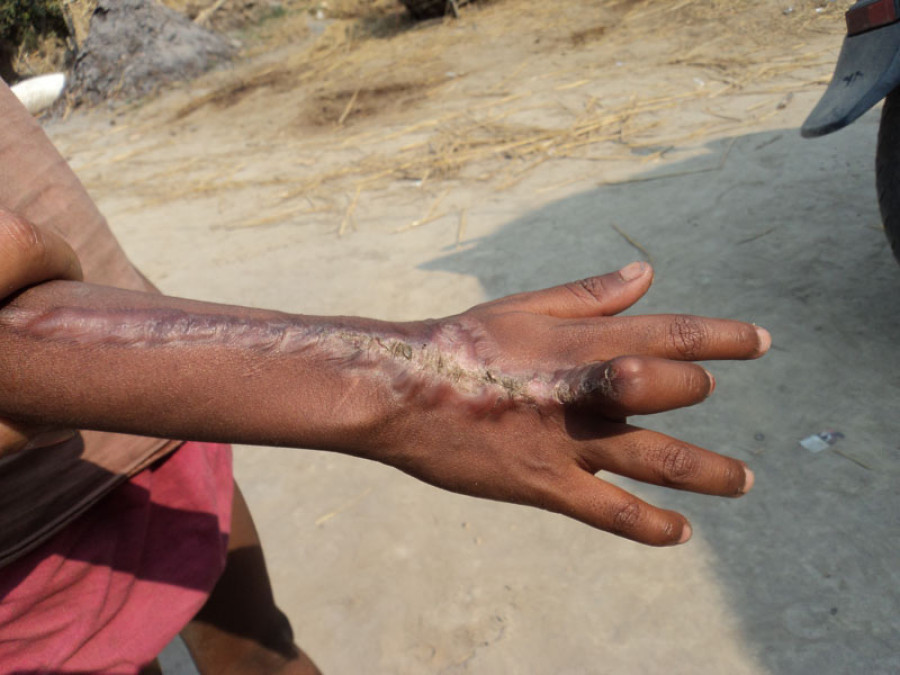
Rising temperatures believed to be pushing venomous snakes from the plains into the hills and mountain regions. A person shows a linear scar from a cobra bite, in this undated photo. Photo: Courtesy of Dr Sanjib Sharma
Eleven snakebite patients visited the Sukraraj Tropical and Infectious Disease Hospital for treatment between March 15 and April 13. Doctors attending the patients said that most of the victims were either from the Kathmandu valley or from adjoining districts.
Data from the National Disaster Risk Reduction and Management Authority shows that 15 snake bite cases were reported from various districts in the past week.
Doctors as well as experts anticipate a further spike in snakebite cases and deaths in the coming days, as rising temperatures increase the risk of human-snake encounters.
Dr Anup Bastola, director at the hospital, said this is just a start. “The number of snakebite cases will rise in the coming days.”
Snakebite and resulting deaths are common in southern Nepal in summer. But, of late, cases of bite by venomous snakes have increased in the hilly and mountainous districts, leaving doctors and experts alarmed.
They said global warming might be pushing venomous snakes from the Tarai into the hilly and mountainous districts, where they were previously not found.
“Last year I rescued over two dozen venomous snakes including king cobra and the venom-spitting monocled cobra from various places of the Kathmandu valley—Dakshinkali, Syuchatar, Gokarna and Godavari,” said Subodh Acharya, a snake rescue trainer from Mithila Wildlife Trust, Janakpur. “We have found nests of highly venomous snakes—king cobra in the hilly regions. This is proof that venomous snakes have started adopting in higher lands.”
Nepal is among the world’s most vulnerable countries to the climate crisis and has witnessed multiple extreme weather events over the past decade and a half.
Evidence suggests that maximum temperatures in Nepal are rising at a faster annual rate of 0.056 degrees Celsius, compared to the global average rise of 0.03 degrees Celsius each year.
Compared to the districts of the Tarai region, those in the hills and mountains have been witnessing a more rapid increase in daytime maximum temperatures, which could have helped venomous snakes survive there, according to the experts.
With cases of snakebite and deaths starting to rise in hillsides, the Epidemiology and Disease Control Division has established snakebite treatment centres in over a dozen districts including Syangja, Rukum and Ramechhap.
Each year, around 2,700 people, mostly children and women from the plains, die of snakebites in Nepal, according to a March 2022 report published in The Lancet, a leading international medical journal.
However, snakebite cases are vastly underreported in the country. Incidents are also common among cattle, and thousands of farmers are affected every year.
The government has committed to halving the deaths and disabilities caused by snakebite envenomation by 2030, the national target aligned with the World Health Organisation’s ‘Snakebite Roadmap’.
As the deadline nears, herpetologists and public health experts emphasise the urgency for raising awareness and training local health workers to meet this crucial health goal.
They say that fatalities and disabilities from snakebites can be drastically reduced if vulnerable populations, especially children, women and farmers residing in rural areas, are made aware of the risks.
“Awarness and precautions against the risk help in curbing incidents of snakebite and deaths,” said Dr Sanjib Kumar Sharma, a snakebite expert with the World Health Organisation. “People should be encouraged to rush victims to health facilities immediately following a snakebite, as 80 percent of deaths from snakebites occur before reaching hospitals.”
Experts say authorities must also strengthen the health infrastructure to achieve the target. They say due to poor infrastructure in healthcare facilities—lack of doctors, anti-snake venoms, ventilator support systems, and kidney dialysis facilities—dozens of people die from snakebites every year.
While health facilities are ill-equipped and short on anti-snake venom, many people in rural areas lack awareness and often consult shamans instead of physicians.
“Avoid home remedies after a snakebite and use tight bands above the wound,” said Sharma. “Immediate medical attention is critical to prevent complications and save lives.”
Doctors say women who go to the fields to collect fodder, farmers working in plantations or during harvest, and children who play in open areas are more vulnerable to snakebites. Poor people living in thatched-roof houses are also highly vulnerable to snakebite, as snakes visit such homes in search of rats for food.
Experts say there should be a greater awareness drive on keeping homes and surroundings clean, preventing children from playing in bushes, and avoiding walking outside at night. If absolutely necessary to go out, people must use torchlights when walking in the dark.
Arjun Poudel is a health reporter for The Kathmandu Post. Before joining the Post, he worked for Sagarmatha Television, Naya Patrika, Republica and The Himalayan Times.




 25.92°C Kathmandu