Valley chokes as PM2.5 soars. Experts urge urgent action
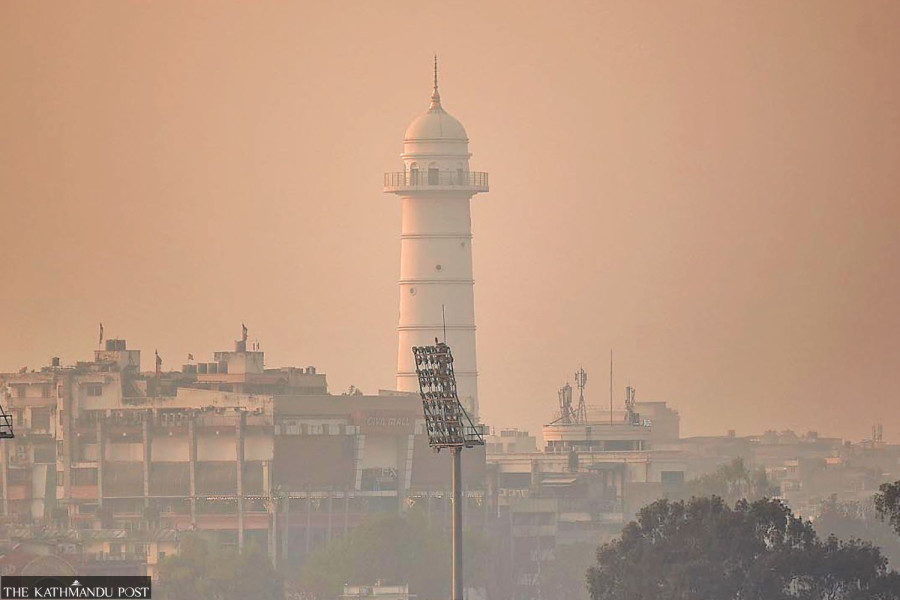
Most monitoring stations showed red alerts Thursday. Light rain expected Friday may not clean the air. The Dharahara tower in downtown Kathmandu, pictured on a smoggy morning. Post file Photo
Kathmandu Valley experienced a surge in air pollution on Thursday morning. Data from 14 of the 16 air quality monitoring stations set up in the Kathmandu Metropolitan City showed a red alert, which means the air is unhealthy and can affect the health of all residents. The remaining two stations showed orange alerts, meaning people from sensitive groups or those with underlying health conditions could be affected.
Moreover, data from IQAir, a Swiss group that collects air quality data from around the world, showed alarming pollution levels in various places of the Kathmandu Valley on Thursday morning.
According to IQAir, air quality in Tarakeshwar Municipality reached 235 micrograms per cubic metre (μg/m3), followed by Kausaltar, Bhaktapur 223; Balaju 215; Jadibuti 202; Madhyapur, Thimi, and Tokha 199 each; Balkumari 198; Shantichowk and Chhetrapati 197 each; Baluwatar 190; and Sudal, Bhaktapur 183.
As per the US Environmental Protection Agency’s air quality index, an air quality reading of 201-300, it is considered very unhealthy and increases health risks for everyone in the area. When the air quality reaches 151–200, it is considered unhealthy; everyone may experience problems, with sensitive groups feeling more severe effects.
PM2.5 refers to particulate matter (solid or liquid droplets) in the air that is less than 2.5 micrometres in diameter. It is among the most dangerous pollutants that can get past the nose and throat to penetrate the lungs and even the bloodstream. PM2.5 particles are small and are also likely to stay suspended in the air for a long time, increasing the chances of people inhaling them.
The PM2.5 concentration recorded on Thursday morning was many times higher than the World Health Organisation’s annual guideline of 5 micrograms per cubic metre.
Air quality experts say that it is just the start, and the worst is yet to come. What concerns them more is that, despite repeated worsening of air pollution, the response from agencies concerned is operating as usual without taking mitigation measures. They say a lack of coordination among intergovernmental agencies, a lackadaisical approach to enforcing the mitigation measures are making the situation worse.
“There are two committees—coordination and implementation under the Ministry of Forest and Environment, whose job is to coordinate among intergovernmental agencies for improvement of air quality,” said Bhusan Tuladhar, an air quality expert. “But meetings of the two committees have not yet been held despite rising air pollution. This kind of lackadaisical approach can be seen in every department and agency.”
The Kathmandu Metropolitan City has prohibited open burning within its jurisdiction, but other local units in the Valley are turning a blind eye to open burnings. Metropolis officials say vehicular emission testing, which was halted months ago, has not started yet.
Likewise, the Valley’s brick kilns will start firing in two weeks, and this will further deteriorate the air quality. The forest fire season has also started, and it emits particulate matter, nitrogen oxides, carbon monoxide and sulfur dioxide. Burning of waste materials releases lead, mercury and other hazardous pollutants that cause both short- and long-term health consequences.
“Strict restrictions on open burning, enforcement of emission control measures, awareness drives, reduction of forest fires, and prohibiting the use of low-grade coal in brick kilns will help improve air quality,” said Tuladhar. “Authorities must take actions to avert worst-case scenarios.”
According to doctors, poor air quality causes both short- and long-term effects on public health. In the short term, bad air can cause pneumonia, bronchitis, conjunctivitis, skin allergy, stroke and heart problems, among others. And in the long run, it can lead to ulcers and cancer of the lungs and intestine, kidney disease and heart problems.
Meanwhile, the Meteorological Forecasting Division under the Department of Hydrology and Meteorology said light rainfall is likely in mountainous and hilly regions on Friday due to the effects of westerly winds.
“Hazy conditions that continued over the last several days in Tarai districts almost cleared on Thursday due to westerlies,” said Binu Maharjan, a meteorologist at the division. “Isolated light rainfall and snowfall are likely in hilly and mountainous areas on Friday.”
However, light rain cannot clear existing air pollution levels, according to officials.
“Both cold and air pollution levels will increase in the coming days,” said Maharjan.
On Thursday, the Kathmandu Valley recorded a minimum temperature of 4.6 degrees Celsius.
Arjun Poudel is a health reporter for The Kathmandu Post. Before joining the Post, he worked for Sagarmatha Television, Naya Patrika, Republica and The Himalayan Times.




 25.92°C Kathmandu