Village nurses are saving mothers despite government lowering mortality targets
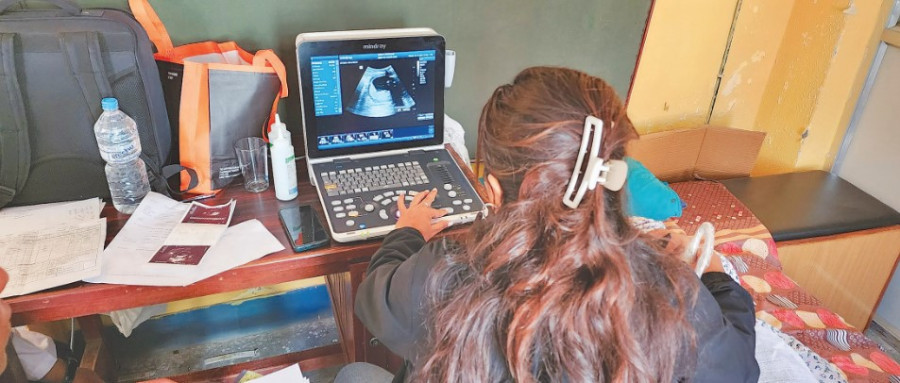
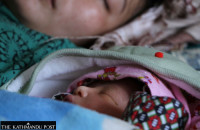
Nurses and auxiliary nurse midwives visit homes with portable ultrasound machines to spot pregnancy risks early. Studies show that ultrasound training received by nurses has been effective in minimising preventable maternal and neonatal mortality and morbidity. Photo: Dr Mingmar Gyelzen Sherpa via X
Last month, a 24-year-old woman from ward 5 of Champadevi Rural Municipality in Okhaldhunga district reached a nearby health post with ectopic bleeding and pelvic pain. Health workers there performed an ultrasound, which showed placenta previa, a condition where the placenta attaches low in the uterus.
“We referred the woman to the district hospital, but she returned home instead and only sought treatment after several days when the pain became severe,” said Melina Magar, an auxiliary nurse midwife, who attended the patient. “Health workers saved the mother’s life but could not save the foetus.”
Magar is among hundreds of health workers serving in remote villages throughout the country who work tirelessly to save the lives of mothers and children at a time when the government has scaled back its target for maternal and newborn health.
The National Planning Commission has reset almost all Sustainable Development Goal (SDGs) targets, effectively reducing international commitments the government earlier promised to achieve by 2030.
The SDGs, a follow-up on the Millennium Development Goals (MDGs), aim to end poverty, hunger and all forms of inequality in the world by 2030. Nepal has committed to meeting them.
The government had committed to allocate at least seven percent of the gross domestic product (GDP) to healthcare expenditure, but this has now been revised to five percent.
As per the new revised target, maternal mortality rate will be reduced to 110 per 100,000 births from 70 committed earlier. Nepal has cut maternal deaths by over 70 percent since 2000, according to the World Health Organisation.
The UN health body, in its report released in April, stated that 142 Nepali women die from maternity-related complications per 100,000 live births.
A study carried out in 2021 by the Central Bureau of Statistics (renamed National Statistics Office in October 2022) had shown 151 maternal deaths per 100,000 live births.
“We don’t know what the government decides. What we know is deaths of mothers and children must be stopped,” said Durga Laxmi Khatri, a senior auxiliary nurse midwife serving at a health post in ward 14 of Katari Municipality in Udayapur district. “We are working day and night to prevent deaths.”
A few months ago, Khatri found a woman with polyhydramnios (a condition in which pregnant women have excess amniotic fluid) when she carried out ultrasound during an outreach health camp.
The woman was referred to Katari Hospital immediately and health workers there referred her to the district hospital at Gaighat.
“The woman did not go anywhere until her fetus died in the womb,” said Khatri. “I myself accompanied the woman later to hospital, where she underwent surgery. Her health is good now.”
Life-threatening complications such as ectopic pregnancy (when a fertilised egg grows outside the uterus), polyhydramnios, shoulder dystocia (baby shoulder gets stuck), oligohydramnious (too little amniotic fluid that restrict foetus growth), placenta previa (placenta covers the cervix), placenta abruption (placenta detaches before delivery), and breech presentation (baby is positioned feet or buttocks down instead of head), among others, risk the lives of both mothers and babies.
Both Magar and Khatri received 21-day portable ultrasound training from the Solukhumbu Polytechnical Academy, through which they have been identifying such risks in pregnant women in health facilities and in villages, where they reach every month with the device.
A report titled ‘Effectiveness of Focussed Obstetric Ultrasound Training to Nurses from Remote Health Posts to Improve Pregnancy Outcome and Reduce Morbidity’ stated that focused obstetric ultrasound in rural and under-resourced communities in Nepal has the potential to improve access and quality of healthcare services and can result in an increased uptake of antenatal care service utilisation.
In Sudurpaschim province, the use of portable ultrasound devices by nurses and auxiliary nurse midwives has saved hundreds of lives.
“Studies show that ultrasound training for nurses is effective in minimising preventable maternal and neonatal mortality and morbidity,” said Dr Mingmar Gyelzen Sherpa, former director general of the Department of Health Services. “We can save even more lives if we could train more health workers in rural areas.”
Following success in Sudurpaschim province, the academy has started imparting portable ultrasound training to health workers in Koshi province, where maternal deaths are high (at 161 per 100,000 births) compared to the national average.
Maternal deaths in Sudurpaschim province have declined dramatically—130 per 100,000 live births, which is less than the national average. The province is only behind Bagmati province, where 98 women die per 100,000 live births.
“We are committed to saving the lives of mothers and newborns,” said Sherpa. “We can achieve SDG targets if we maintain the current pace and promote methods like screening pregnancies at the village-level and identifying risks in advance.”
Public health experts say several health targets under SDGs, including maternal, neonatal, and under-five mortality rates are achievable even if measures taken at present are continued. They say that the government cannot escape its responsibilities by simply resetting targets.
“Preventing existing maternal and child deaths is our responsibility, and we cannot escape it under any pretext,” said Dr Yasho Vardhan Pradhan, former director general at the Department of Health Services. “Along with international obligations, we have to fulfill our duty to the people, and international organisations will welcome further progress.”
Arjun Poudel is a health reporter for The Kathmandu Post. Before joining the Post, he worked for Sagarmatha Television, Naya Patrika, Republica and The Himalayan Times.




 19.72°C Kathmandu