Last week, a man from Sarlahi district reached the Sukraraj Tropical and Infectious Disease Hospital, after other hospitals could not identify the cause of his fever, which continued for around two weeks.
The patient, who is in his early 30’s, told doctors that he sought treatment at multiple private hospitals in Kathmandu but neither the fever subsided nor the cause of the problems diagnosed.
“We suspected scrub typhus infection and the test confirmed it,” said Dr Sher Bahadur Pun, chief of the Clinical Research Unit at the hospital. “Infection in the winter season indicates that the disease is continuously spreading, even in Tarai districts.”
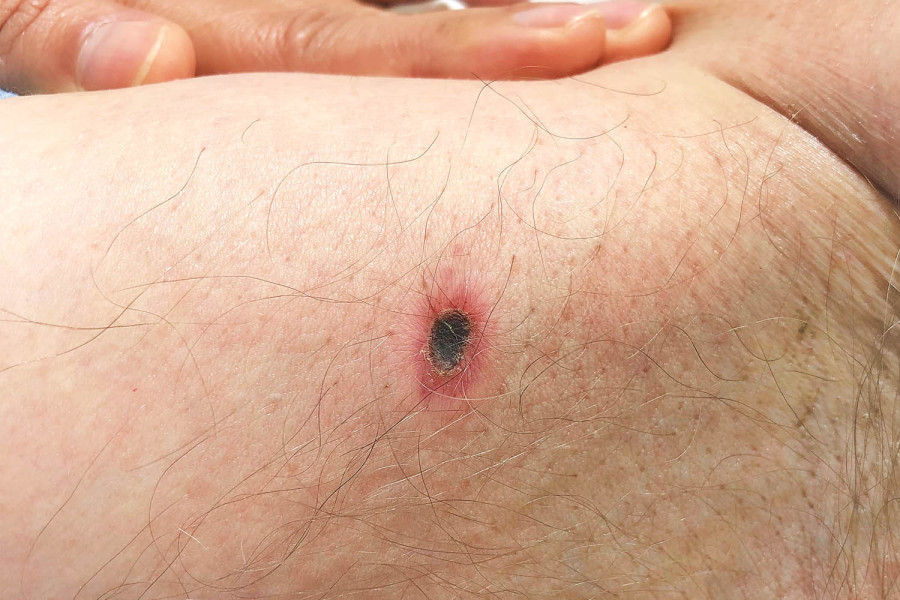
Scrub typhus, or bush typhus, is a potentially fatal infectious disease caused by the parasite Orientia tsutsugamushi, a mite-borne bacterium. It spreads to humans when bitten by infected chiggers (larval mites) found in mice.
The disease, which was unknown until a decade ago in Nepal, has now emerged as a major public health problem. This year, it surpassed dengue and became the country’s leading vector-borne disease in terms of morbidity.
Officials concede, there are deaths from the scrub typhus infection, but doctors often fail to identify scrub typhus deaths as the cause since patients suffer other complications, including multiorgan failure.
Nepal saw a surge in scrub typhus cases after the calamitous 2015 earthquakes that killed nearly 9,000 persons across the country.
Three months after the earthquakes, the BP Koirala Institute of Health Sciences, Dharan, alerted the Epidemiology and Disease Control Division about six children with unusual fevers and severe respiratory problems.
Serum samples were collected for subsequent tests in Kathmandu and Bangkok, which confirmed a scrub typhus outbreak. By then, four children had already died in the course of the treatment. By the end of the year, 101 cases were confirmed in 16 districts, and four more people succumbed to the disease.
The magnitude of the outbreak escalated in the fiscal year 2024-025,when 16,597 people across the country were infected. Of the total cases of infection, Lumbini Province recorded 4,322 cases, the highest number in the country, followed by Sudurpaschim province (3,746 cases), Karnali province (2,539), Koshi province (2,119), Bagmati Province (1,838), Gandaki province (1,725) and Madhesh province (308).
The number could be higher still, as all cases of infection do not enter government records.
What alarms health officials is that people living in urban settings are also getting infected. Until a few years ago, it was believed that only those residing in rural areas or those working in farms and fields were at high risk.
“This year scrub typhus surpassed dengue and became the top vector-borne disease in terms of morbidity,” said Gokarna Dahal, chief of the Vector Control Section at the Epidemiology and Disease Control Division. “We don’t know the exact number of deaths from infection, as patients often die from multiple complications including multiorgan failure.”
Since there is no vaccine available, officials say that they have ensured common antibiotics, such as doxycycline and azithromycin, in state-run health facilities. These medicines are also on the government’s essential drugs list and distributed free to health facilities across the country, and can cure the disease.
However, many health workers, including doctors, lack sufficient knowledge to diagnose scrub typhus. Many health facilities also lack the reagents needed for testing.
Doctors can diagnose the disease based on symptoms, but the risk of misdiagnosis is high, as scrub typhus symptoms are similar to those of other illnesses.
And waiting for lab results before starting treatment can be dangerous. It can take about a week to get test results and, by that time, the patient can fall into coma and suffer multiorgan failure.
Symptoms of the disease include high fever, headache, abdominal pain, backache, joint and muscle pain, red rash, nausea and vomiting. Patients with severe illness may develop bleeding, which could lead to organ failure. The infection can lead to respiratory distress, inflammation of brain, lungs, kidney failure and then multiorgan failure. If not treated immediately, it can be fatal.




 14.03°C Kathmandu