3.2 million doses of Vero Cell set to arrive next week from China
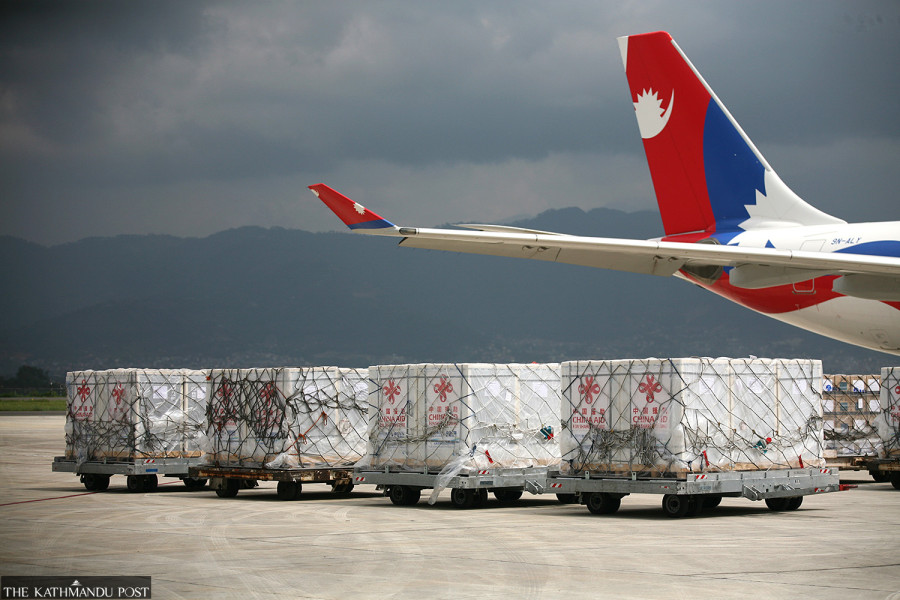
The consignments, expected from August 17 to 20, are part of the doses Nepal has procured and the Chinese government has pledged as grant. Post File Photo
More than 3 million doses of Vero Cell are expected to arrive next week, according to officials at the Ministry of Health.
The 3.2 million doses of Vero Cell are said to be part of the vaccine the government purchased from Sinopharm and grant assistance pledged by China to Nepal.
Multiple officials said the tentative delivery dates are August 17 to 20.
“Additional vaccines will also come regularly afterwards as well,” Dr Roshan Pokhrel, secretary at the Health Ministry, told the Post. “The ongoing vaccination drive will not stop. People of other age groups will also get the vaccines soon.”
China has pledged to provide an additional 1.6 million doses of vaccine under grant assistance. It has already provided 1.8 million doses of Vero Cell (BBIBP-CorV).
The government, which had purchased 4 million doses of Vero Cell under a non-disclosure agreement, has also signed a deal to buy an additional 6 million doses.
Though an agreement to purchase additional doses of vaccine was made by the erstwhile government the incumbent government sent the payment, which ensured the supply of the vaccine.
“The government is committed to providing vaccines to all eligible people at the earliest, and the Health Ministry has been working accordingly,” said Pokhrel.
The Health Ministry has increased the storage capacity of the vaccine and it has said that around 3 million doses can be stored at various storage facilities in Kathmandu.
The Health Ministry has planned to purchase over 42 million doses of vaccine and inoculate all eligible people by mid-April next year.
Public health experts say the vaccination campaign must be scaled up to achieve the target and to protect people as the third Covid-19 wave looms large.
“It will take more than two years if our immunisation pace is not increased,” said Dr Baburam Marasini, former director at the Epidemiology and Disease Control Division. “The current vaccination rate should be increased manifold to meet the mid-April target of inoculating all eligible citizens.”
So far, 4,570,553 people (around 15.23 percent) received their first dose and 2,888,360 people (around 9.62 percent) have been fully vaccinated.
On Wednesday, 2,616 people tested positive in 10,907 polymerase chain reaction tests and an additional 865 people tested positive in 5,749 antigen tests. In the last 24 hours, 30 Covid-19 deaths were reported.
As of Wednesday, Nepal’s Covid-19 death toll stands at 10,180 people.
The Health Ministry said that there are 38,033 active cases throughout the country.
Public health experts say amid a sluggish vaccination drive, authorities must pay attention to the rising number of cases and hospitalisation rates.
“It has been proved that vaccines lessen the severity, hospitalisations and deaths, but they don’t prevent infections,” Dr Prabhat Adhikari, an infectious disease and critical care expert, told the Post. “Authorities concerned should also pay attention to preventive measures.”
Health facilities of several cities, including Kathmandu Valley, providing treatment to the infected have been already running into their full capacity.
Nepal started its vaccination drive in January with the 1 million doses of Covishield, the AstraZeneca type vaccine manufactured by the Serum Institute of India, which were gifted to Nepal by the India government.
Of the 2 million doses Nepal bought from the Serum Institute, only 1 million doses were shipped.
Nepal so far has used Covishield, Vero Cell, developed and manufactured by China’s Sinopharm, and Janssen by Johnson & Johnson to inoculate its population against Covid-19.
Of the 5.8 million doses of Vero Cell, 4 million doses Nepal bought from China while 1.8 million doses were provided by the Chinese government under grant assistance.
Nepal so far has received 10,860,170 doses of vaccine from different sources.
Meanwhile, the Health Ministry has decided to provide the first dose of Vero Cell or AstraZeneca vaccine to the students of Tribhuvan University and other universities, who are taking exams of various levels. The vaccines will be provided on the basis of their exam admit cards.
Arjun Poudel is a health reporter for The Kathmandu Post. Before joining the Post, he worked for Sagarmatha Television, Naya Patrika, Republica and The Himalayan Times.




 22.12°C Kathmandu