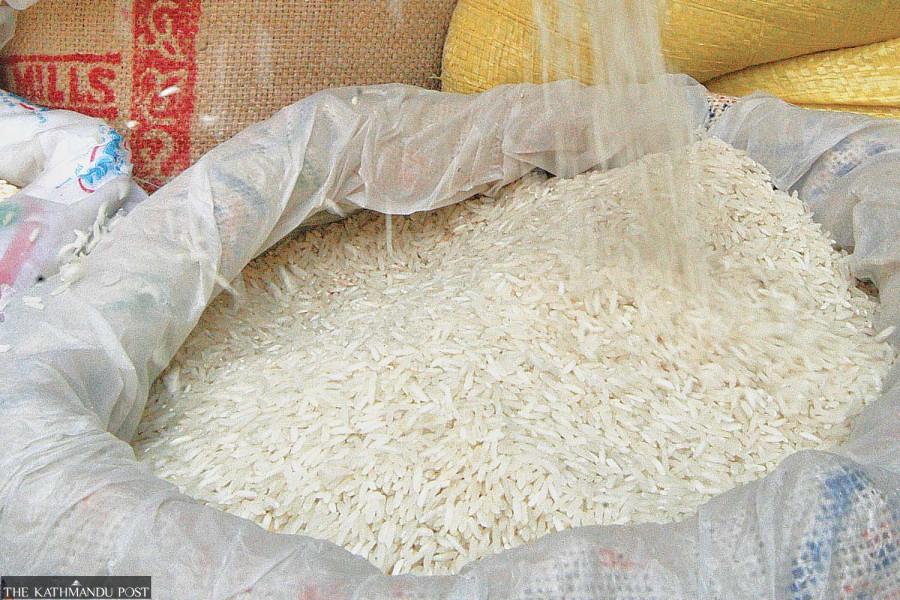
A study has found residues of 11 different pesticides in rice consumed in the Kathmandu Valley, including fungicides, insecticides and rodenticides, some of them banned.
Rice sold in Kathmandu contains higher levels of pesticides than rice distributed in Bhaktapur and Lalitpur. Experts say basmati rice contains roughly double the pesticide residues compared to non-basmati varieties.
The report titled “Pesticide use and safety behaviour among rice farmers in Nepal: The assessment of theory of planned behaviour and potential health risk” was made public by Kathmandu-based Progressive Sustainable Developers Nepal and India’s Council of Scientific and Industrial Research–Indian Institute of Toxicology Research.
According to the report, pesticide concentrations in rice consumed across the three districts of Kathmandu Valley range from 5.09 micrograms to 312.54 micrograms per kilogram. The report has been published in Springer Nature’s international academic journal Environment, Development and Sustainability.
The report states that 83 percent of the sampled rice contained pesticide residues. Of these, 80 percent had residues of two or more types of pesticides. “Among the 11 pesticides found in rice, the levels of tricyclazole, thiamethoxam and tebuconazole are far above the maximum residue limits set by the European Union,” said Utkal Sapkota, one of the researchers. “These pesticides are extremely harmful to human health.”
Researchers say farmers use higher quantities of pesticides in basmati rice because it fetches higher prices and has lower resistance to pests. The study shows that basmati rice contains double the pesticide residues compared to non-basmati rice. According to Sapkota, since basmati rice sells at a higher price and has lower resistance against pests, farmers tend to use more pesticides. “Because basmati is a high-value crop, farmers apply pesticides more frequently and in higher doses than recommended to protect their investment and maximise profit,” he said. “As a result, residue levels are higher.”
The study warns that long-term consumption of pesticide-contaminated rice could be fatal to human health. “Continuous intake of such rice leads to accumulation of pesticides in the human body, which over time may cause deadly diseases such as cancers related to the stomach, prostate and reproductive system,” Sapkota said.
The study also found banned pesticides such as chlorpyrifos, alpha-cypermethrin and profenofos in rice. It concludes that weak market monitoring has failed to stop their use. Due to lapses in regulatory bodies, banned chemicals are still reaching farmers and wholesale traders.
Roshan Adhikari, senior crop protection officer at the Plant Quarantine and Pesticide Management Centre, said pesticide residues applied to paddy should not persist for such a long time until reaching consumers. “Residues of pesticides like chlorpyrifos do not last very long,” he said. “It takes at least one and a half to two months for harvesting, drying and milling rice. Over that period, residues are expected to degrade.” However, he said he has not yet reviewed the report and can comment in detail only after studying it.
Explaining the presence of banned pesticides in Nepal’s market, Adhikari said such bans are not implemented overnight and are accompanied by a certain grace period. “The reason such pesticides were found during the study could be that the grace period had not expired at the time of the research,” he said. Sapkota also agreed with this assessment.
According to Adhikari, Nepal has a legal process for pesticide import, and only registered pesticides are allowed. Importers are licensed to operate. He said the presence of pesticide residues in rice, compared to vegetables, is a different issue. “Vegetables reach the market soon after pesticide application, so residues are higher,” he said. “In paddy, pesticides are used for pest control, and the crop undergoes processing, so residues are expected to be lower.”
While high levels of pesticides have been reported in vegetables produced in Nepal and imported from India, this study shows residues even in rice available in the federal Capital. The report was prepared by two Nepali, two Indian and one Japanese scientist, including Govinda Bhandari, Utkal Sapkota, Shailendra Pratap Singh, Anushka Pandey and Japanese researcher Hirotatsu Murano.
The study also points out the lack of advanced technology for pesticide testing in Nepal. “We used LC-MS/MS technology in this research, which is not systematically available in Nepal,” Sapkota said. “The RBPR method currently used in Nepal can only detect whether pesticides are present, but cannot identify which pesticides or quantify their levels. Therefore, it is already overdue to replace this method with LC-MS/MS.”
The 11 pesticides detected in rice consumed in Kathmandu include azoxystrobin, chlorpyrifos, clothianidin, difenoconazole, imidacloprid, malathion, paclobutrazol, propiconazole, tebuconazole, thiamethoxam and tricyclazole. The study notes that samples collected from Kathmandu showed higher contamination than those from Bhaktapur and Lalitpur, placing consumers in Kathmandu at greater health risk.
For the study, rice samples were collected from the Kathmandu Valley. A survey was conducted among 120 paddy farmers in Rupandehi, discussions were held with 25 pesticide retailers, and wholesale traders and mill operators were also involved.
More than 65 percent of surveyed retailers said they recommend banned pesticides. Over 80 percent of farmers and sellers who come into direct contact with pesticides reported not using basic protective equipment to safeguard their health. According to the study, most retailers lack sufficient knowledge about the serious impacts of pesticides.
“Direct exposure to pesticides causes both short-term and long-term health problems among farmers,” the report states. “Short-term effects include diseases related to the skin, eyes and liver, while long-term effects include neurological or developmental disorders.” The study adds that exceeding maximum residue limits and unsafe use increase the risk of serious long-term conditions such as cancer and kidney failure.
According to the World Health Organisation’s cancer research agency report GLOBOCAN 2022, around 22,000 new cancer cases are recorded annually in Nepal. As this figure only includes patients who reach hospitals, the actual number may be higher. The report states that 7.8 percent of new cases involve stomach cancer.
A 2019 study by the Nepal Health Research Council covering nine districts analysed 12,336 cancer cases, including 3,295 new patients and 1,427 deaths.
Sapkota said districts with high vegetable production and heavy pesticide use, such as Kavre, Kaski and Dhading, are seeing increasing numbers of cancer patients visiting hospitals. “The pesticides found in rice and those used in vegetables are of a similar nature,” he said. “Therefore, the cancers they may cause could also be similar. Our study did not cover specific cases of cancer caused by rice consumption, so that aspect remains to be explored.”
To ensure food safety in the future, the study recommends that the government set its own standards for pesticide residues in staple foods like rice and strengthen legal mechanisms to prevent the illegal use of banned pesticides. It also calls for replacing the existing RBPR system with advanced LC-MS/MS laboratories in every province for regular monitoring.
The researchers further recommend promoting bio-pesticides instead of chemical pesticides and introducing crop insurance programmes to protect farmers’ investments in paddy cultivation.




 28.12°C Kathmandu