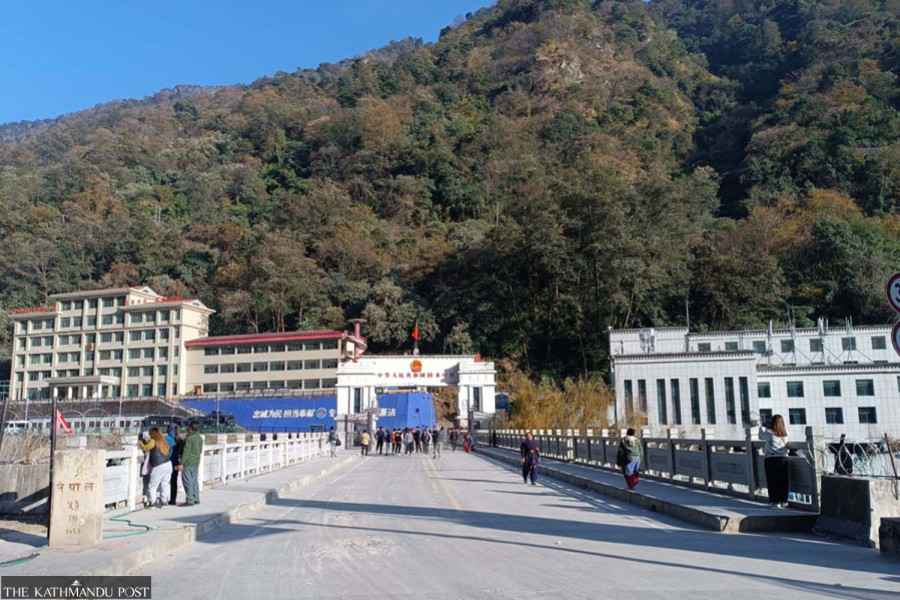
Resuming trade operations through Tatopani would greatly help traders facing heavy financial losses and consumers already weighed down by inflation. Post file photo
Nepal’s major festivals—Dashain, Tihar and Chhath—are approaching. This is when massive quantities of goods are imported from the country’s northern neighbour, China, to supply the festive market. However, things are different this year. Trade through the Rasuwagadhi border has come to a complete halt following last month’s devastating Bhotekoshi floods. China has closed the Tatopani border—the nearest and most convenient route from Kathmandu—for an indefinite period from August 29, citing landslide risks on the Nepali side of the border. Additionally, the under-resourced Korala border point in upper Mustang cannot handle the pressure of the season.
Traders who already lost their goods in the floods are now struggling with high transport costs at the northern border point of Korala. Road conditions are poor, resulting in longer travel time for goods to move from the border to their destination. They are now facing delays when timely delivery matters most during festivals. Consumers are also struggling with higher retail prices because of import delays and transport costs.
But that is not all. What’s more troubling is the unnatural price hike that unscrupulous traders often create. Such acts are reported every festival season, and during times of crises and celebrations, consumers suffer more. The government therefore has two immediate responsibilities: to engage in diplomatic talks with China by heeding repeated calls from traders, and to improve the condition of the Araniko Highway linking the Tatopani border to Kathmandu.
Although Kathmandu has reportedly taken steps with Beijing to reopen Tatopani, it remains unclear whether it will do so before Dashain. Negotiations should continue. At the same time, the state must do its bit by paying urgent attention to the road condition of the Araniko Highway, which is vulnerable to floods and landslides. According to traders and customs officials, the road is currently functional despite small landslides and can handle the imports. This message must be conveyed to the Chinese side.
Nepal has even requested China’s assistance in rebuilding the 16-km Syaphrubesi-Rasuwagadhi road damaged by the Bhotekoshi flash flood. But since rebuilding could take many years, it is crucial to keep imports running through Tatopani ahead of the major festivals. Nepal imported goods worth Rs425.24 billion from China in the last fiscal year, while Tatopani alone handled imports worth Rs47.48 billion. Therefore, realising Tatopani’s economic benefits would also benefit both countries.
This is not the first time China has closed this northern border point. Following the devastating 2015 earthquakes, it remained closed for nearly four years. Services were also halted during the Covid-19 pandemic. Tonnes of goods became stranded, rotted and expired, causing major losses for traders. However, both countries can learn from their past approaches to reopening the border. To safely resume operations at the Tatopani border point after closure prompted by health and safety risks during the Covid-19 pandemic, authorities from Nepal and China focused on all the necessary safety measures. China’s positive signal would provide great relief to traders facing heavy financial losses and consumers already weighed down by inflation.
Given the vulnerability of trading through Nepal’s northern border with China, as highlighted by the Bhotekoshi flash floods, the long-term plan of both countries should be to develop reliable, disaster-resilient trade routes that can operate year-round. The future of cross-border trade in the Himalayas depends on this.




 20.39°C Kathmandu