The recent Bhotekoshi flood tore through riverbank areas on August 26, leaving behind a trail of dead bodies, some of which were washed downstream to India. The death toll has exceeded 1,000, and at least 3,916 people are still missing. Families are desperately waiting—and searching—for their missing loved ones.
The dead cannot always be returned to their families, because no one—barring family and friends—can identify bodies with certainty. This situation led Nepal to turn to forensic DNA testing, a technology that sounds futuristic but rests on fairly ordinary biology.
DNA carries a person’s inherited genetic information. A forensic laboratory can build a genetic profile from human remains and compare it with DNA from close relatives, usually parents, children or siblings. If the pattern matches, it can help establish an identity. The idea is simple. Doing it in the middle of a disaster zone is not.
A body pulled from floodwater is often swollen, discoloured, sometimes barely recognisable. Prolonged soaking turns skin pale and so soft that it can slip away from hands and feet, taking fingerprints with it. Currents strip away clothing and documents, rocks and debris cause fractures or tear limbs from torsos, and mud covers the tattoos and scars that might otherwise offer a shortcut to recognition. The longer remains sit in warm, contaminated water, the less useful visual identification becomes, and the more forensic teams have to rely on teeth and dense bone—tissues that hold onto DNA long after skin and muscle have broken down.
The extraction itself is a small feat of chemistry. Forensic teams clean a tooth or bone fragment, then drill or grind it into powder. Decalcification strips away that mineral structure first. Detergents and enzymes then break open the remaining cells and release the DNA inside, which is purified and checked for quality before testing. Nepal Police has described this exact sequence (drilling, crushing and decalcifying) at its Central Police Forensic Science Laboratory, which has long used blood, bone and hair-root samples for profiling.
Families provide a swab from the inside of the cheek or a blood sample. The strongest comparisons come from parents, children or siblings, since a child inherits one copy of each chromosome from each parent.
Forensic laboratories do not sequence a person’s whole genome to make these matches. They look at short tandem repeats, brief stretches of DNA that repeat a different number of times in different people, across dozens of locations in the genome. A process called multiplex polymerase chain reaction (PCR) copies these targeted regions millions of times over and attaches a fluorescent tag to each copy. Most forensic labs now use capillary electrophoresis, in which the tagged DNA travels through a hair-thin tube while a laser reads the tags and turns them into a series of coloured peaks. Those peaks, converted into numbers, become a person’s genetic signature.
Even a strong match is not absolute. At each location on the DNA, a child should carry one allele from the mother and one from the father. If the pattern in the remains couldn’t have come from the tested relatives, the relationship is ruled out. If it’s consistent, scientists calculate a likelihood ratio: How much more probable the result would be if the remains really did belong to the missing person, compared with a random stranger. Even a strong number like that gets weighed alongside fingerprints, dental records, medical history, photographs, personal belongings and the circumstances in which the body was found. DNA is meant to be one part of an identification process, not the whole.
Nepal has done this kind of work before, too. After the 2015 earthquake, its Central Police Forensic Science Laboratory used DNA and Interpol channels to identify five missing foreign nationals, in some cases matching remains to reference samples pulled from a toothbrush or a razor.
The current, more immediate problem Nepal faces is logistical. Only 20 of 669 recovered bodies had been identified by August 30. In Chitwan, hospitals and holding centres have been overwhelmed. Local mortuaries can store roughly 50 bodies; hundreds more have washed up downstream, more than 200 of them mutilated, partial or severed. Without refrigeration, decomposition sets in within hours, and overcrowded facilities make careful labelling and safe handling harder by the day.
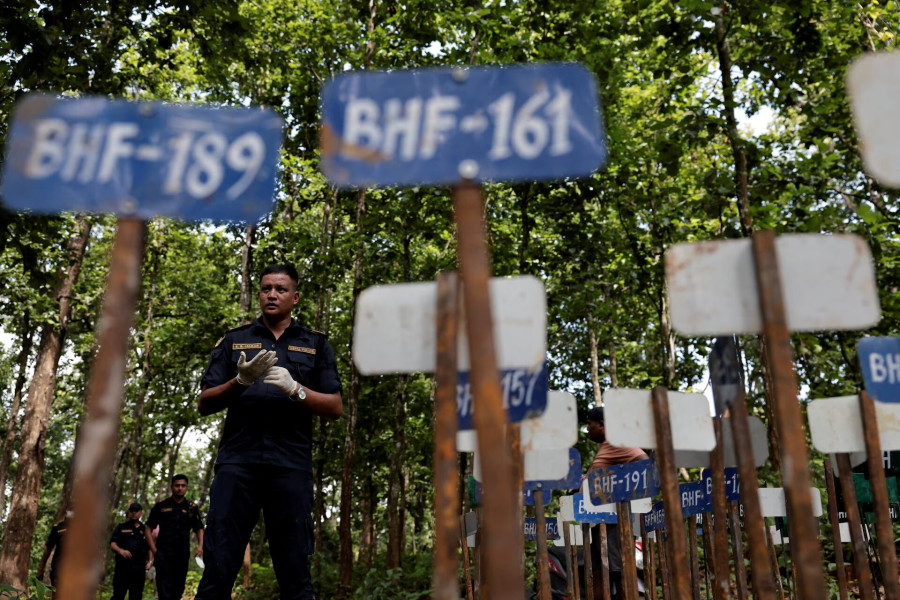
One common fear deserves to be addressed directly: piles of corpses do not, by themselves, cause epidemics. The World Health Organisation has said that human remains from natural disasters generally pose little risk of spreading disease to the public. The real danger falls on the people handling the remains. That’s part of why Nepal has begun temporary burials. Done properly, this isn’t a shortcut around dignity but a way to buy time: each body photographed, sampled and buried under a permanent tracking number that can guide a future exhumation if identification requires it.
Still, the cultural cost is real. Nepal is a country where funeral rites carry deep religious meaning. A numbered grave may be necessary in an emergency, but it can’t become a permanent stand-in for family involvement and cultural dignity.
Nepal isn’t starting from nothing. Nepal Police runs a dedicated DNA Profiling Section, and the National Forensic Science Laboratory in Khumaltar already offers forensic biology and DNA services. But a mass-fatality event tests far more than a lab’s equipment. It requires enough trained forensic biologists and pathologists to process an overwhelming volume of samples, refrigerated storage and uninterrupted power, extraction kits, analysers and secure databases, and, above all, one coordinated system. A body is not an anonymous object. It belonged to someone who was expected home, who had a name, a family, a place in the world. DNA testing can’t undo the flood or bring anyone back. But it can help the affected families bid farewell to those they lost, the way they desire.




 15.71°C Kathmandu
.PNG&w=200&height=120)