Geta medical institute set to start classes before its teaching hospital is fully equipped
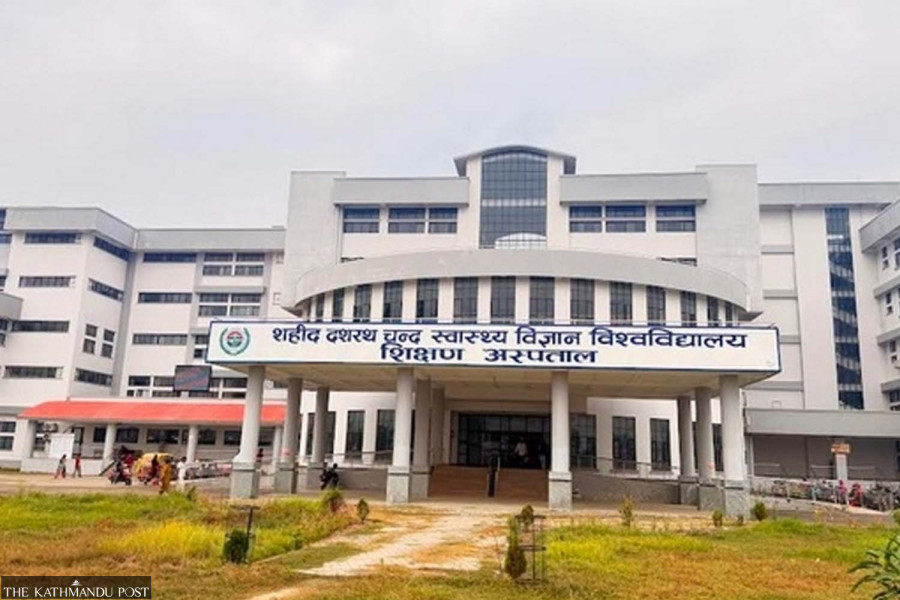
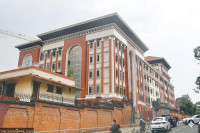
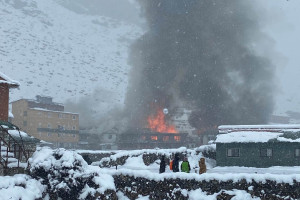
The hospital lacks several essential services. Doctors question its ability to provide the clinical training medical students need. Medical education reforms campaigner Dr Govinda KC is on a hunger strike since October 29 demanding that MBBS classes at Geta (pictured) not begin without a fully equipped teaching hospital. Post File Photo
Martyr Dasharath Chand University of Health Sciences at Geta in Kailali, plans to begin academic programmes in February 2027. The move is being touted as a milestone for medical education and healthcare in Nepal’s far-western region.
The Medical Education Commission has approved 90 seats under four programmes: 50 in Bachelor of Medicine and Bachelor of Surgery (MBBS), 20 in BSc Nursing, 10 in BSc Medical Laboratory Technology (BMLT) and 10 in Bachelor of Optometry.
But doctors and hospital employees question whether the institution has the infrastructure, academic staff, and capacity to run the programmes. They allege approval was granted under government and political pressure, based on paperwork and figures that do not reflect conditions on the ground.
Dr Govinda KC, a campaigner for medical education reforms, has been staging a hunger strike for five days demanding that the approval be revoked and classes not begin until the university hospital is fully operational.
But university officials insist that classes will begin as planned. They say the commission approved the programmes after an on-site inspection and that the university meets the legal, infrastructural, and operational requirements.
Vice-chancellor Sunil Kumar Joshi said the approval followed assurances that the necessary legal procedures would be completed and the required infrastructure and practical arrangements put in place.
Registrar Bhim Bahadur Chand said the teaching hospital currently operates 325 beds, has arrangements for 622, and has infrastructure for up to 920. The commission’s inspection team, he said, confirmed that the infrastructure, human resources, and legal standards had been met.
Chand said preparations were underway to develop curricula, recruit qualified faculty, laboratories, equipment and clinical training. He added that resources had been secured to accommodate students, expand hospital capacity, and provide scholarships.
“We already have a hospital with more than 300 operational beds and infrastructure capable of accommodating 920,” he said. The university can accommodate more than 2,000 students and treats an average of 400 to 500 patients daily, he added.
“We will complete the remaining work required for academic and hospital operations by the time students are selected and arrive,” he said.
Joshi said the hospital currently provides services in general medicine, surgery, orthopaedics, gynaecology, paediatrics, psychiatry, dermatology, ENT, neurology, and dentistry, as well as emergency, intensive care, and diagnostic and surgical services.
Hospital employees, however, dispute these claims. They say many of the departments and services are not yet operational and that the hospital lacks the facilities needed to support medical education.
“Geta still has a lot of work to do before it can run academic programmes,” said a hospital employee who requested anonymity.
University officials say they plan to expand services by establishing a cardiac catheterisation laboratory, burn unit, and a trauma centre.
“We are also preparing to begin the procurement process for CT scan and MRI machines as soon as possible,” a university official said. “We are arranging the necessary staff and equipment to bring the hospital to full capacity.”
Devendra Bahadur Khatri, vice-chair of the Medical Education Commission, said the seats were allocated following recommendations of its inspection team and seat-allocation committee, both of which had visited Geta. He said approval was granted on the understanding that the government would ensure the required standards were met.
“The commission granted approval after the seat-allocation committee concluded that the institution could run classes,” Khatri said. “Students need hospital-based clinical practice only after completing their first two years. They don’t require it in the first and second years. We allocated the seats and allowed classes to begin on the understanding that the government would provide the necessary infrastructure within those two years.”
A visit to the teaching hospital on Friday, however, revealed a different picture. Most of its imposing buildings stood empty and quiet. Only one building was operating outpatient services, a laboratory, ultrasound facilities, a cardiac examination room, an emergency unit, general medicine and surgery wards, an operating theatre and an ICU.
The hospital has only general medicine and surgery wards for inpatients. Patients with paediatric and psychiatric conditions are admitted alongside general medicine patients, while those requiring gynaecological, ENT, and orthopaedic treatment are accommodated in the general surgery ward. There are no dedicated wards for these specialities.
Deepak Khatri of Malakheti, Kailali, had been at the hospital for three days with his wife, who was receiving treatment for a mental health condition. With no dedicated psychiatric ward, she had been placed alongside other patients.
“It has been difficult to manage her treatment when she has to share a ward with other patients,” Khatri said on Friday.
Psychiatrist Prabesh Bhatta, who works at the teaching hospital, said treating psychiatric patients alongside others had created difficulties.
Another ward bears signs identifying it as the dermatology and paediatrics ward, but its doors are locked. Patients’ names are displayed outside, although neither service is operational.
“A hospital employee said the wards were hurriedly set up, with patients’ names displayed outside, to give the inspection team the impression that the facilities were ready. Once the commission’s team left, the doors were locked again.”
Patients requiring ENT, gynaecological, orthopaedic, and surgical treatment also share the general surgery ward. A doctor said the hospital offered outpatient consultations and surgery for limb injuries and fractures but could not yet perform complex procedures.
“We have not yet started major orthopaedic operations, including those involving the spine and other parts of the body,” he said.
Doctors and employees also disputed claims that the hospital was operating neonatal intensive care units (NICUs), paedetric intensive care units (PICUs), and high-dependency units (HDUs).
“There is not even a maternity service at this hospital. How, then, can it be running an NICU?” an employee said. “Several essential services, including a blood bank, are also unavailable. Patients have been struggling to obtain medicines from the hospital pharmacy for months.”
Bhatta said the hospital’s limited services meant patients were often referred to other hospitals in Dhangadhi.
“Should Geta be equipped to handle cases that Seti Hospital cannot, rather than sending its own patients to other hospitals?” he asked.
He questioned what improvements had been made over the past year and accused university officials of bypassing standard procedures and falsely claiming that non-existent services were operational. He warned that this could jeopardise specialised healthcare in the far west and the quality of medical education.
Chand said Geta Hospital was formally designated the university’s teaching hospital only after a federal cabinet’s decision on July 8. All departments had since been set up, he said, with work underway to start services that were not yet operational.
“By the time MBBS students complete their first two years of basic sciences, the teaching hospital will be fully operational with 500 beds,” he said.
Bhatta warned that misrepresenting the hospital’s capabilities could undermine academic standards.
“The basic sciences faculty is not in place, and much remains to be done in clinical sciences. Buildings alone are not enough; they must be properly equipped and staffed,” he said. “University officials also showed the commission’s inspection team facilities that did not exist.”
He said the shortcomings could still be addressed. If university officials put the necessary facilities and staff in place over the next three to four months, medical education could begin without compromising academic standards.
Faculty strength is another major concern. Doctors said people who had not been formally appointed by the university were presented as faculty members during the commission’s inspection.
Doctors say a 50-seat MBBS programme requires at least 64 teachers—23 in basic sciences and 41 in clinical sciences.
“The biggest question is whether Geta actually has 64 teachers for its basic and clinical sciences programmes,” a doctor working at the hospital said.
Doctors alleged that individuals from Kathmandu, Nepalgunj and Dhangadhi who had not been recruited by the university were brought to Geta and presented as faculty members on the day of the inspection.
“We don’t have a single faculty member appointed in anatomy or microbiology,” the doctor said. “We were astonished to find that people working at hospitals in Kathmandu, Nepalgunj and Dhangadhi, who had never gone through Geta’s recruitment process, were presented to the commission as its faculty members.”
Chand said each of the university’s six basic sciences departments needed a professor, an associate professor and an assistant professor. Two had already been appointed and were working in each department, he claimed, while the remaining faculty had been appointed to join shortly before classes began.
“Rather than bringing doctors employed at other medical colleges here immediately and paying them salaries before classes begin, we have arranged for their appointments to take effect from February 13, 2027,” he said.
The university advertised 26 vacancies for professor and associate professor, and 51 for assistant professors on February 20. It published the final selection results for 17 posts—four professors and 13 associate professors—on August 2. On August 18, it announced that 43 candidates had passed the selection process for the 51 assistant professor positions.
Dhangadhi-based doctor Amrit Jaishi questioned why the university had refused to provide the names of appointed faculty members despite a formal request under the Right to Information Act.
“Nobody is demanding that Geta transforms overnight. But the university should not undermine established procedures and systems by presenting false information,” he said.
Despite having substantial infrastructure of its own, the university has signed 20-year agreements with four provincial hospitals: Seti in Dhangadhi, Mahakali in Mahendranagar, Lamkichuha in Lamki, and Tikapur Provincial Hospital. They are located between 20 and 80 kilometres from Geta.
The agreements have raised suspicions among some residents that the university may be relying on other hospitals instead of developing its own teaching hospital.
“Given the enormous infrastructure already built at Geta, it is difficult to understand why the university needs support from provincial hospitals instead of focusing on upgrading its own teaching hospital,” said Sher Bahadur Bista of Attariya. “If the university is ready to start MBBS classes, why has it signed 20-year agreements with other hospitals instead of making its own hospital fully operational?”
Niraj Aryal, head of the Medical Education and Hospital Development Division at the provincial Ministry of Social Development, said the university initially secured the ministry’s consent for a five-year arrangement with Seti, Tikapur and Mahakali hospitals when it submitted its self-appraisal form to the commission.
“But when it came to signing the agreements, the circumstances suddenly changed, and a 20-year term was imposed,” Aryal said. “That happened at the direction of political leaders.”
Seti Hospital has 125 beds, Mahakali 50, Tikapur 51, and Lamkichuha 50.
Joshi defended the agreements, saying the university had entered into the partnerships under its governing Act.
The government has allocated Rs2.54 billion to the university for the current fiscal year.




 12.61°C Kathmandu