



 15.88°C Kathmandu

Tue, Nov 3, 2026
Theater
In ‘Bhag Bheda Bhag’, a flock of sheep holds up a mirror to Nepali society
Samyog Guragain’s absurdist play satirises the contradictions and herd mentality of contemporary Nepali society with a generous dose of humour.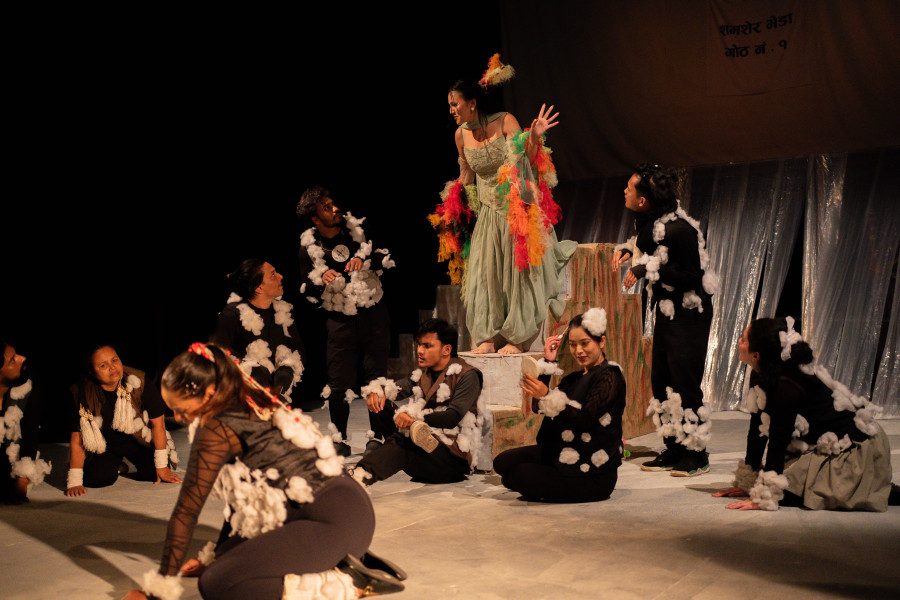
bookmark![]()
![]()
![]()
![]()
Samarpan Shree
Published at : November 3, 2026
Updated at : November 3, 2026 06:55
Kathmandu
Watching the play ‘Bhag Bheda Bhag’, currently being staged at Mandala Theatre in Thapagaun, Kathmandu, can be a disorienting experience. For a moment, it becomes difficult to tell humans from sheep. Some people seem to have taken on the characteristics of sheep, while the sheep behave remarkably like humans. The tension between the two, as each mirrors the other’s behaviour, gives the play much of its appeal.
Sensitive to serious issues yet unafraid of biting satire, the 90-minute play directed by Samyog Guragain manages to convey several ideas at once. Told through an absurdist lens, it explores the uneasy coexistence of humans and animals while taking sharp aim at the tendencies of Nepali politics. Within the flock, some sheep embrace revolutionary ideas, while others are content to remain submissive. The play draws a parallel with Nepal’s political establishment, asking how the old parties weakened the system and how those who presented themselves as a new alternative are continuing much the same practices. It delivers this criticism with a generous dose of humour.
Guragain wrote the play himself. He has spent the past 13 years pursuing theatre in Kathmandu, having moved to the Capital to train and work on stage. A member of Mandala Theatre’s second training batch, he is now helping mentor its 20th batch of students.
During his recent visits to the theatre, an idea kept returning to him, he says. What would happen if humans and animals occupied the same space?
Guragain had also been thinking about ‘Baitarni Cafe’, a play staged around a decade ago in which he played a character named Syaule. That production had woven a compelling story around animals, and the memory stayed with him. The animal that eventually took shape in his imagination was sheep.
“Whether viewed from a political or social perspective, sheep are widely inferred,” he says. “Humans exploit sheep for almost everything, from wool and meat to medicinal products. That was another reason I wanted to tell a story through the eyes of sheep.”
Guragain is drawn to absurdist theatre, a preference that also reflects his academic interests. ‘Bhag Bheda Bhag’ brings that sensibility to a story in which sheep try to escape from humans, while humans are, in their own way, trying to escape themselves. Neither seems to know where such an escape might lead.

The play’s strongest element is its narrative. It establishes intrigue from the outset and sustains it through a series of increasingly absurd developments. The tension begins when a government inspection team, led by a chairperson, is due to visit a sheep farm. But there’s a problem: The farm owner has no sheep in any of his sheds except one. The measures he takes to evade official action, and the complications that follow, drive the story forward.
The characters are well conceived, each contributing to the play’s momentum. The farm owner’s “designer” is ostensibly responsible for designing clothes and covers, but soon finds himself devising—or rather, designing—plans to help the owner escape a much bigger predicament. The chairperson, vice-chairperson, shepherds and hired performers all have distinct roles in the unfolding drama. The sheep, too, bring their own personalities and quirks to the story, keeping the interplay engaging.
A middleman who appears only towards the climax is particularly striking. His character seems to capture the contradictions and shifting dynamics of Nepal’s contemporary political landscape.
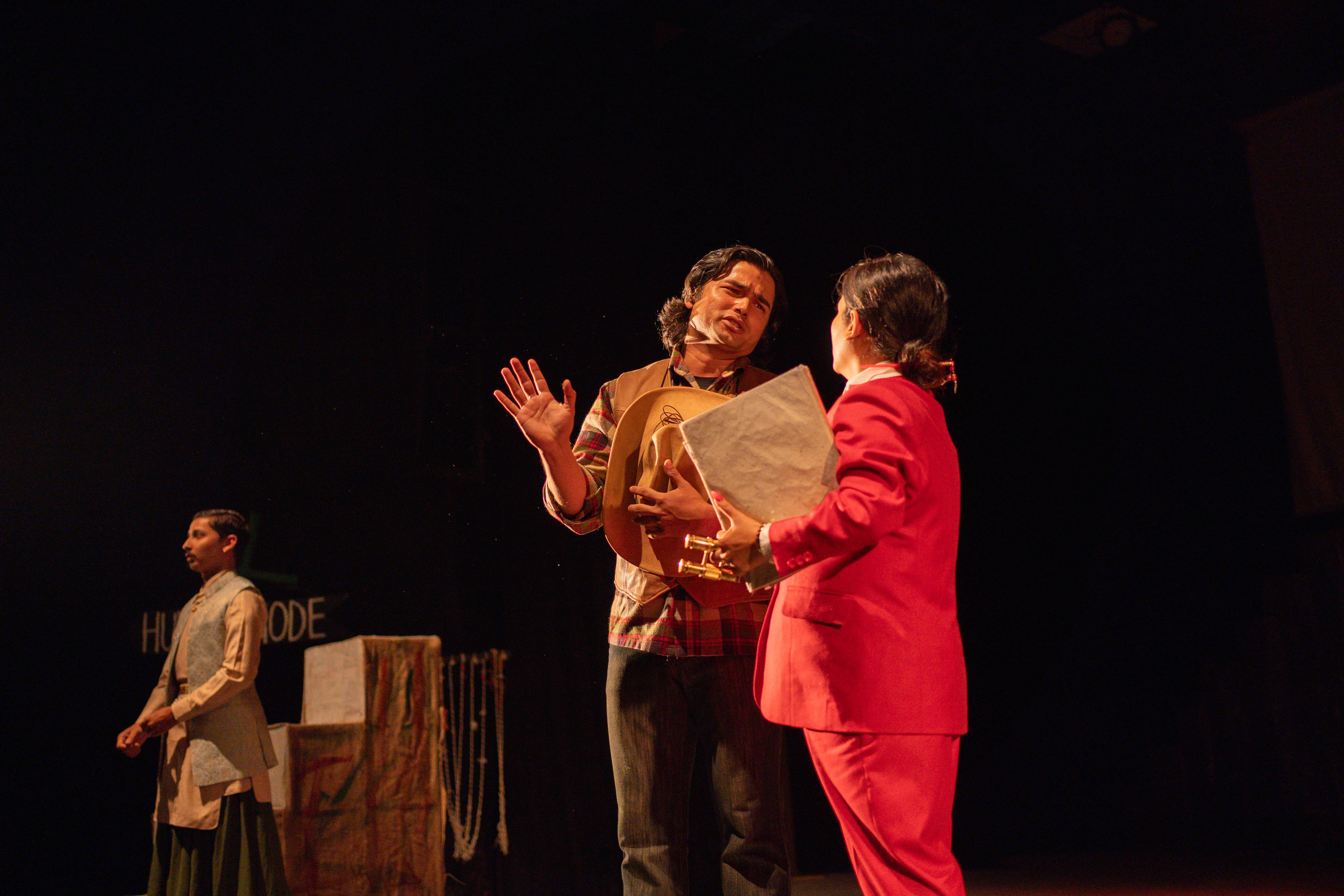
The play uses props to establish two categories—“Sheep Mode” and “Human Mode”. The distinction offers a visual way of expressing the conflict between two different species sharing the same space. A myna bird serves as the narrator, guiding the audience through the story. But the bird is more than a storytelling device. It also becomes a metaphor for awakening consciousness among living beings.
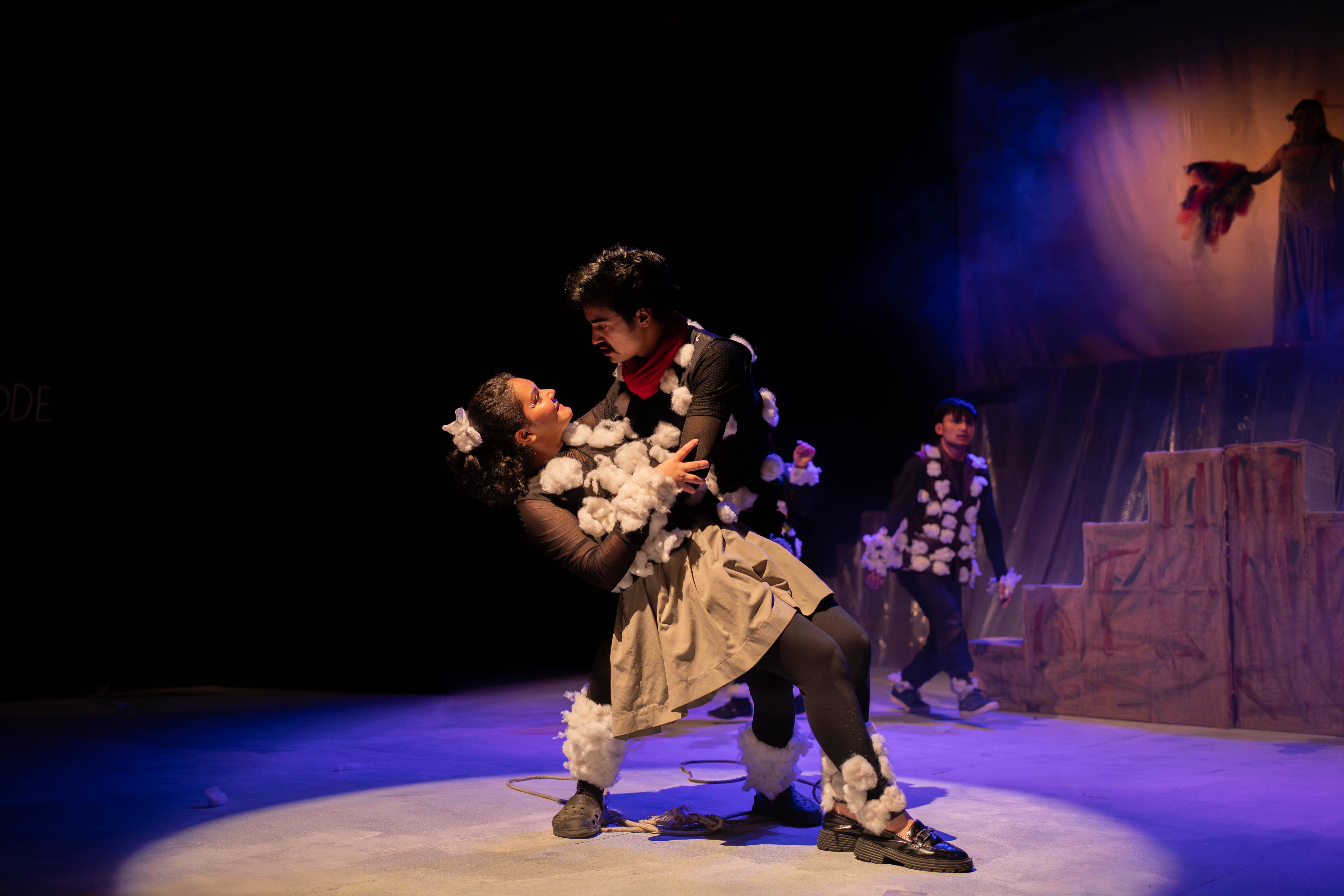
The production makes effective use of the limitations of a theatre set, turning a single space into a home, sheep shed, cafe and forest. Such transformations need to feel credible, and the production largely succeeds. Lighting, in particular, helps establish changes in time and space without disrupting the narrative.
One especially effective sequence comes when foxes clash with shepherds in the forest. The interplay of blue and red lighting captures the tension and sense of danger, giving the confrontation a visual intensity.

The acting, however, could use further refinement. It should be noted that for many of the performers, this is their first experience on stage. Moreover, the characters they have been asked to portray are not easy ones. Some performances hence come across as rather exaggerated; certain lines sound unnatural or lack convincing delivery. These shortcomings are noticeable; but the strength of the story itself makes them easier to overlook as the play progresses.
Absurdist productions such as ‘Bhag Bheda Bhag’ offer a welcome change of pace from conventional realist narratives. They take audiences beyond familiar theatrical territory and leave them with a different way of looking at the world. Guragain’s play—an engaging and satisfying theatrical experience—does exactly that.
The play will be on stage every day at 5:15pm until November 7.
Samarpan Shree
Samarpan Shree is an Arts and Culture Correspondent for Kantipur Media Group, covering film, theatre, music, and contemporary social issues.



Most Read from Theater
Editor's Picks

What Balendra Shah can learn from Zohran Mamdani

Explained: The leaked WhatsApp chats that have shaken Nepal’s judiciary

Who is Inam Sapkota, the man linked to Cholendra Rana and top police officials?

The police chief who objects, delays—and ultimately complies
Shabana Azmi on acting, equality and the power of cinema
E-PAPER | November 03, 2026

×