



 25.92°C Kathmandu
Tue, Oct 27, 2026
Theater
Theatre review: A world beyond the obvious in ‘Guliyo Shyau’
Through playful defiance, the play reminds children that there is rarely one right answer.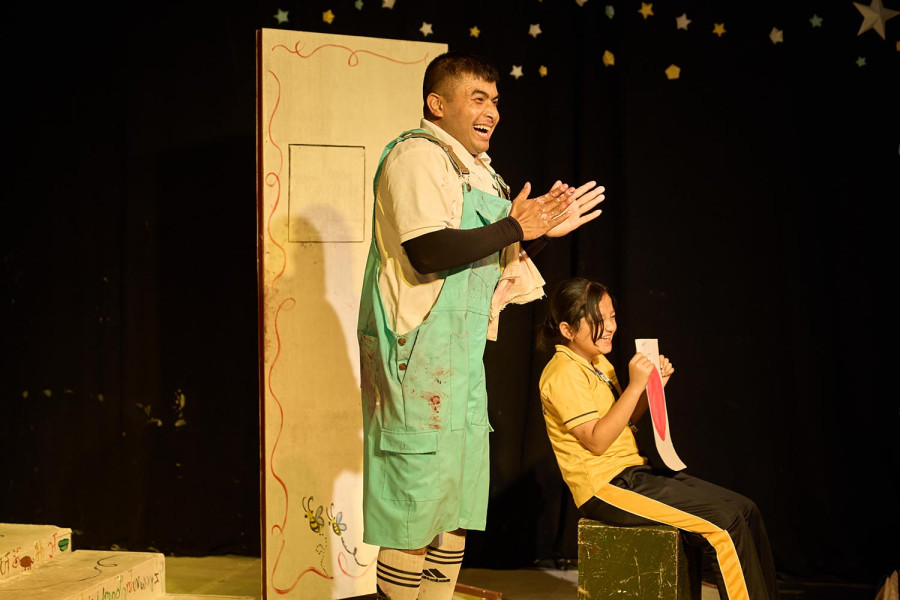
bookmark![]()
![]()
![]()
Rivash Rijal
Published at : July 16, 2026
Updated at : July 16, 2026 07:07
Kathmandu
What colour should a leaf be painted? Green? What about the sun? Yellow? And what about an apple? Red? Kedar Shrestha’s produced children’s play ‘Guliyo Shyau’, ‘A Sweet Apple’, asks its mostly preschool audience these questions. And when the children see the preschooler on stage, played by Manish Byanju, paint the leaf brown, the sun yellow, and the apple green, they turn riotous.
The play’s concept is incredibly simple yet well executed. Byanju plays what appears at first to be a bumbling fool on stage. When he needs help from one of the preschool audience members for something as simple as picking up a small wooden stand, the children take it for granted that Byanju’s character will need assistance for whatever is to come.
The rest of the play challenges this and many other assumptions the children have. Byanju has some drawings he needs to paint. A big piece of paper with some clouds on it, one with a sun, one with a leaf and one with a flower.
The heartbreak comes when he asks the preschoolers what colour he should paint these drawings, and then goes on to do his own thing. Byanju’s mother, played by Elina Nakarmi, serves not as the voice of reason, as the children initially imagine, but as the voice of the obvious.
When Byanju paints the sun red, his mother steps onto the stage to tell him he should have painted it yellow. When he paints the clouds black, she tells him they should be blue. The children stamp their feet in approval, shouting and waving their hands, but much to their disapproval, Byanju stands his ground.
He has an answer for everything. The sun is red because it is the morning sun. The apple is green because it is not yet ripe, and the sky is black because it is dark out. He even adds a few small stars to his work to prove his point in the last one.
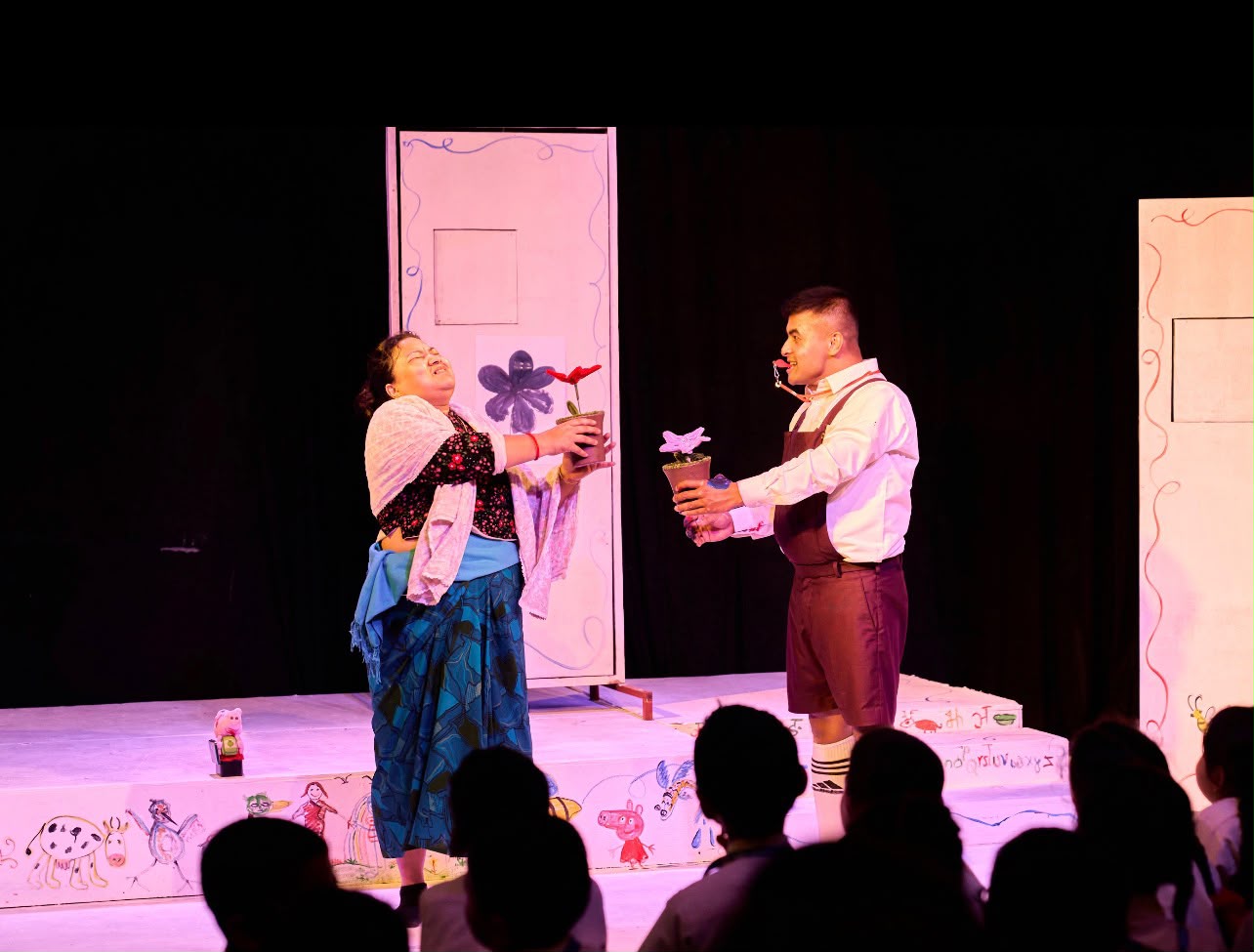
The play also features Sanjita Parajuli—the daughter, dressed up as a mouse with big black ears, although not named what you might think. The mouse sometimes sides with the mother’s conventional advice, while at other times, she is swayed by her brother’s arguments. For example, when her brother produces a brown leaf to show everyone, she is drawn to his side. “Old leaf, brown leaf,” she says.
In the end, Byanju’s character is not so foolish after all. He has an unorthodox way of doing things, and he is set on standing his ground.
The very last drawing he needs to paint is an apple. Pushing past the roaring children in the audience paints it green. When his mother sees what he has done, she begins to weep. “My son is not smart,” she says. She explains that a red apple is sweet or 'guliyo'. A green one, now that is bitter.
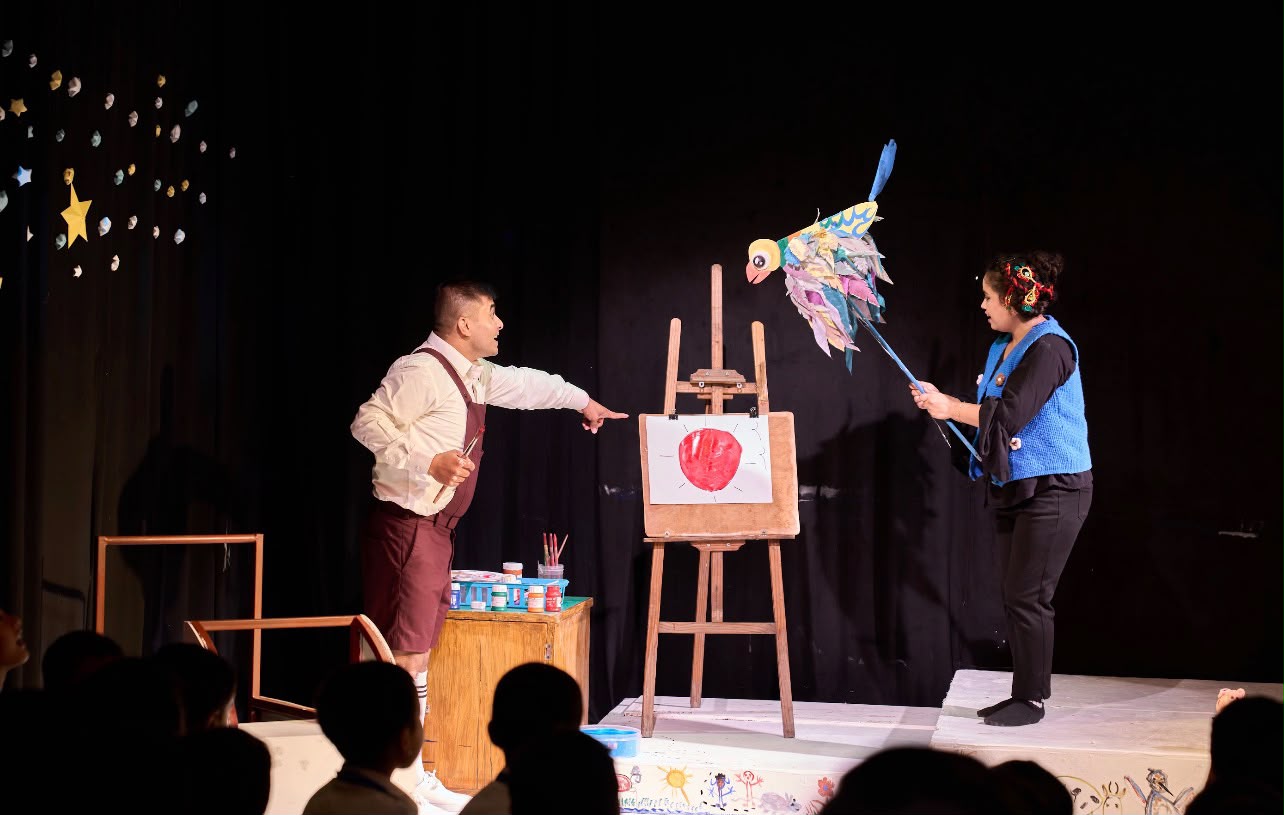
Byanju's character protests. He explains the apple is green because it is his apple and he likes it green. In the end, he manages to convince his sister and his mother that just because he has his own way of doing things does not mean he is not smart. “Red apple, sweet apple. Green apple, sweet apple,” the mother exclaims towards the end.
‘Guliyo Syau’ breaks three-year-old hearts. It makes the kids angry. But it teaches them a very important lesson. That of acceptance. The children are asked to question why the sun has to be painted yellow and the leaf green. And it makes them accept that the preschooler on stage is going to do his own thing, no matter what anyone says.
The play features songs by beloved children’s writer Rambabu Subedi, who was present at the performance we attended. He was met with applause and appreciation at both the start and the end of the interactive play.
The performance is a testament to all the actors’ merit as children’s educators. Throughout the play, they manage to keep the children fully engaged, excited and disciplined, all seamlessly and with a smile.
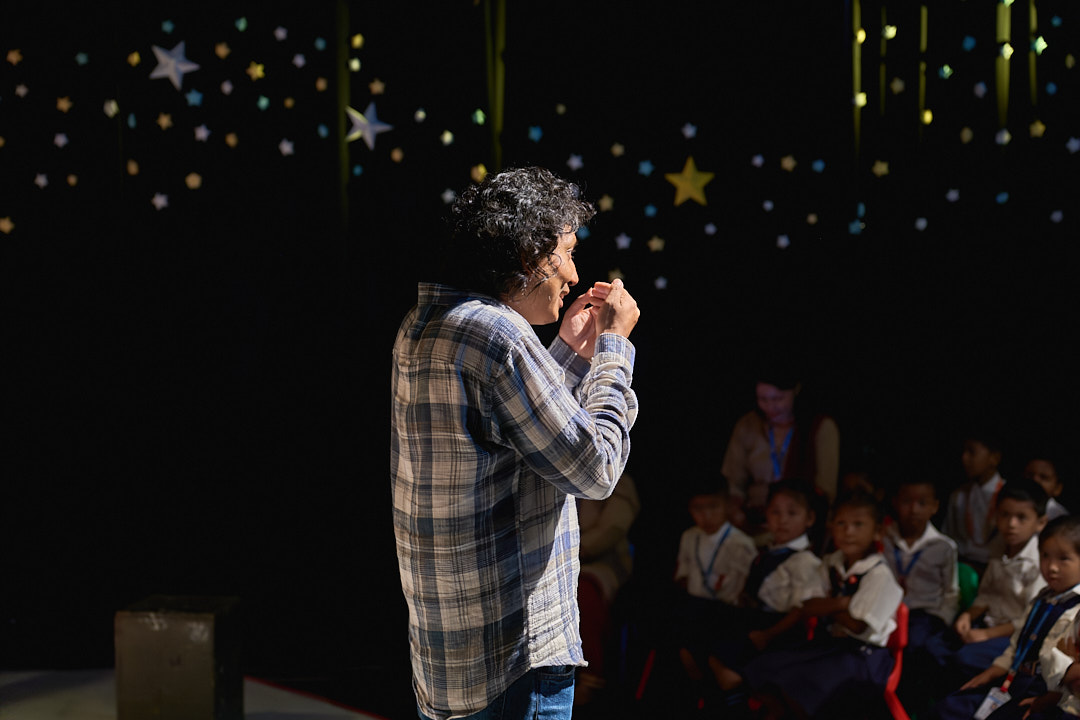
Now, children are noisy. They are impatient and they cannot wait to be entertained. But, throughout the process, with its many challenges, writer Shrestha never drops his smile. His passion and competence as an educator of children are on display during the entire process. When the room runs out of seats, Shrestha asks for patience, and when the children start to run up on stage, he lets them, all while beaming with joy.
It is clear the play is made by a team full of love and understanding for children. The stage is colourfully set; the props are intricate and thoughtful, and the kindergarteners find the background music and sound effects hilarious.
Guliyo Shyau
Written and Directed by Kedar Shrestha
Where: Mandala Theatre, Thapagaun
When: Until July 18, 10:30 am and 12:30 pm on weekdays and 12:30 pm on weekends.
Duration: 90 minutes
Rivash Rijal
Rivash Rijal is a culture and lifestyle intern at the post. He is also a rising senior at St John's College in Santa Fe, NM. He will be graduating from the class of 2027 with a BA in Philosophy, Literature and Natural Sciences.


Editor's Picks

What to know about the US trial over Mamta Kafle’s disappearance
NPL returns with bigger ambitions and global recognition
What’s new in the Nepal Premier League’s third season?

After Nepal’s recent disaster, it wants to test whether COP31 can deliver climate justice

Why does an hour long flight to Dhangadhi cost more than a flight to New Delhi?
E-PAPER | October 27, 2026

×