



 14.81°C Kathmandu

Sat, Oct 24, 2026
Columns
Budget through federalism lens
Nearly a decade after the adoption of federalism, an important question remains: Does the budget truly reflect its spirit? It does so only partially.
bookmark![]()
Source: Calculated by the author using fiscal transfer data published by the Ministry of Finance
Khim Lal Devkota
Published at : June 24, 2026
Updated at : June 24, 2026 06:49
The federal budget is more than an annual statement of revenues and expenditures; in a federal system, it reflects how power, resources and responsibilities are distributed among different levels of government. Whether a budget strengthens or weakens federalism, therefore, depends not only on the size of public expenditure, but also on who receives the resources, who exercises spending authority and whether the constitutional division of powers is respected.
Under the Constitution, the federal government is required to present its annual budget on May 29 (Jestha 15). The Intergovernmental Fiscal Arrangement Act, 2017, requires provincial governments to present their budgets on June 15 (Asar 1) and local governments on June 24 (Asar 10). For FY 2026-27, both the federal and provincial governments have already announced their budgets, while local governments are presenting theirs today.
This staggered budget calendar is not merely procedural. It allows provincial governments to formulate their budgets after considering federal priorities and fiscal allocations, while local governments subsequently align their plans with both federal and provincial budgets. The sequencing reflects the constitutional vision of a federal system founded on coordination, cooperation and complementarity among the three tiers of government. Yet, nearly a decade after the adoption of federalism, an important question remains: Does the budget truly reflect the spirit of federalism? The evidence suggests that it does so only partially.
The scale of fiscal resources available to each level of government reveals the extent of fiscal centralisation in Nepal. The Government of Nepal has announced a budget of Rs2.124 trillion for FY 2026-27, whereas the combined budgets of all seven provincial governments amount to only Rs300.11 billion. Even more striking, the budget of the Ministry of Infrastructure Development alone stands at Rs302.83 billion, exceeding the combined budgets of all seven provinces.
A defining feature of Nepal’s federal system is that functional responsibilities have been decentralised, while revenue authority remains highly centralised. According to a study by the Office of the Prime Minister and Council of Ministers, nearly 60 percent of public service delivery responsibilities have been devolved to provincial and local governments, while the federal government retains more than 80 percent of revenue sources. This mismatch between expenditure responsibilities and revenue authority creates what fiscal federalism literature describes as a vertical fiscal imbalance.
The Constitution explicitly recognises this imbalance and provides the remedy. It guarantees intergovernmental fiscal transfers, including fiscal equalisation grants, conditional grants, special grants, matching grants and revenue sharing. These transfers are not discretionary allocations from the federal government; they are constitutional entitlements intended to ensure that provincial and local governments possess adequate fiscal capacity to discharge their constitutional responsibilities. Against this constitutional backdrop, the trend observed over the past nine federal budgets is concerning.
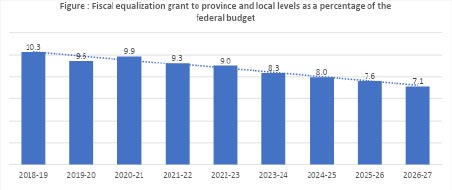
Since FY 2018-19, the first full budget following the operationalisation of federalism, the federal budget has increased from approximately Rs1.315 trillion to Rs2.124 trillion in FY 2026-27, an increase of more than 60 percent. In principle, as the federal budget expands, the fiscal resources available to subnational governments should also increase proportionately, particularly because they shoulder the majority of service delivery responsibilities. The data, however, tell a different story.
In FY 2018-19, total fiscal transfers to the province and local levels including grants and revenue sharing accounted for 33.6 percent of the federal budget. By FY 2026-27, this share had declined to 28.2 percent. Likewise, total grants represented 24.9 percent of the federal budget in FY 2018-19, but have fallen to 20 percent in FY 2026-27. Even more concerning is the decline in fiscal equalisation grants, the principal unconditional transfer designed to address vertical fiscal imbalance. Their share has dropped from 10.3 percent of the federal budget to only 7.1 percent during the same period.
This trend is particularly troubling because the constitutional responsibilities of provincial and local governments have not diminished. If anything, the demand for public services has increased. A shrinking fiscal share, therefore, weakens the financial foundation upon which the federal system is expected to operate.
The FY 2026-27 budget further reinforces this trend. Compared with FY 2025-26, total grants allocated to local governments have declined from Rs320 billion to Rs315 billion. The reduction is primarily due to cuts in conditional, special and matching grants. For local governments, these grants are far more than supplementary resources. They finance a significant portion of service delivery and development activities at the local level. Many local governments rely on conditional grants to implement programs in education, health, agriculture, livestock development and other constitutionally assigned sectors. Reducing these grants is, therefore, likely to delay ongoing projects, constrain service delivery, and weaken the implementation capacity of local governments.
Another persistent weakness of federal budgeting is the federal government’s continued financing of highly localised projects. One of the expectations from the FY 2026-27 budget was that this practice would finally come to an end. The government’s own Budget Principles and Priorities committed the federal government to focusing on large-scale, transformative national projects, leaving projects of provincial significance to provincial governments and community-level infrastructure and services to local governments. This commitment is fully consistent with the constitutional distribution of powers.
However, the detailed allocations in the FY 2026-27 Red Book suggest that little has changed. Media analyses reveal hundreds of small projects financed directly by the federal government, many receiving allocations of only Rs100,000, Rs200,000 and Rs500,000. These include grants for the renovation of individual temples and monasteries, construction of community buildings, small drinking water schemes, local road improvements, health facilities and feasibility studies for village-level infrastructure.
The issue is not the size of these allocations, but the level of government financing them. Such projects fall squarely within the constitutional responsibilities of local governments. By continuing to finance them directly, the federal government retains fiscal resources and decision-making authority that could instead be transferred through constitutionally guaranteed grants.
Reducing fiscal transfers to local governments while allowing political leaders to insert projects at their own discretion and impose them from above is neither an effective nor a principled approach to intergovernmental fiscal relations. Such practices undermine local autonomy, weaken participatory planning processes and erode the accountability of subnational governments.
They also reveal a fundamental contradiction in the practice of fiscal federalism. While the federal government justifies reduced transfers on the grounds of fiscal constraints, it continues to allocate resources to projects that subnational governments are often better positioned to identify, prioritise and implement. At the same time, the share of fiscal transfers in the federal budget continues to decline, further limiting the capacity of provincial and local governments to exercise their constitutionally assigned responsibilities. Future budgets must move beyond merely increasing overall expenditure and instead strengthen the fiscal capacity of provincial and local governments.
Khim Lal Devkota
Devkota is an expert in federalism.





Most Read from Columns




Editor's Picks





E-PAPER | October 24, 2026

×